

Quick Brief
- Microsoft AI grounding powers nearly every major AI assistant in the market as of February 2026
- Grounding connects AI models to current, authoritative web information beyond training data
- Bing Webmaster Tools now tracks AI citations and grounding queries for content owners
- Generative Engine Optimization (GEO) emerges as the new visibility standard for AI-driven search
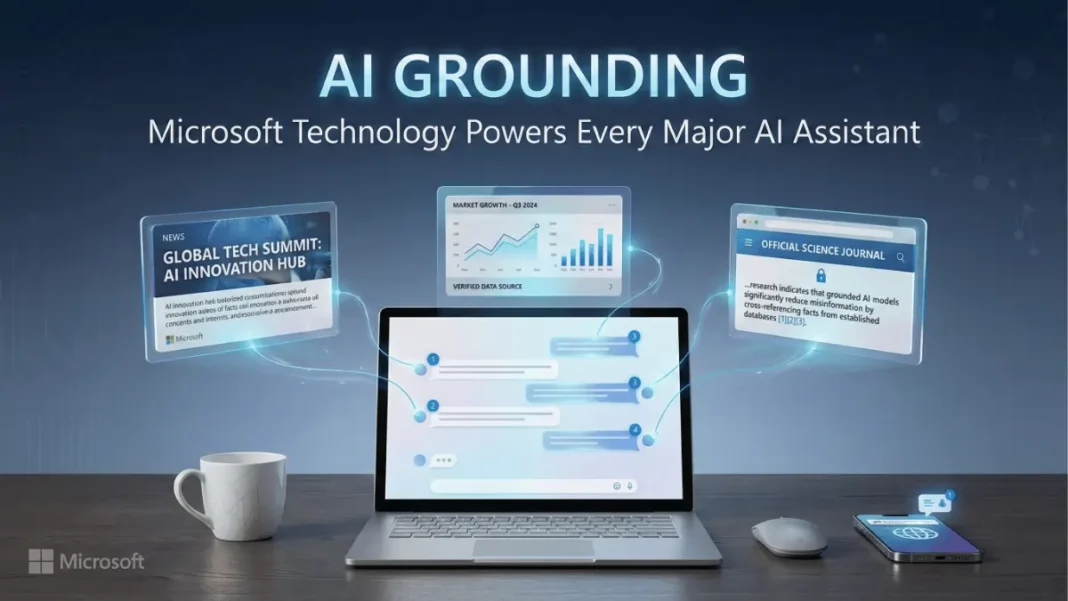
Microsoft revealed a foundational shift in how AI assistants access information and the company sits at the center of it. AI grounding, the system connecting generative models to verified, real-time web content, now powers nearly every major AI assistant in the market. This technology operates invisibly but determines whether AI answers are accurate, current, and trustworthy.
What AI Grounding Actually Does
AI grounding ties AI outputs to real-world meaning, verified data, and current context. When you ask ChatGPT, Copilot, or any modern AI assistant a factual question, grounding retrieves authoritative web content and anchors the response to sources beyond the model’s training data. Without grounding, AI assistants generate plausible-sounding answers that may be outdated or fabricated.
Microsoft has operated large-scale search and information systems through Bing for decades, building infrastructure for scale, reliability, and trust. This expertise now extends to AI grounding across the industry. The technology ensures responses are fluent, factually correct, and verifiable through citations.

The Web Enters the AI Era
Traditional search follows predictable patterns: users type queries, click results, and select content. AI assistants flip this model. Now AI agents browse on behalf of users, acting as precision retrievers drawn to structured, verifiable, and applicable content. This shift changes what web infrastructure needs to deliver.
Generative Engine Optimization (GEO) emerges from this transformation. GEO focuses on how content participates in AI-driven experiences, not just rankings or clicks. Visibility now depends on how content contributes to answers, citations, reasoning, and outcomes. Research demonstrates GEO strategies can boost visibility in generative engine responses by up to 40%.
What is GEO?
Generative Engine Optimization is a flexible framework for optimizing web content visibility in proprietary and closed-source generative engines. GEO strategies vary across domains, requiring domain-specific optimization methods. Content owners must now understand how AI systems retrieve, evaluate, and cite their material.
Bing Webmaster Tools Introduces AI Performance Dashboard
Microsoft launched new visibility tools through updates to Bing Webmaster Tools. The AI Performance dashboard, now in public preview, shows publishers how content gets cited across Copilot and AI-generated Bing answers.
The dashboard provides four core metrics:
- Total citations: Tracks how often content appears as a source in AI-generated answers during a selected time period
- Average cited pages: Shows daily average of unique URLs from your site referenced across AI answers
- Page-level citation activity: Breaks down which specific URLs get cited most often and how activity changes over time
- Grounding queries: Key phrases AI used when retrieving content for answers (sample data, not complete citation activity)
This marks the first time Bing Webmaster Tools has shown how often content is cited in generative answers, including which URLs are referenced and how citation patterns change over time. Google includes AI Overviews in Search Console’s overall Performance reporting but doesn’t offer dedicated AI citation tracking or URL-level counts.
How Grounding Works Across Microsoft Products
Microsoft integrates grounding technology across multiple products beyond search. The Phi-Ground model family achieves state-of-the-art performance across all five grounding benchmarks among comparably-sized models. This technology has been integrated into Windows Copilot’s Vision Highlighting feature, enabling step-by-step visual guidance for onscreen tasks.
Power BI received AI grounding updates in January 2026. Users can now attach specific reports or semantic models to Copilot chat in the Power BI mobile app. This allows AI to ground responses in actual business data rather than generating generic insights.
Why Grounding Matters for Content Owners
Grounding represents the connective tissue between generative models and the world’s information. As this layer gains importance, transparency and collaboration with the web community matter more. Content that AI systems can easily retrieve, verify, and cite gains visibility in an AI-first information ecosystem.
Publishers should focus on three priorities:
- Structure content for machine readability: Use clear headings, semantic HTML, and schema markup to help AI systems understand content hierarchy and meaning
- Prioritize authoritative sourcing: AI grounding systems favor content with clear attribution, recent publication dates, and domain authority
- Monitor AI citation patterns: Use Bing Webmaster Tools to track which pages get cited and what queries trigger citations
Microsoft Corporate Vice President of Search & AI Jordi Ribas indicated more updates are coming in the months ahead. The company aims to strengthen grounding infrastructure while giving publishers clearer insight into how content participates in AI-driven experiences.
Comparison: Bing AI Performance vs Google Search Console
| Feature | Bing AI Performance Dashboard | Google Search Console |
|---|---|---|
| AI citation tracking | Page-level citation counts with timeline view | No dedicated AI citation metrics |
| Grounding query data | Shows key phrases AI used for retrieval | Not available |
| URL-level visibility | Individual URL citation activity | AI Overviews grouped in single position |
| AI experience coverage | Copilot, Bing AI summaries, partner integrations | AI Overviews in overall Performance report |
| Data status | Public preview with sample data | Standard reporting |
Preparing for the GEO Era
Content owners face a fundamental shift in how visibility works. Traditional SEO optimizes for rankings and clicks. GEO optimizes for how content contributes to AI-generated answers and citations. The two approaches overlap but require different strategies.
Microsoft positions grounding as essential infrastructure for the AI ecosystem. Content that participates effectively in grounding systems gains distribution across every AI assistant that relies on Microsoft’s technology which includes nearly every major platform.
Publishers who adapt early gain competitive advantage. The AI Performance dashboard provides data publishers can act on instead of guessing what works. Track which pages get cited, identify patterns in grounding queries, and refine content to match how AI systems retrieve and evaluate information.

Frequently Asked Questions (FAQs)
What is Microsoft AI grounding?
AI grounding is the system that connects AI models to current, authoritative web information beyond their training data. Microsoft’s grounding technology ensures AI assistant responses are factually correct, up-to-date, and properly cited.
Which AI assistants use Microsoft grounding?
Microsoft AI grounding powers nearly every major AI assistant in the market as of February 2026. This includes Copilot, Bing AI experiences, and select partner integrations.
What is Generative Engine Optimization (GEO)?
GEO is the practice of understanding how content participates in AI-driven experiences. It focuses on optimizing content visibility in AI-generated answers, citations, and reasoning rather than traditional search rankings.
How can I track AI citations for my website?
Bing Webmaster Tools now offers an AI Performance dashboard showing citation counts, page-level activity, grounding queries, and trends over time. The feature is available in public preview for all publishers.
How does Bing AI Performance differ from Google Search Console?
Bing provides dedicated AI citation tracking with page-level URL counts and grounding query data. Google includes AI Overviews in overall Search Console reporting but doesn’t offer separate AI citation metrics or URL-level visibility.
What is the Phi-Ground model?
Phi-Ground is Microsoft’s model family for GUI grounding, achieving state-of-the-art performance across grounding benchmarks. It’s integrated into Windows Copilot to help users with visual tasks and onscreen navigation.
How does grounding reduce AI hallucinations?
Grounding anchors AI responses to verified, real-world data and authoritative sources. This reduces the risk of AI fabricating plausible but incorrect responses by tying outputs to actual information.
Can GEO strategies increase content visibility?
Research shows GEO optimization can boost visibility in generative engine responses by up to 40%. Effectiveness varies across domains, requiring domain-specific optimization approaches.

