

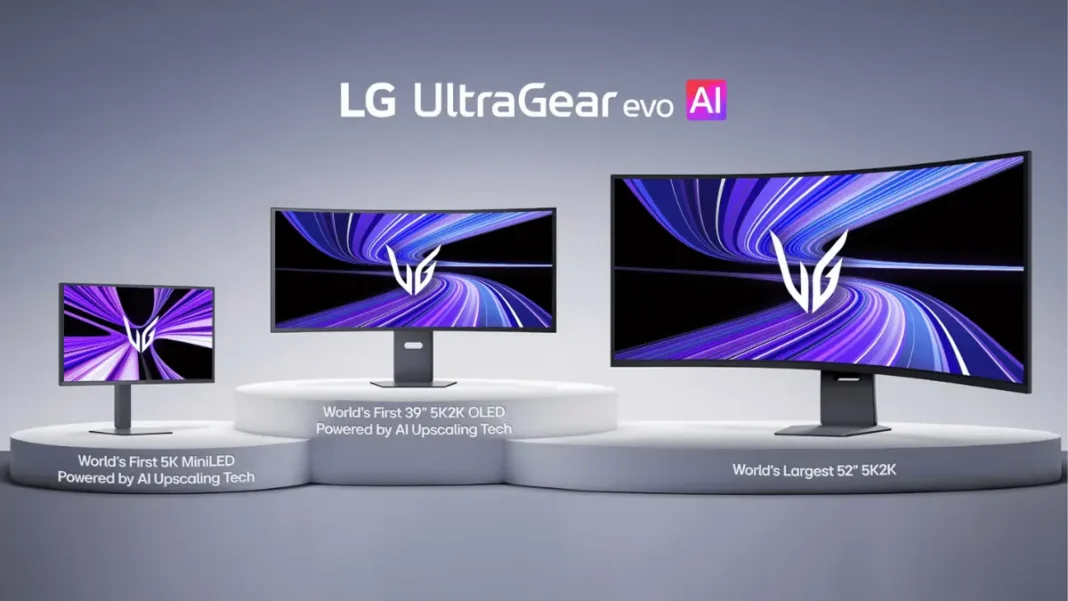
LG has announced UltraGear Evo, a premium gaming monitor brand that introduces AI-powered upscaling to 5K displays for the first time. Set to debut at CES 2026 in January, the lineup includes three models spanning OLED, Mini LED, and ultra-wide technologies, each designed to deliver higher visual fidelity without demanding more from your GPU.
LG UltraGear Evo is LG’s new premium gaming monitor lineup featuring the world’s first AI upscaling technology for gaming displays. The series includes three 5K resolution models with AI chips that enhance lower-resolution content to near-5K quality, Dual Mode refresh rate switching, and options across OLED, Mini LED, and ultra-wide formats debuting at CES 2026.
What Makes UltraGear Evo Different
The UltraGear Evo lineup addresses a fundamental challenge in high refresh rate gaming: delivering exceptional image quality without sacrificing performance. Traditional 5K monitors demand significant GPU horsepower, but LG’s AI upscaling solution allows gamers to render games at lower native resolutions while the monitor’s dedicated AI chip enhances image quality to approach native 5K clarity.
AI Upscaling Technology Explained
Each UltraGear Evo monitor contains a dedicated AI processor that analyzes incoming video signals frame-by-frame. When you’re running a game at 1440p or 4K, the chip applies machine learning algorithms to reconstruct fine details, sharpen edges, and reduce compression artifacts before displaying the enhanced image at 5K resolution. This process happens in real-time with minimal latency impact, letting you maintain high frame rates while enjoying sharper visuals than standard upscaling methods produce.
Think of it like Netflix’s 4K upscaling, but optimized specifically for gaming content with fast motion and UI elements. The AI model has been trained on gaming scenarios rather than film and TV, so it better handles HUD elements, text clarity, and rapid camera movements common in competitive titles.
Why 5K Resolution Matters for Gaming
5K gaming monitors (5120×2160 or 5120×1440) offer approximately 40% more pixels than 4K displays, resulting in sharper text, finer detail visibility, and reduced pixel density visibility at typical viewing distances. For gaming, 5K provides clearer enemy spotting in competitive titles and more immersive detail in single-player experiences, though it requires significantly more GPU power than 4K at equivalent settings.
5K displays bridge the gap between 4K and true 8K, delivering noticeable sharpness improvements without the extreme hardware requirements of 8K panels. At 27 inches, 5K resolution provides 218 pixels per inch, substantially sharper than 4K’s 163 PPI making text, UI elements, and distant objects significantly clearer. For competitive gamers, this translates to easier enemy spotting in titles like Counter-Strike 2 or Valorant.
Three Models for Different Gaming Needs
LG designed the UltraGear Evo lineup to serve distinct gaming preferences, from competitive esports to immersive single-player experiences and large-format gaming. Each model shares the AI upscaling core but implements different panel technologies and form factors.
39GX950B: The Curved OLED Flagship
The 39-inch 39GX950B delivers what LG calls the “ultimate gaming experience” with a 1500R curved OLED panel at 5K2K (5120×2160) resolution. Primary RGB Tandem OLED technology provides improved brightness, color accuracy, and panel longevity compared to traditional WOLED designs.
Key specifications:
- 39-inch curved (1500R) OLED display
- 5K2K resolution at 142 pixels per inch
- Dual Mode: 165Hz at 5K2K or 330Hz at WFHD
- 0.03ms (GtG) response time
- 21:9 aspect ratio
- VESA DisplayHDR True Black 500 certification
The Dual Mode feature lets you switch between visual fidelity and competitive performance on the fly. Running Cyberpunk 2077? Lock in 165Hz at full 5K2K for maximum detail. Jumping into Apex Legends? Switch to 330Hz at WFHD (2560×1080) for buttery-smooth competitive advantage. The 0.03ms response time is among the fastest available, eliminating ghosting even during the most frantic gameplay moments.
27GM950B: Mini LED Precision Display
The 27-inch 27GM950B represents what LG calls the “world’s first 5K New MiniLED display,” specifically engineered to eliminate blooming artifacts that plague traditional Mini LED monitors. With 2,304 independently controlled local dimming zones packed into 27 inches, the display achieves precise backlight control that rivals OLED’s contrast ratio without the burn-in concerns.
Technical specifications:
- 27-inch flat Mini LED panel
- 5K resolution (5120×2160) at 218 PPI
- Dual Mode: 165Hz at 5K or 330Hz at QHD (2560×1440)
- 1ms (GtG) response time
- Peak brightness: 1,250 nits
- VESA DisplayHDR 1000 certification
- 2,304 local dimming zones
That 1,250-nit peak brightness significantly exceeds typical OLED capabilities, making the 27GM950B better suited for bright room environments and HDR content with intense specular highlights. Explosions in games like Modern Warfare III or sunlit scenes in racing simulators will display with striking intensity alongside deep, controlled blacks.
52G930B: Ultra-Wide Gaming Theater
The 52-inch 52G930B becomes the world’s largest 5K2K gaming monitor, creating an immersive panorama that wraps around your peripheral vision. This ultra-wide format (21:9 aspect ratio) provides the same vertical resolution as the 39-inch model but extends horizontal space, ideal for racing sims, flight simulators, and games that support ultra-wide FOV.
While LG has shared fewer specifications for this model ahead of CES 202 , the 52G930B targets gamers who want a single-monitor solution that replaces multi-monitor setups without bezels interrupting the visual field. The sheer scale makes it suitable for both gaming and productivity workflows where horizontal screen real estate matters.
Breakthrough Technologies Under the Hood
Beyond the headline AI upscaling feature, LG has integrated several display technologies that differentiate UltraGear Evo from existing gaming monitors.
Primary RGB Tandem OLED Technology
Traditional OLED gaming monitors use WOLED (White OLED with color filters) or QD-OLED (Quantum Dot OLED) architectures. LG’s Primary RGB Tandem OLED takes a different approach by stacking two RGB OLED layers, effectively doubling the light output while extending panel lifespan.
This tandem architecture addresses two common OLED concerns: limited peak brightness and potential burn-in from static UI elements. By distributing luminance across two emissive layers, each layer operates at lower individual intensity, reducing stress on organic materials and theoretically extending the panel’s useful life. For gamers worried about persistent HUD elements causing image retention, this represents meaningful progress over first-generation OLED gaming monitors.
New Mini LED with 2,304 Dimming Zones
The 27GM950B’s Mini LED implementation uses what LG calls “New MiniLED” technology, featuring smaller LEDs packed more densely than previous generations. With 2,304 zones controlling a 27-inch panel, zone size shrinks dramatically compared to typical Mini LED monitors that use 500-1,000 zones.
Smaller zones mean less blooming around bright objects against dark backgrounds, the classic Mini LED weakness. When you’re spotting enemies in dark corners of horror games or watching HDR movie content, bright UI elements won’t create distracting halos. LG claims this advancement makes Mini LED viable for content creators and gamers who previously avoided the technology due to blooming artifacts.
Dual Mode Performance Switching
Dual Mode on LG UltraGear Evo monitors allows instant switching between two operating modes without rebooting: high-resolution mode (5K at 165Hz) for visual fidelity in single-player games, and high-refresh mode (WFHD/QHD at 330Hz) for competitive performance. The feature is activated through the monitor’s OSD menu and takes effect immediately, letting gamers optimize for different game types.
Every UltraGear Evo model implements Dual Mode, recognizing that different games prioritize different aspects of monitor performance. Story-driven titles like Baldur’s Gate 3 or Red Dead Redemption 2 benefit most from maximum resolution and visual detail, while competitive shooters demand the smoothest possible motion.
Rather than forcing you to choose one fixed configuration, Dual Mode lets you switch between:
- Fidelity Mode: Full 5K resolution at 165Hz for immersive experiences
- Performance Mode: Reduced resolution (WFHD or QHD depending on model) at 330Hz for competitive advantage
The switch happens through the monitor’s OSD without requiring game restarts or GPU setting changes. Your graphics card simply receives a different signal request from the display, and you’re gaming at different specs within seconds.
Real-World Gaming Performance
Based on the announced specifications and comparisons to existing OLED vs Mini LED gaming monitors, we can project how UltraGear Evo models will perform across different gaming scenarios.
Competitive Gaming Scenarios
For esports titles like Valorant, Counter-Strike 2, Overwatch 2, and League of Legends, the 330Hz Performance Mode becomes the priority. At these refresh rates, motion blur nearly disappears, and input latency from mouse click to on-screen response drops to imperceptible levels.
The 39GX950B’s 0.03ms response time combines with 330Hz refresh to deliver some of the fastest pixel transitions available in any gaming monitor. Even the 27GM950B’s 1ms response time at 330Hz exceeds what most IPS and VA panels achieve at any refresh rate. Competitive players will appreciate clearer motion during rapid camera movements and more consistent target tracking.
However, competitive gamers should note that driving 330Hz at WFHD (2560×1080) or QHD (2560×1440) still requires substantial GPU power you’ll need at least an NVIDIA RTX 4070 or AMD RX 7800 XT to consistently hit those frame rates in modern competitive titles at high settings.
Single-Player Immersive Titles
For visually stunning single-player games Cyberpunk 2077, Starfield, Elden Ring, Flight Simulator 2024 the full 5K resolution at 165Hz provides the optimal experience. The additional pixel density compared to 4K makes textures sharper, foliage more defined, and distant scenery clearer.
The 39-inch ultrawide’s 21:9 aspect ratio particularly shines in first-person titles, expanding your peripheral vision to create more natural spatial awareness. Racing games and flight simulators feel significantly more immersive when your view isn’t constrained by a 16:9 frame.
OLED’s perfect blacks and infinite contrast ratio elevate games with dramatic lighting think of exploring dark dungeons in Diablo IV or navigating The Last of Us Part I’s post-apocalyptic environments. The HDR True Black 500 certification ensures highlights pop against genuinely black backgrounds, not the “dark gray” you see on LED-backlit displays.
Content Creation Workflow
While marketed as gaming monitors, the UltraGear Evo lineup’s specifications appeal to content creators who need color accuracy and screen real estate. The 27GM950B’s 218 PPI pixel density at 5K resolution makes it particularly suitable for photo and video editing, where you need to see fine details without zooming.
LG hasn’t yet disclosed specific color gamut coverage percentages or factory calibration details, but the company typically targets 98-99% DCI-P3 coverage on premium displays. The OLED models’ per-pixel emission inherently provides perfect uniformity without backlight bleed or IPS glow that can interfere with color-critical work.
The 52-inch ultra-wide offers enough horizontal space to display video timelines, color grading panels, and preview windows simultaneously without needing secondary displays. For photographers, the width accommodates multiple RAW images side-by-side for comparison, a workflow advantage over standard 16:9 monitors.
How UltraGear Evo Compares to Competitors
The high-end gaming monitor market has intensified significantly in 2025, with ASUS, Alienware, MSI, and Samsung all offering advanced OLED and Mini LED options. Here’s how LG’s new lineup positions against current leaders:
| Feature | LG UltraGear Evo 39GX950B | ASUS ROG Swift OLED PG27UCDM | Samsung Odyssey OLED G9 | Dell Alienware AW3225QF |
|---|---|---|---|---|
| Panel Type | Primary RGB Tandem OLED | QD-OLED | QD-OLED | QD-OLED |
| Size | 39″ curved | 27″ flat | 49″ curved | 32″ curved |
| Resolution | 5120×2160 (5K2K) | 3840×2160 (4K) | 5120×1440 (DQHD) | 3840×2160 (4K) |
| Max Refresh | 330Hz (WFHD mode) | 240Hz | 240Hz | 240Hz |
| Response Time | 0.03ms | 0.03ms | 0.03ms | 0.03ms |
| Peak Brightness | ~450 nits (est.) | 450 nits | 400 nits | 450 nits |
| AI Upscaling | ✓ | ✗ | ✗ | ✗ |
| Dual Mode | ✓ (165Hz/330Hz) | ✗ | ✗ | ✗ |
| HDR Cert | True Black 500 | True Black 400 | True Black 400 | True Black 400 |
| DisplayPort | 2.1 (likely) | 2.1 | 2.1 | 2.1 |
Key differentiators:
The AI upscaling represents LG’s most significant competitive advantage no other gaming monitor manufacturer has announced similar technology. This lets you balance visual quality and performance without being locked into your GPU’s raw rendering capabilities.
LG’s Tandem OLED architecture theoretically improves brightness and longevity compared to single-layer QD-OLED panels in competing monitors, though we’ll need independent testing to verify real-world differences. The 330Hz maximum refresh rate in Dual Mode exceeds most competitors’ 240Hz caps, appealing to esports professionals seeking every possible advantage.
However, competing monitors from ASUS and Dell have proven track records with extensive reviews and testing data. The UltraGear Evo lineup won’t have that independent validation until units reach reviewers after CES 2026. ASUS’s ROG Swift monitors, for instance, consistently rank among RTINGS best gaming monitors with verified color accuracy and performance metrics.
Technical Specifications Breakdown
39GX950B (39″ OLED)
- Panel: 39″ curved (1500R) Primary RGB Tandem OLED
- Native Resolution: 5120×2160 (5K2K), 21:9 aspect ratio
- Pixel Density: 142 PPI
- Refresh Rate: 165Hz (5K2K) / 330Hz (WFHD)
- Response Time: 0.03ms (GtG)
- HDR: VESA DisplayHDR True Black 500
- Color: Primary RGB with color filter (exact gamut TBA)
- Connectivity: DisplayPort 2.1 (expected), HDMI 2.1
- Features: AI upscaling, Dual Mode, AMD FreeSync Premium Pro, G-SYNC Compatible
27GM950B (27″ Mini LED)
- Panel: 27″ flat New MiniLED with 2,304 dimming zones
- Native Resolution: 5120×2160 (5K), 16:9 aspect ratio
- Pixel Density: 218 PPI
- Refresh Rate: 165Hz (5K) / 330Hz (QHD)
- Response Time: 1ms (GtG)
- Peak Brightness: 1,250 nits
- HDR: VESA DisplayHDR 1000
- Contrast Ratio: High contrast with full-array local dimming
- Connectivity: DisplayPort 2.1 (expected), HDMI 2.1, USB-C (likely)
- Features: AI upscaling, Dual Mode, blooming reduction tech
52G930B (52″ Ultra-Wide)
- Panel: 52″ curved OLED (exact curvature TBA)
- Native Resolution: 5120×2160 (5K2K), 21:9 aspect ratio
- Refresh Rate: TBA (likely similar to 39″ model)
- Response Time: Expected <1ms
- HDR: VESA DisplayHDR certification (level TBA)
- Features: AI upscaling, world’s largest 5K2K gaming monitor
- Use Case: Racing sims, flight sims, multi-window productivity
*Full specifications will be confirmed at CES 2026 in January 2025 *
Pricing and Availability
LG has not announced pricing for any UltraGear Evo model ahead of CES 2026. Based on competitive positioning and technology implementation, expect premium pricing:
Projected pricing estimates:
- 27GM950B (Mini LED): $1,299 – $1,599 USD
- 39GX950B (OLED): $1,799 – $2,199 USD
- 52G930B (Ultra-Wide OLED): $2,499 – $2,999 USD
These estimates position UltraGear Evo against ASUS ROG Swift PG27UCDM ($1,099), Samsung Odyssey OLED G9 ($1,799), and Dell Alienware AW3225QF ($1,199). The AI upscaling and Dual Mode features may justify premium pricing over competitors with similar panel specifications.
Availability timeline:
- CES 2026 Showcase: January 7-10, 2026 in Las Vegas
- Pre-orders: Expected Q1 2026 (February-March)
- Retail Launch: Q2 2026 (April-June estimated)
- Regional Rollout: North America and Europe first, followed by Asia-Pacific
Global availability and pricing will vary by region. LG typically staggers gaming monitor launches with enthusiast markets (US, UK, Germany, South Korea) receiving initial stock before broader distribution.
Where to buy when available:
Major electronics retailers, LG.com direct, Amazon, B&H Photo, Newegg, Best Buy, and regional gaming specialty retailers will likely stock UltraGear Evo models.
- Industry-first AI upscaling reduces GPU requirements for 5K gaming without major visual compromises
- Dual Mode flexibility lets you optimize for fidelity or performance per game without monitor swapping
- Primary RGB Tandem OLED addresses brightness and longevity concerns of earlier OLED gaming monitors
- 2,304-zone Mini LED on 27GM950B provides unprecedented backlight precision to minimize blooming
- 330Hz maximum refresh in Performance Mode exceeds most competitor offerings
- 0.03ms response time on OLED models eliminates motion blur even in fastest-paced games
- Multiple form factors (27″ flat, 39″ curved, 52″ ultra-wide) address different gaming preferences and spaces
- DisplayPort 2.1 support (expected) provides sufficient bandwidth for 5K at high refresh rates
- No independent testing available yet; specifications are manufacturer claims pending verification
- Pricing unannounced but likely premium based on feature set and competitive landscape
- High GPU requirements; even with AI upscaling you’ll need RTX 4070 Ti or better for optimal performance
- OLED burn-in risk remains a concern for static UI elements despite Tandem architecture improvements
- Limited 27″ availability; only Mini LED option, no OLED at this size in the UltraGear Evo lineup
- CES 2026 debut means several-month wait before retail availability
- Color accuracy specs not yet disclosed for content creator evaluation
- Mini LED uniformity needs verification; LG claims reduced blooming but real-world testing required
Should You Wait for UltraGear Evo?
Consider waiting for UltraGear Evo if:
- You’re planning a PC upgrade in Q2 2026 anyway and can delay monitor purchases
- AI upscaling appeals as a solution to GPU limitations in 5K gaming
- Dual Mode switching between fidelity and performance fits your mixed gaming habits
- You want the latest display technology and don’t mind premium pricing
- The 27″ Mini LED’s blooming reduction or 39″ OLED’s specific specs match your needs
Buy current-generation monitors instead if:
- You need a display immediately and can’t wait until Q2 2026
- Budget is constrained current 4K OLED monitors offer excellent value with proven performance
- You’re skeptical of first-generation technology and prefer products with extensive review data
- Existing options like ASUS ROG Swift or Alienware QD-OLED already meet your requirements
- You game primarily at 4K where GPU hardware is more manageable
The UltraGear Evo lineup represents meaningful innovation in gaming display technology, particularly the industry-first AI upscaling implementation. However, “first-generation” products often carry premium pricing, limited availability, and potential early-adopter issues that get resolved in subsequent revisions.
If your current monitor suffices for the next few months, waiting allows you to read independent reviews, compare real-world performance against competitor claims, and potentially catch early-adopter discounts once initial demand stabilizes. If you’re upgrading from a 1080p or older 1440p display, current 4K OLED gaming monitors deliver transformative improvements at lower prices than UltraGear Evo will likely command.

Frequently Asked Questions
How does AI upscaling on LG UltraGear Evo compare to NVIDIA DLSS or AMD FSR?
AI upscaling on UltraGear Evo operates at the display level using a dedicated chip in the monitor itself, while DLSS and FSR are GPU-based rendering technologies. DLSS/FSR reconstruct the image before it leaves your graphics card, whereas LG’s solution enhances the signal after it arrives at the monitor. You can theoretically use both simultaneously to render with DLSS at 1440p, then let the monitor’s AI upscale to 5K though the practical benefit of stacking upscaling technologies needs testing.
Will the AI upscaling work with consoles like PlayStation 5 or Xbox Series X?
Yes, LG’s AI upscaling processes any incoming video signal regardless of source. When you connect a PS5 outputting at 4K, the monitor’s AI chip will enhance that signal to near-5K quality. However, consoles are typically capped at 120Hz maximum output, so you won’t access the full 165Hz or 330Hz capabilities that PC gamers can utilize.
Can I turn off AI upscaling if I prefer native rendering?
LG hasn’t detailed the exact implementation, but industry-standard practice includes OSD menu toggles for upscaling features. You should be able to disable AI upscaling when running games at native 5K resolution or when you prefer the display to handle scaling through traditional algorithms. The setting would be per-input, letting you enable it for your gaming PC but disable it when connecting a productivity laptop.
What’s the real-world difference between 165Hz and 330Hz in gaming?
The difference becomes increasingly subtle as refresh rates climb. Going from 60Hz to 144Hz is transformative; 144Hz to 240Hz is noticeable; 240Hz to 330Hz is marginal. Professional esports players with trained perception might gain an edge from the reduced frame time (3.03ms per frame at 330Hz vs 4.17ms at 240Hz), but casual competitive players likely won’t notice in blind tests. Consider the resolution reduction required to hit 330Hz you’re trading significant pixel count for minimal motion smoothness improvement.
Should I choose the OLED or Mini LED model for mixed gaming and productivity?
Mini LED (27GM950B) advantages for productivity:
- Brighter peak luminance (1,250 nits) for daylit offices
- No burn-in risk from static elements like taskbars or UI
- Smaller 27″ size fits standard desks better
- Flat panel easier for text work and coding
OLED (39GX950B) advantages:
- Perfect blacks and infinite contrast ratio superior for dark-themed workflows
- Larger 39″ curved screen provides more workspace
- Better motion clarity for video editing playback
- Wider viewing angles maintain color accuracy
If your workspace has significant natural light and you work with productivity apps featuring bright interfaces for extended periods, the Mini LED model offers better practical durability. If you use dark themes, edit video/photo content, and game more than you work, the OLED delivers superior visual quality despite burn-in precautions.
What graphics card do I need to run 5K gaming at 165Hz?
Running native 5K (5120×2160) at 165Hz with modern games at high settings requires top-tier GPU hardware:
Minimum for 5K gaming:
- NVIDIA RTX 4070 Ti Super / AMD RX 7900 XT
- Runs most games at 5K medium-high settings 80-120 fps
Recommended for 5K 165Hz:
- NVIDIA RTX 4080 Super / AMD RX 7900 XTX
- Handles 5K high settings 100-144 fps in most titles
Optimal for 5K 165Hz:
- NVIDIA RTX 4090 / AMD RX 7900 XTX (OC)
- Achieves 5K ultra settings approaching 165 fps in optimized games
The AI upscaling feature lets you render at 4K or even 1440p with acceptable visual results at 5K display resolution, significantly reducing GPU requirements. If you’re running a mid-tier card like RTX 4070 or RX 7800 XT, you can render at 1440p or 4K and rely on the monitor’s AI enhancement to approach 5K image quality.
When will reviews from independent testers be available?
CES 2026 runs January 7-10, 2026, where LG will showcase UltraGear Evo monitors. Major tech outlets like RTINGS, TFT Central, Hardware Unboxed, and Tom’s Hardware typically receive review units 2-4 weeks before retail launch. Expect detailed reviews with calibrated measurements to appear in March-April 2026, assuming a Q2 2026 retail release. Be cautious of early “hands-on impressions” from CES show floors these controlled demonstrations don’t represent real-world performance.
Does the 52-inch model have OLED burn-in protection features?
LG hasn’t disclosed specific burn-in mitigation technologies for the 52G930B yet. However, LG’s recent OLED TVs and previous UltraGear OLED monitors include pixel shift, logo dimming, screen savers after inactivity, and panel refreshers. The Tandem OLED architecture in the 39GX950B distributes luminance across two emissive layers, reducing individual pixel stress this technology may extend to the 52-inch model. Wait for CES 2026 announcements and independent testing before committing to the ultra-wide OLED if burn-in is a primary concern.

