

Quick Brief
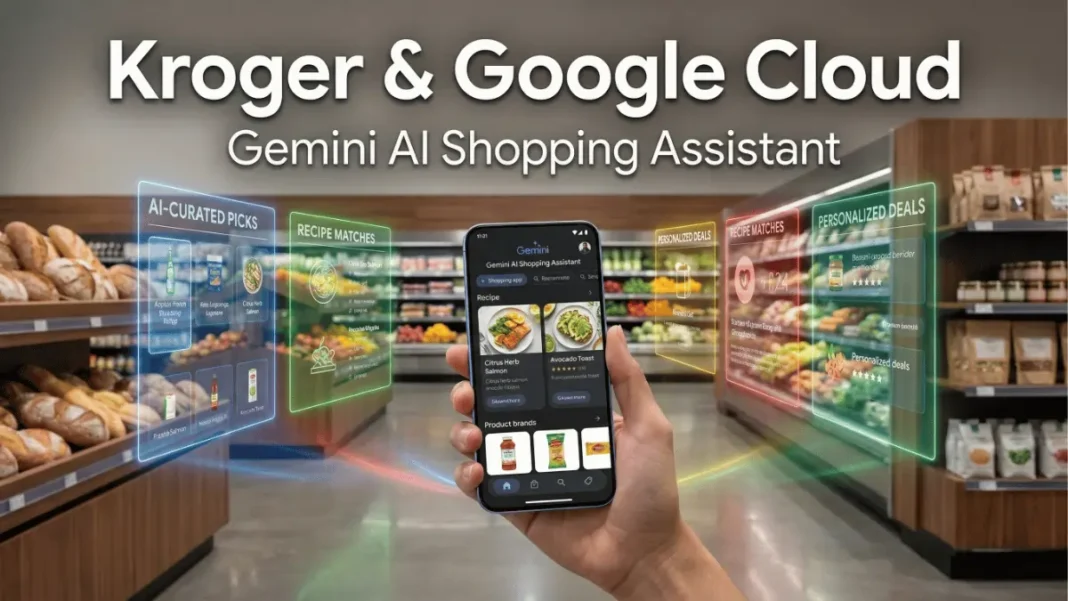
- The Partnership: Kroger (NYSE: KR) expands Google Cloud relationship to deploy Gemini Enterprise for Customer Experience nationwide, launching integrated Shopping and Meal AI assistants
- The Impact: Targets $400 million in ecommerce profitability improvement for 2026, building on 17% digital sales growth in Q3 2025
- The Context: Move positions Kroger against Albertsons’ OpenAI assistant as grocery retail enters agentic AI era, with market projected to reach $37.45 billion by 2034
Kroger Co. (NYSE: KR) announced an expanded partnership with Google Cloud on January 11, 2026, deploying Gemini Enterprise for Customer Experience nationwide across its 2,700+ stores. The Cincinnati-based grocer will roll out AI-powered Shopping and Meal assistants capable of agentic task execution from recipe conversion to cart building using natural language processing grounded in Kroger’s proprietary product data, pricing, and real-time inventory.
The deployment represents Kroger’s most significant AI infrastructure commitment as the retailer pursues ecommerce profitability following six consecutive quarters of double-digit digital growth. With a market capitalization of $37.66 billion and digital sales increasing 17% year-over-year in fiscal Q3 2025, Kroger expects to generate $400 million in ecommerce operating profit improvements in 2026.
What Kroger’s AI Shopping Assistant Delivers
The Gemini Enterprise for CX solution introduces three core capabilities differentiated by agentic architecture. The Shopping assistant executes multi-step workflows from single customer instructions, enabling requests like “prepare vegan tomato soup” to generate recipe recommendations, ingredient lists, and one-click cart additions without manual navigation.
Kroger’s implementation leverages its proprietary customer data asset accumulated through nearly 150 years of retail operations and its 84 million loyalty program households to ground AI recommendations in actual product assortment, regional pricing, and store-specific availability. The system surfaces personalized offers and compares product specifications while maintaining context across meal planning, budgeting, and delivery scheduling.
Customer Experience Agent Studio will analyze inbound store call interactions to identify issue patterns, enabling proactive resolution and associate productivity gains through automated intent recognition. This positions Kroger to reduce friction across its hybrid fulfillment model combining automated centers and third-party delivery partners including Instacart, DoorDash, and Uber.

Why This Matters: The Grocery AI Arms Race
Kroger’s Gemini deployment arrives as competitor Albertsons reports 10% larger basket sizes from its Google Cloud Conversational Commerce agent launched in 2024, supplemented by an OpenAI-powered assistant in December 2025. Albertsons claims its AI reduces shopping time from 46 minutes to four minutes for complex tasks, setting aggressive benchmarks for digital engagement.
The broader AI shopping assistant market is projected to expand from $3.42 billion in 2024 to $37.45 billion by 2034, representing a 27.04% compound annual growth rate driven by omnichannel retail adoption and natural language processing advances. Product discovery and search capabilities currently command 32% market share as retailers prioritize personalized recommendation engines.
Kroger’s strategic timing aligns with its ecommerce profitability inflection point. After closing three automated fulfillment centers to optimize its $400 million savings target, the retailer is pivoting from capital-intensive infrastructure to AI-driven customer acquisition and retention. The company fulfilled one million DoorDash orders in its first month of partnership, demonstrating rapid third-party integration velocity.
Technical Architecture and Deployment Scope
| Component | Function | Business Impact |
|---|---|---|
| Gemini Enterprise for CX | Agentic shopping and meal planning | Reduces task completion time, increases basket size |
| Customer Experience Agent Studio | Call interaction analysis and intent mapping | Proactive issue resolution, associate productivity |
| Proprietary data grounding | Product assortment, pricing, inventory integration | Recommendation accuracy, regional relevance |
| Multi-agent workflow | Recipe-to-cart, reordering, product comparison | Single-instruction task execution |
Google Cloud’s Gemini Enterprise pricing typically ranges $20-$30 per user per month for workforce applications, though Kroger’s customer-facing deployment likely operates under custom enterprise licensing aligned with transaction volume and API consumption. The platform’s ability to access Kroger’s data ecosystem including loyalty profiles, purchase history, and regional preferences creates competitive moats against generic AI assistants.
Kroger will deploy the assistant across its banner brands serving diverse customer segments, from budget-conscious households to premium organic shoppers, requiring the AI to navigate price sensitivity while maintaining food quality recommendations. The system must process regional availability variations across Kroger’s geographic footprint while integrating with existing delivery windows and fulfillment capacity constraints.
What’s Next: Agentic Commerce and External Agent Integration
Kroger’s roadmap will test the assistant’s expansion to mobile apps and voice interfaces, following Albertsons’ trajectory of adding budgeting features, in-store aisle location guidance, and multi-agent architecture supporting external integrations. The emerging “agentic commerce” paradigm envisions customer-owned AI agents negotiating prices, scheduling purchases around promotional cycles, and assessing affordability within household budget contexts.
Google Cloud unveiled Gemini Enterprise for CX at NRF 2026, positioning Kroger alongside early adopters Lowe’s, Papa John’s, and Woolworths in retail AI transformation. The grocer’s success metrics will center on digital sales acceleration beyond the current 17% growth rate, basket size expansion, and repeat visit frequency through AI-driven engagement.
Kroger expects its ecommerce business to achieve profitability in 2026, with the Gemini deployment serving as a key pillar alongside fulfillment network optimization and retail media revenue growth. The company’s ability to monetize customer interactions through targeted advertising while maintaining shopping experience quality will determine whether AI assistants drive sustainable margin expansion or simply shift channel mix.

Frequently Asked Questions (FAQs)
When will Kroger’s AI shopping assistant launch?
Kroger announced nationwide deployment of Gemini Enterprise for CX on January 11, 2026, with rollout across its stores and digital platforms underway.
How much will Kroger’s AI assistant improve profitability?
Kroger targets $400 million in ecommerce profitability improvements for 2026, combining AI deployment with fulfillment optimization and third-party partnerships.
What can Kroger’s AI shopping assistant do?
The assistant converts recipe requests into shopping carts, reorders past purchases, compares products, and builds complex occasion-based orders from single natural language instructions.
How does Kroger’s AI compare to competitors?
Albertsons reports 10% larger baskets and four-minute shopping times using Google and OpenAI assistants, establishing benchmarks Kroger must match.

