

Key Takeaways
- FlashSystem.ai reduces routine storage management tasks by up to 90% through agentic AI automation
- Three new models deliver 40% greater data efficiency: 5600 (2.5 PBe), 7600 (7.2 PBe), 9600 (11.8 PBe)
- Fifth-generation FlashCore Module 5 offers up to 105TB capacity with hardware-accelerated ransomware detection
- General availability begins March 6, 2026 for enterprise and edge deployments
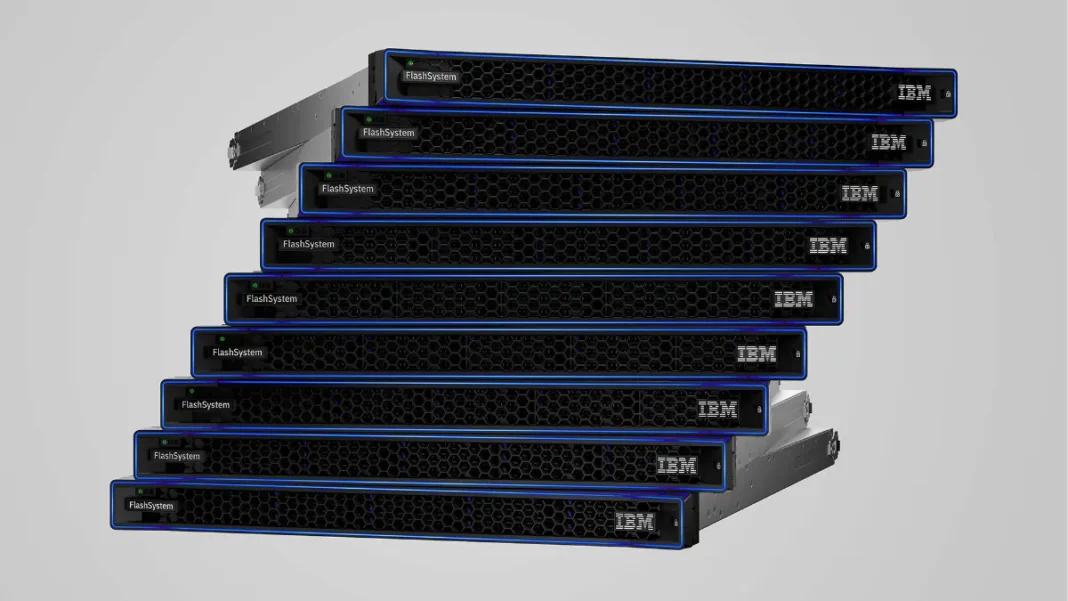
IBM has fundamentally redefined enterprise storage architecture and the FlashSystem 2026 portfolio proves autonomous infrastructure is no longer theoretical. Announced February 10, 2026 in Warsaw, the next-generation IBM FlashSystem portfolio introduces agentic AI as co-manager, transforming storage from passive repositories into self-optimizing intelligence layers. This marks the most significant FlashSystem launch in six years, with three simultaneous model releases engineered for workloads ranging from edge computing to mission-critical banking systems.
What FlashSystem.ai Delivers to Enterprise IT
FlashSystem.ai represents a paradigm shift in storage operations, executing thousands of automated decisions daily that previously demanded human oversight. IBM trained the AI model on tens of billions of data points from real-world deployments, enabling it to adapt to application behavior patterns and provide performance optimization recommendations. Administrators receive suggestions with explainable reasoning, creating an audit trail that satisfies compliance requirements.
The system automates workload placement across storage devices, including third-party arrays, enabling non-disruptive data mobility without manual intervention. IBM claims FlashSystem.ai cuts audit and compliance documentation time in half through AI-generated operational reasoning that auto-assembles evidence of configurations, protection policies, and risk postures.
How does FlashSystem.ai reduce storage management workload?
FlashSystem.ai automates routine operations like multi-volume provisioning, Safeguarded Copy policies, and disaster recovery configurations that traditionally required graphical user interface work. IBM testing shows up to 90% reduction in manual effort for these specific tasks compared to previous-generation FlashSystem models operating without the AI layer.
FlashSystem 5600: Enterprise Density in 1U Form Factor
The FlashSystem 5600 targets space-constrained environments, edge locations, remote offices, and compact data centers with enterprise-class capabilities compressed into a single rack unit. It delivers up to 2.5 petabytes of effective capacity and 2.6 million IOPS in a 1U chassis, setting a new density benchmark for the midrange market.
This model suits organizations requiring full FlashSystem capabilities without the physical footprint of traditional enterprise arrays. The ultra-dense design supports distributed infrastructure strategies where physical space carries premium costs or operational constraints.
FlashSystem 7600: High Performance for Growing Workloads
IBM designed the FlashSystem 7600 for organizations scaling virtualized environments, analytics platforms, and consolidated applications. The 2U system provides up to 7.2 petabytes of effective capacity with 4.3 million IOPS, handling workloads that demand greater capacity and faster response times than midrange systems can deliver.
The 7600 bridges the gap between departmental storage and mission-critical arrays, offering expandability that accommodates rapid data growth without forklift upgrades. Both the 7600 and 9600 feature optional interactive LED bezels for physical visualization of system state information, enabling at-a-glance status monitoring in data center environments.
FlashSystem 9600: Mission-Critical Performance at Scale
The FlashSystem 9600 anchors IBM’s 2026 storage portfolio for enterprises running core banking systems, ERP platforms, and AI-driven applications requiring extreme performance. It delivers 11.8 petabytes of effective capacity with 6.3 million IOPS in a 2U enclosure, supporting 3.4 petabytes of raw capacity.
IBM estimates the 9600 reduces operational costs by 57% compared to the previous-generation 9500 model through AI optimization and consolidation. The cost reduction factors include approximately 50% admin effort savings via FlashSystem.ai, 67% rack unit reduction, and 25-30% power efficiency gains based on IBM’s modeling.
What makes the FlashSystem 9600 suitable for mission-critical workloads?
The FlashSystem 9600 combines massive scalability (11.8 PB effective capacity), extreme performance (6.3M IOPS), and AI-driven resilience in a 2U system. Its fifth-generation FlashCore Modules provide hardware-accelerated ransomware detection without impacting application performance, making it appropriate for core banking, ERP, and regulated industries where downtime carries severe consequences.
Fifth-Generation FlashCore Module Technology
All three FlashSystem models contain the fifth-generation FlashCore Module, IBM’s proprietary all-flash drive with up to 105 terabytes of capacity. The module offloads computationally intensive operations like compression, deduplication, and encryption from storage controllers, performing these tasks directly on the drive for improved efficiency.
Hardware-Accelerated Ransomware Detection
The FlashCore Module 5 computes complex statistics on every I/O operation using hardware-accelerated analytics designed to detect ransomware and anomalies without degrading system performance. The technology monitors data at block-level granularity as it’s written, checking drive statistics against trained ransomware patterns every 2 seconds.
IBM states the ransomware detection models achieve false-positive rates under 1% and guarantee detection of potential risks in under one minute. Laboratory testing using ransomware simulators on previous-generation FlashCore Module 4 detected encryption patterns in 58 seconds, supporting IBM’s sub-minute detection capability claim for the new generation.
When threats surface, the system triggers Safeguarded Copy snapshots automatically, creating immutable recovery points without administrator intervention. This autonomous response capability positions FlashSystem among storage offerings with integrated threat response, according to IBM.
Agentic AI: Beyond Template-Based Automation
The distinction between FlashSystem.ai and conventional storage automation lies in its agentic architecture. Traditional systems operate on pre-configured templates that require extended periods to adapt to new workload patterns. FlashSystem.ai agents learn from application behavior, incorporating administrator feedback to refine recommendations over time.
The system explains its reasoning for performance optimizations, enabling IT teams to audit AI decisions, a capability IBM emphasizes for regulated industries with strict compliance requirements. Natalya Yezhkova, Research Vice President at IDC, noted these capabilities allow organizations to react to changing business requirements through adaptive SLAs without additional IT administrator burden.
How does agentic AI differ from traditional storage automation?
Agentic AI in FlashSystem learns and adapts autonomously rather than following static templates. It analyzes application behavior patterns, suggests optimizations with explainable reasoning, incorporates human feedback, and makes thousands of decisions daily. Traditional automation executes pre-programmed rules without learning from outcomes or adapting to changing workload characteristics.
Data Efficiency and Footprint Reduction
The 2026 FlashSystem portfolio reduces required storage footprints by 30-75% depending on model configuration through optimized placement and consolidation compared to previous generations. This efficiency stems from advanced deduplication and compression working in combination, achieving up to 40% greater data reduction than previous approaches.
IBM states deduplication and compression ratios derive from data collected from IBM-shipped FlashCore Modules in client systems running between three months and seven years as of January 2026. The FlashCore Module 5 introduces on-drive deduplication capabilities, a new feature in this generation that enables enhanced data reduction ratios.
Industry Adoption Trajectory
An IBM Institute for Business Value study found 76% of executives report their organizations are developing, executing, or scaling proof-of-concepts that automate intelligent workflows through self-sufficient AI agents. This adoption pattern creates market readiness for autonomous storage as enterprises integrate AI workflows across their technology stacks.
Nezih Boyacioglu, Business Development at Istanbul Pazarlama A.S., emphasized IBM’s lead in reshaping storage around resiliency through innovations like Safeguarded Copy and built-in anomaly detection. The FlashSystem.ai launch represents evolution from built-in protection to pervasive intelligence, combining human expertise with systems that learn and adapt.
Technology Lifecycle Services Integration
IBM Technology Lifecycle Services leverages AI-enabled monitoring, automated issue detection through Call Home functionality, pre-code health checks, and priority support for critical issues. These services identify and resolve potential system problems before they cause downtime, extending the autonomous operations model beyond the storage arrays themselves.
The service integration creates a continuous improvement loop where field data from deployed systems feeds back into system optimization, progressively improving operational recommendations.
Considerations for Enterprise Buyers
Organizations evaluating FlashSystem 2026 models should conduct pilot testing with representative workloads to verify performance claims match their specific environments. The 90% management effort reduction applies to specific routine operations like multi-volume provisioning with Safeguarded Copy and DR policies, measured against manual GUI-based workflows. Actual results vary by environment, existing integrations, policy complexity, and administrator proficiency.
The 57% operational cost reduction for the 9600 model represents IBM’s modeled comparison at approximately 10PB usable capacity with specific assumptions about admin labor, rack space, and energy costs. Organizations should calculate total cost of ownership based on their actual operational parameters and usage patterns.
What are the limitations of FlashSystem.ai’s autonomous capabilities?
FlashSystem.ai automates routine storage operations but requires human oversight for strategic decisions, capacity planning, and policy definition. The 90% effort reduction IBM reports applies to specific tasks tested internally actual savings vary by workload, environment complexity, and existing automation levels. Organizations should evaluate whether their operational patterns align with IBM’s documented test scenarios.
Availability and Deployment Timeline
IBM announced general availability for the FlashSystem 5600, 7600, and 9600 beginning March 6, 2026. Organizations can access detailed specifications and deployment planning resources at the official IBM FlashSystem product page.
Early adopters should establish baseline performance metrics before migration to accurately measure the impact of AI-driven optimizations in their specific environments.

Frequently Asked Questions (FAQs)
How much does IBM FlashSystem 2026 cost?
IBM has not publicly disclosed pricing for the FlashSystem 5600, 7600, or 9600 models. Enterprise storage pricing typically varies based on capacity configuration, service contracts, and volume licensing. Contact IBM sales representatives or authorized partners for configuration-specific quotes and total cost of ownership analysis.
Can FlashSystem.ai manage third-party storage arrays?
Yes. FlashSystem.ai provides intelligent workload placement and non-disruptive data mobility across storage devices, including third-party storage arrays. This capability enables heterogeneous storage environment management for workload distribution.
What workloads benefit most from FlashSystem 2026?
Mission-critical applications requiring high IOPS and low latency benefit most core banking systems, ERP platforms, large-scale virtualization, analytics workloads, and AI training applications. Organizations facing rapid data growth, strict compliance requirements, or limited IT staff gain value from autonomous management capabilities.
Does ransomware detection work with encrypted data?
The FlashCore Module 5 analyzes I/O patterns and statistical anomalies at the block level, monitoring write behavior characteristics that indicate ransomware activity. The system checks drive statistics every 2 seconds against trained patterns to identify threats.
What happens after FlashSystem.ai detects ransomware?
When threat detection triggers, the system automatically creates Safeguarded Copy snapshots immutable recovery points. Administrators receive alerts with recovery recommendations, enabling restoration to clean data states without manual snapshot management.
How does FlashSystem 2026 compare to previous generations?
The 2026 models deliver 40% greater data efficiency through improved compression and deduplication, up to 67% rack space reduction, 25-30% lower power consumption, and autonomous AI management capabilities. IBM estimates the FlashSystem 9600 offers 57% lower operational costs than the 9500 predecessor through these combined improvements.
Is FlashSystem.ai available for existing FlashSystem deployments?
IBM’s February 2026 announcement focuses on FlashSystem.ai integration with the 5600, 7600, and 9600 models launching March 6, 2026. Compatibility with previous-generation FlashSystem arrays has not been publicly confirmed. Organizations with existing deployments should consult IBM regarding upgrade paths.

