

Quick Brief
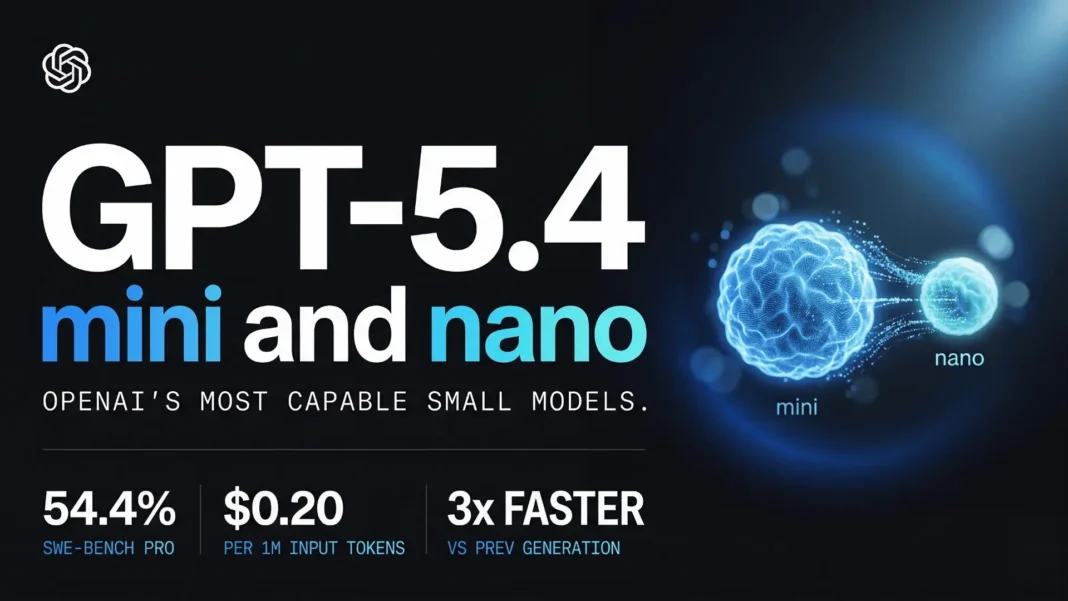
- GPT-5.4 mini runs over 2x faster than GPT-5 mini while scoring 54.4% on SWE-Bench Pro, only 3.3% behind the flagship
- GPT-5.4 nano scores 52.4% on SWE-Bench Pro, outperforming the previous-generation GPT-5 mini (45.7%)
- API pricing starts at $0.20 per million input tokens for nano, making large-scale deployments viable
- Both models support text and image input, tool use, function calling, file search, and web search via API
OpenAI’s approach to AI access changed on March 17, 2026, when the company released two models that deliver near-top-tier performance at a cost most developers can actually afford. GPT-5.4 mini and nano are not compromised versions of a flagship. They are purpose-built engines for speed, scale, and efficiency. This article breaks down what each model does, who benefits most, and exactly what the numbers mean for developers globally.
What GPT-5.4 Mini Actually Delivers
GPT-5.4 mini replaces GPT-5 mini and is the most significant upgrade in OpenAI’s lightweight tier. It runs over 2x faster than GPT-5 mini while scoring 54.4% on SWE-Bench Pro, compared to 57.7% for the full GPT-5.4 flagship. That 3.3-point gap is the closest any small model has come to OpenAI’s top-tier performance on real-world coding evaluations.
On Terminal-Bench 2.0, mini scored 60.0% versus GPT-5 mini’s 38.2%, a 57% generational improvement. On GPQA Diamond, a doctoral-level scientific reasoning benchmark, mini scored 88%, only 5 points behind the flagship’s 93%.
For complex tool-chain tasks, GPT-5.4 mini scored 42.9% on Toolathlon, compared to GPT-5 mini’s 26.9%. On the telecom-specific benchmark tau2-bench, mini achieved 93.4% against GPT-5 mini’s 74.1%. These numbers confirm mini as a capable executor for multi-step production workflows, not just a scaled-down assistant.
What GPT-5.4 Nano Is Built For
GPT-5.4 nano is the smallest and fastest model in the GPT-5.4 family. OpenAI designed it for high-volume, lower-complexity tasks: classification, data extraction, ranking, entity detection, and supporting roles within multi-agent pipelines.
The nano scores 52.4% on SWE-Bench Pro. That figure places it above the previous-generation GPT-5 mini (45.7%), which means the smallest model in the new family outperforms the mid-tier model from the previous generation on real coding tasks.
API pricing for nano sits at $0.20 per million input tokens and $1.25 per million output tokens. At that rate, processing 76,000 photos with descriptive captions costs approximately $52. For media companies, e-commerce platforms, and content operations handling image-heavy workflows, this is a workable production cost. Nano is API-only and is not accessible through the standard ChatGPT interface.
Computer Use: Mini Leads, Nano Has Limits
On OSWorld-Verified, the benchmark that measures an AI model’s ability to interpret UI screenshots and perform screen-based tasks, GPT-5.4 mini scored 72.1% compared to the flagship’s 75.0%. GPT-5 mini scored only 42.0% on this same benchmark, meaning mini’s computer-use ability nearly doubled in one generation.
GPT-5.4 nano scored 39.0% on OSWorld-Verified, slightly below even GPT-5 mini’s 42.0%. This gap confirms that nano is not suited for computer-use or UI interpretation tasks. Its strengths remain in classification, extraction, and fast text-based operations where visual reasoning is not required.
For developers building real-time computer-use agents, mini is the appropriate model. Nano should be reserved for text-based pipeline steps where latency and cost are the primary constraints.
How Mini and Nano Work Together in Agentic Pipelines
The real shift with these releases is architectural. OpenAI has outlined a clear multi-model workflow: GPT-5.4 handles planning and final decision-making, mini executes mid-complexity subtasks at speed, and nano manages classification and extraction steps at scale.
In this structure, the flagship model coordinates, mini agents process actions such as codebase search, file review, and document summarization, and nano handles parallel supporting tasks. OpenAI specifically describes GPT-5.4 mini as working well in systems “where larger models handle planning and judgment, while GPT-5.4 mini executes narrower subtasks.”
This architecture reduces latency and cost simultaneously without degrading overall output quality. Developers building agentic tools or multi-step reasoning pipelines can distribute workloads across these tiers rather than routing everything through the flagship.
ChatGPT Access: Who Gets What
GPT-5.4 mini is available in ChatGPT, the OpenAI API, and Codex. Free and Go plan users can access mini in ChatGPT through the “Thinking” menu. For Plus and Pro users, mini functions as a rate-limit fallback for GPT-5.4 Thinking when quota is exhausted.
In OpenAI’s Codex environment, mini uses only 30% of the GPT-5.4 quota. This enables teams running automated code review, pull request drafting, or codebase scanning to run roughly three times as many tasks within the same budget allocation.
GPT-5.4 nano remains API-only and targets enterprise and developer use cases. OpenAI has not announced a consumer-facing deployment for nano.
GPT-5.4 Model Pricing Compared
| Model | Input (per 1M tokens) | Cached Input | Output (per 1M tokens) |
|---|---|---|---|
| GPT-5.4 | $2.50 | $0.25 | $15.00 |
| GPT-5.4 mini | $0.75 | $0.075 | $4.50 |
| GPT-5.4 nano | $0.20 | $0.02 | $1.25 |
Mini output is priced at roughly 30% of GPT-5.4’s output cost. Nano output at $1.25 per million tokens is approximately one-twelfth of the flagship output cost, making it the most economical option for bulk text processing tasks.
Benchmark Performance at a Glance
| Benchmark | GPT-5.4 | GPT-5.4 mini | GPT-5 mini | GPT-5.4 nano |
|---|---|---|---|---|
| SWE-Bench Pro (coding) | 57.7% | 54.4% | 45.7% | 52.4% |
| OSWorld-Verified (computer use) | 75.0% | 72.1% | 42.0% | 39.0% |
| Terminal-Bench 2.0 | N/A | 60.0% | 38.2% | N/A |
| GPQA Diamond (reasoning) | 93% | 88% | N/A | N/A |
| Toolathlon (tool use) | N/A | 42.9% | 26.9% | N/A |
| tau2-bench (tool use) | 98.9% | 93.4% | 74.1% | N/A |
Capabilities: Mini vs Nano
GPT-5.4 mini supports the following through the API:
- Text and image input
- Tool use and function calling
- File search and web search
- Computer use (UI screenshot interpretation)
- Sub-agent workflow compatibility
- 400K token context window
GPT-5.4 nano supports the following through the API:
- Text and image input
- Tool use and function calling
- File search and web search
- Lightweight classification, extraction, and ranking tasks
Nano does not have confirmed support for computer use or skills features. Developers should use mini for any workflow requiring visual reasoning or complex tool chaining.
Considerations
GPT-5.4 mini does not fully match the flagship on complex multi-step reasoning. Workflows requiring deep planning or highly ambiguous problem-solving should still route to GPT-5.4. Nano’s computer-use score (39.0%) falls below the previous-generation GPT-5 mini (42.0%), making it unsuitable for UI-based automation tasks. Developers should run targeted benchmarks on their specific use case before committing either model to production at scale.
Frequently Asked Questions (FAQs)
What is GPT-5.4 mini?
GPT-5.4 mini is OpenAI’s mid-tier model in the GPT-5.4 family, released March 17, 2026. It runs over 2x faster than GPT-5 mini and scores 54.4% on SWE-Bench Pro, only 3.3 points behind the flagship GPT-5.4. It is available in ChatGPT, the API, and Codex.
What is GPT-5.4 nano used for?
GPT-5.4 nano is optimized for high-volume, lower-complexity tasks including classification, ranking, entity extraction, and background steps within multi-agent pipelines. It scores 52.4% on SWE-Bench Pro. It is available via the OpenAI API only, with no ChatGPT consumer access.
How much does GPT-5.4 nano cost?
GPT-5.4 nano is priced at $0.20 per million input tokens and $1.25 per million output tokens. Cached input costs $0.02 per million tokens. At this rate, processing 76,000 images with descriptive captions costs approximately $52 in total.
Can free ChatGPT users access GPT-5.4 mini?
Yes. GPT-5.4 mini is accessible to Free and Go plan users in ChatGPT through the “Thinking” menu. For Plus and Pro users, mini serves as a rate-limit fallback when GPT-5.4 Thinking quota is exhausted.
How does GPT-5.4 mini compare to the full GPT-5.4?
GPT-5.4 mini scores 54.4% on SWE-Bench Pro versus 57.7% for the flagship, a 3.3% gap. On OSWorld-Verified (computer use), mini scores 72.1% versus 75.0% for GPT-5.4. API output pricing for mini is $4.50 per million tokens versus $15.00 for GPT-5.4, roughly 70% cheaper.
Can GPT-5.4 nano handle computer use tasks?
No. GPT-5.4 nano scored 39.0% on OSWorld-Verified, which is below the previous-generation GPT-5 mini’s 42.0% on the same benchmark. Nano is not suited for UI interpretation or computer-use workflows. GPT-5.4 mini at 72.1% is the appropriate choice for those tasks.
What is the context window for GPT-5.4 mini?
GPT-5.4 mini supports a 400K token context window. This makes it suitable for processing large codebases, long documents, and extended multi-turn conversations within a single API call.
What are sub-agent workflows in the GPT-5.4 family?
Sub-agent workflows involve multiple models dividing a task by complexity. GPT-5.4 handles planning and judgment, mini executes mid-complexity steps such as codebase searches and file reviews, and nano manages fast repetitive tasks like classification and data extraction. In Codex, mini uses only 30% of GPT-5.4’s quota, making this architecture cost-effective.

