

Quick Brief
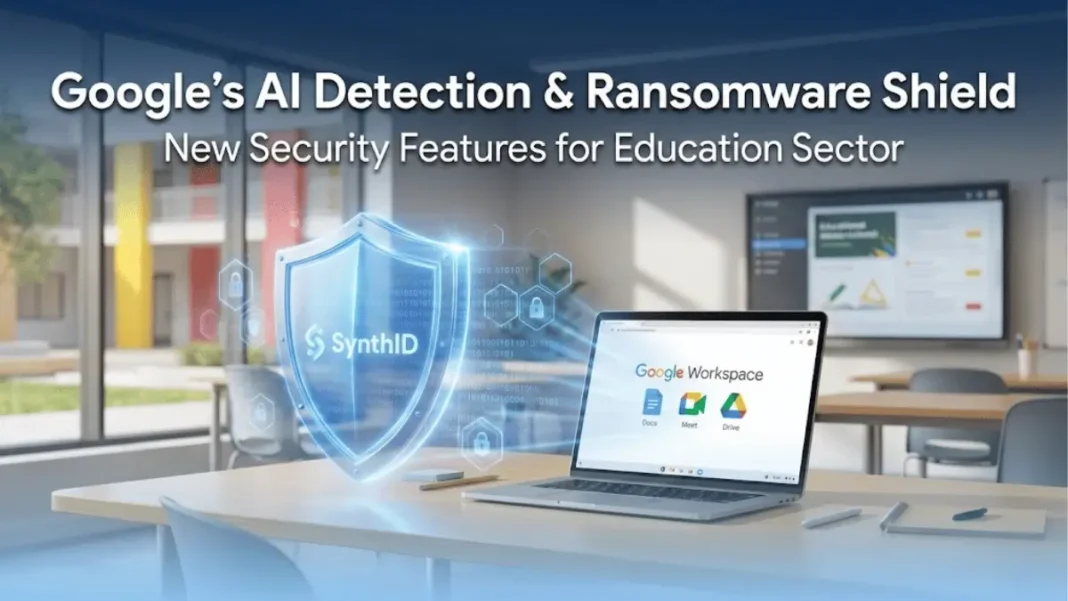
- The Launch: Google introduced SynthID AI verification, automated ransomware detection, and SecOps integration for Workspace for Education at Bett 2026
- The Impact: New security tools protect Education Plus and Standard subscribers against escalating cyber threats
- The Context: Education sector faced 180 ransomware attacks in 2025 with average demands of $444,400 generating nearly $80 million in ransom demands
- The Deployment: SynthID detection available now in Gemini app; ransomware protection rolling out to Drive for desktop users
Google announced a comprehensive security overhaul for Workspace for Education at the British Educational Training and Technology (Bett) conference in London on January 20, 2026. The deployment addresses escalating ransomware threats that generated over $80 million in ransom demands across the education sector in 2025.
SynthID AI Verification Architecture
Google integrated its invisible watermarking technology SynthID directly into the Gemini app, allowing educators and students to verify AI-generated content by uploading media and asking, “Is this AI-generated?”. The system detects images and videos created or edited by Google AI models, with planned expansion to audio files and non-Google models.
SynthID embeds machine-detectable markers that remain intact through content transformations while maintaining visual quality. Over 10 billion pieces of content have been watermarked since the technology’s deployment across Gemini, Imagen, Lyria, and Veo models. The detector highlights specific portions of uploaded content most likely to contain watermarks, providing granular verification at the segment level for video and audio files.
Drive Ransomware Detection System
Google deployed automated ransomware protection for Drive for desktop that immediately pauses cloud syncing when malicious activity is detected on a device. The system triggers simultaneous alerts to administrators through the Admin console and affected users, who can restore multiple files to pre-infection versions through a streamlined interface.
The timing addresses critical infrastructure vulnerabilities 95 of the 180 global education ransomware attacks in 2025 occurred in the United States, with confirmed incidents resulting in network disruptions lasting days to weeks. The PowerSchool breach in December 2024 compromised data from 60 million students and 10 million teachers, resulting in a $2.85 million ransom payment and lawsuits from over 100 school districts.

SecOps Integration for Education Plus
Education Plus and Education Standard subscribers gain access to the SecOps data connector, which forwards all Workspace activity logs including Gmail, Drive, and Calendar telemetry into the Google SecOps platform. The centralized architecture enables cross-platform threat detection, automated investigation workflows, and long-term audit archives for compliance requirements.
Security Feature Comparison
| Feature | Education Fundamentals | Education Standard | Education Plus |
|---|---|---|---|
| SynthID AI Detection | ✓ (Gemini app access) | ✓ | ✓ |
| Drive Ransomware Protection | ✓ (Drive for desktop) | ✓ | ✓ |
| SecOps Integration | ✗ | ✓ | ✓ |
| Meet Live Stream Controls | ✗ | ✓ | ✓ |
Google Meet Access Architecture
Google introduced granular access controls for Meet live streams through a new opt-in “Adaptive” meeting type. Hosts can restrict viewership to specific users or groups rather than entire domains, and control external participant access to broadcasts. Existing meetings retain current behaviors to prevent workflow disruptions during the transition.
AdwaitX Analysis: The $80M Security Mandate
The deployment directly responds to financial and operational damage from education cybercrime. With 2.6 terabytes of data stolen per confirmed attack and ransom demands averaging $444,400, institutions face escalating costs from ransom payments, system downtime, and breach remediation. Cherokee County School District’s March 2025 attack affected 46,000 individuals with 624 gigabytes compromised, resulting in week-long system outages.
Google’s integration of SynthID into Workspace creates a unified verification layer as generative AI adoption accelerates in educational settings. The SecOps connector positions Google to compete with enterprise security platforms by consolidating telemetry that previously required third-party solutions.
Regulatory and Deployment Timeline
Google confirmed the security features comply with FERPA, COPPA, and GDPR requirements. The company plans to expand SynthID verification to audio files and non-Google AI models in upcoming releases, though specific deployment dates remain unannounced. Drive ransomware protection requires the latest Drive for desktop client version, with automatic updates rolling out to managed devices through admin-controlled policies.
Frequently Asked Questions (FAQs)
What is SynthID and how does it work in Google Workspace for Education?
SynthID is an invisible digital watermark embedded in AI-generated images and videos. Users upload content to Gemini app to verify if it was created by Google AI.
How does Google Drive ransomware detection protect school data?
Drive for desktop automatically pauses cloud syncing when ransomware is detected, alerts admins and users, and enables multi-file restoration to pre-infection states.
Which Google Workspace Education editions include SecOps integration?
SecOps data connector is available exclusively to Education Plus and Education Standard subscribers, forwarding all Workspace activity logs to Google SecOps platform.
Why did Google prioritize ransomware protection for education?
Education faced 180 ransomware attacks globally in 2025 with average demands of $444,400, including the PowerSchool breach affecting 60 million students.

