

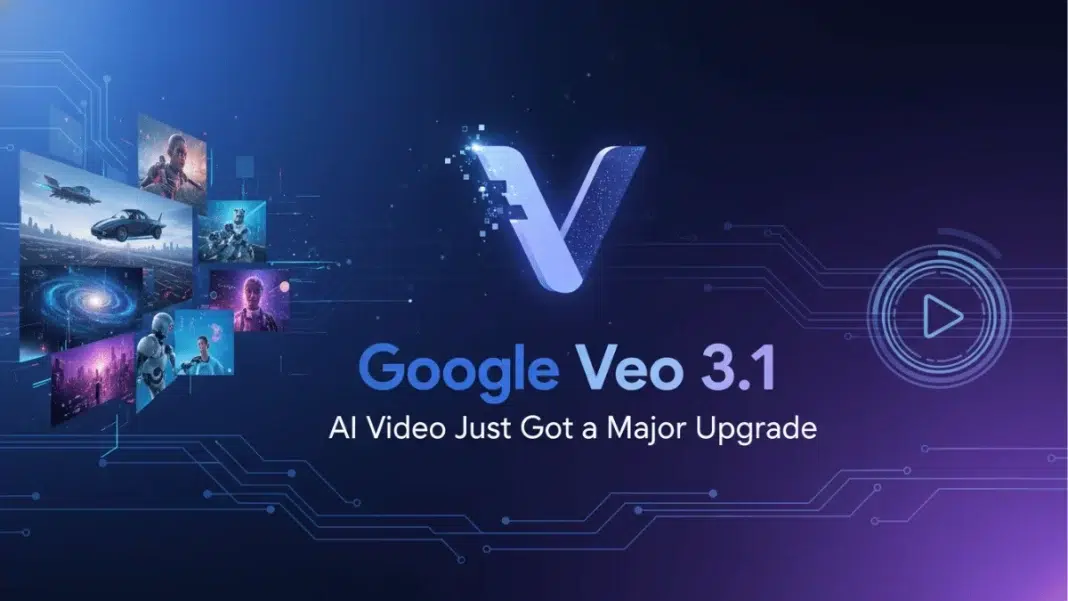
Veo 3.1 is Google’s latest AI video model with richer native audio, stronger prompt adherence, and better image-to-video quality. In Flow, you now get audio across key tools, plus more precise edits like adding new objects. Extend chains clips to a minute or more, useful for longer shots and transitions. Availability spans Flow, the Gemini app, the Gemini API, and Vertex AI.
Table of Contents
What is Google Veo 3.1?
Veo 3.1 is the newest version of Google’s video generation model. It focuses on realism, audio, and narrative control. You can run it inside Flow, access it in the Gemini app, or call it from the Gemini API and Vertex AI. A “Fast” variant offers cheaper, speed-optimized generations.
How it differs from Veo 3
The big changes are audio quality and control. Veo 3.1 tightens prompt adherence, keeps characters consistent across scenes better, and adds stronger image-to-video results. It also integrates with new creative flows like Ingredients to Video and First-and-Last Frame transitions.

Where you can use it today
- Flow: Google’s AI filmmaking tool for story-led projects.
- Gemini app: For quick access and experiments.
- Gemini API & Vertex AI: For developers and enterprises that want programmatic control, pipelines, and team workflows.
New features at a glance
Native audio upgrades
Veo 3.1 generates richer conversations, ambient sound, and synced effects. The goal is believable scenes without manual sound design on day one.
Ingredients to Video
Provide up to three reference images to control characters, objects, or style. Flow blends these “ingredients” into a coherent scene. This is the fastest way to keep a look and cast consistent.
Frames to Video (first and last frame)
Pick a starting image and an ending image. Veo 3.1 bridges the two with motion and audio, which is handy for reveal shots and before-after sequences.
Extend to a minute or more
Start with a short clip and chain “Extend” steps. Each new clip continues from the final second of the previous one. It’s ideal for building a longer establishing shot or stitching a simple scene.
Insert now, Remove soon
You can insert new elements into a scene and Flow will handle lighting and shadows so they blend in. Removal of objects is listed as “coming soon,” with Flow reconstructing the background.
Hands-on: your first Flow project
- Create a project and pick Veo 3.1
Open Flow, start a project, and select Veo 3.1. Select a feature: Text to Video, Ingredients to Video, Frames to Video, or Extend. - For a short ad shot, try Ingredients
Add three images: your character, a product shot, and a style frame. Keep the prompt short and clear. If the first pass is off, tweak the ingredient set before rewriting the prompt. - Bridge two art frames with Frames to Video
Upload an opening frame and a closing frame. Aim for similar composition so motion feels natural. Think reveal shots, logo wipes, or environment pans. - Extend thoughtfully
Use Extend at scene boundaries to avoid visual seams. Since each extension depends on the last second of the prior clip, plan your cuts. Avoid tiny subjects entering frame at the end; they can dominate the next shot. - Polish with Insert
If you forgot a detail, use Insert to add it. Flow accounts for shadows and light so the new object fits the scene. Keep additions small to reduce artifacts.
Pricing and cost math
- Gemini API pricing (per second): Veo 3.1 Standard ~$0.40, Veo 3.1 Fast ~$0.15. A 30-second Standard clip is about $12; a 60-second chain would be about $24 before retries. Teams can mix Fast for drafts and Standard for finals.
- Flow subscriptions: Flow is part of Google AI subscriptions with credit buckets and trial offers shown on the Flow About page. Check India availability on the same page before purchase.
Veo 3 vs Veo 3.1 vs Flow features (at a glance)
| Feature | Veo 3 | Veo 3.1 | In Flow now |
|---|---|---|---|
| Richer native audio | Basic | Improved speech, ambience, SFX | Enabled across key features |
| Ingredients to Video | Limited | Up to 3 reference images | Yes |
| Frames to Video | Limited | First-and-last frame with audio | Yes |
| Extend | Short chains | “Minute or more” via clip chaining | Yes |
| Insert object | N/A | Yes | Yes |
| Remove object | N/A | Coming soon | Coming soon |
Mini case study 1: 15-sec ad beat
Goal: 3-shot product teaser.
Approach: Ingredients to lock brand colors and product angles, then Frames to Video for the logo reveal, final polish with Insert for reflections. Estimated API cost for a 15-second Standard pass: ~$6, drafts in Fast for ~$2.25.
Mini case study 2: 30-sec vertical reel
Goal: City walk with character carryover.
Approach: Two 8-second base shots with consistent character, one Frames transition, then two Extend steps to reach ~30 seconds. Sound bed from Veo 3.1. Estimated Standard cost ~$12, with a Fast-first workflow to iterate cheaply.
What’s still coming or limited
- Object removal is slated as “coming soon.” Build timelines with Insert today and plan cleanup later.
- API guide shows 8-second base generations at 720p or 1080p, with longer lengths assembled using Extend.
- Not every user flow will feel “cinema-real.” Expect iteration on complex motion and lighting.
Why it matters
Flow has already powered hundreds of millions of generations, which signals creator comfort with the tool. The Veo 3.1 jump focuses on the practical pain points: audio, longer beats, and small surgical edits. For marketers, short-form teams, and pre-viz, it fills gaps without a heavy VFX stack.
Frequently Asked Questions (FAQs)
Is Veo 3.1 available in India?
Flow notes global availability across many countries. Check Flow’s About page and FAQ for your region before subscribing.
What’s the difference between Veo 3.1 Standard and Fast?
Standard targets higher fidelity, Fast is cheaper and good for drafts. Both are in paid preview via the Gemini API.
What are per-second API prices?
Veo 3.1 Standard is about $0.40 per second, Fast about $0.15 per second. You’re charged only on successful generations.
How long are base generations in the API?
The API docs show 8-second generations at 720p or 1080p. Longer videos are built by chaining.
Does Veo 3.1 handle dialogue and ambience?
Yes, the model targets richer native audio, from conversations to synced effects.
Can I insert or remove objects mid-scene?
Insert is available; Remove is coming soon.
Is it in the Gemini app and Flow?
Yes, Veo 3.1 is available in both, plus Gemini API and Vertex AI.
How many videos has Flow generated?
Over 275 million, including Veo 2 and Veo 3 generations.
Featured Snippet Boxes
What is Google Veo 3.1?
It’s Google’s latest AI video model focused on richer audio, better prompt adherence, and improved image-to-video results. You can use it in Flow, the Gemini app, the Gemini API, and Vertex AI.
Can Veo 3.1 make 1-minute videos?
Yes, using Extend in Flow or the API. You chain clips, with each new segment continuing from the final second of the prior one to keep continuity.
How do Ingredients and Frames work?
Ingredients lets you guide scenes with up to three reference images. Frames builds a smooth video between a chosen first and last frame, complete with audio.
What’s coming soon in Flow?
Object removal. Flow will reconstruct the background so it appears as if the item was never there. Plan timelines assuming this ships later.

