

Quick Brief
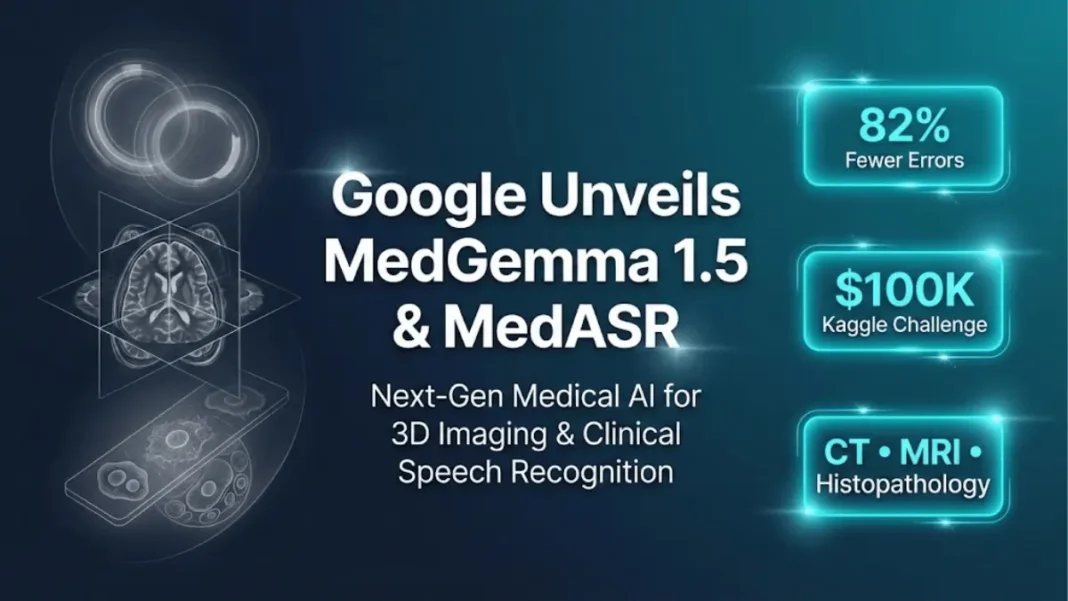
- The Launch: Google released MedGemma 1.5 4B and MedASR on January 13, 2026, expanding support for CT, MRI, and histopathology imaging with a $100,000 Kaggle hackathon
- The Impact: Healthcare organizations adopting AI at 22% 2.2x faster than the broader economy gain open-source tools for clinical workflows, medical transcription, and diagnostic support
- The Context: AI in healthcare market reached $52.28 billion in 2026, up from $37.98 billion in 2025, projected to hit $928 billion by 2035 as regulatory frameworks solidify
Google Research announced MedGemma 1.5 and MedASR on January 13, 2026, introducing expanded multimodal capabilities for three-dimensional medical imaging and clinical speech recognition. The release addresses developer feedback from millions of downloads of MedGemma 1, which generated hundreds of community-built variants on Hugging Face since its 2025 debut. Both models remain free for research and commercial use through Hugging Face and Google Cloud’s Vertex AI.
What’s New in MedGemma 1.5
MedGemma 1.5 4B processes high-dimensional medical imaging across CT scans, MRI volumes, and whole-slide histopathology marking the first public open multimodal large language model with these capabilities. Performance gains over MedGemma 1 4B include 3% absolute accuracy improvement on CT disease classification (61% vs 58%) and 14% on MRI findings (65% vs 51%). Histopathology analysis improved significantly, with ROUGE-L scores jumping from 0.02 to 0.49, matching the specialized PolyPath model.
The model delivers 35% higher intersection-over-union scores for anatomical localization on Chest ImaGenome benchmarks (38% vs 3%) and 5% better accuracy on longitudinal chest X-ray reviews using MS-CXR-T data. Text-based capabilities advanced 5% on MedQA (69% vs 64%) and 22% on electronic health record question-answering with EHRQA datasets (90% vs 68%). Google Cloud deployments now include full DICOM support for streamlined medical imaging integration.
Why It Matters: Market Timing and Strategic Context
Healthcare organizations are implementing domain-specific AI tools at 22% 2.2x faster than the broader economy, according to Menlo Ventures and Morning Consult research. The AI in healthcare market reached $52.28 billion in 2026, up from $37.98 billion in 2025, with projections targeting $928 billion by 2035 at a compound annual growth rate of 37.66%. The EU AI Act effective August 1, 2024 requires mandatory risk management reviews for diagnostic algorithms.
MedASR directly addresses clinical documentation burden, an area where healthcare networks are rapidly deploying AI-powered tools for patient interactions. The model achieved 58% fewer transcription errors on chest X-ray dictations compared to Whisper large-v3 (5.2% vs 12.5% word error rate) and 82% fewer errors on diverse medical dictation benchmarks (5.2% vs 28.2% WER). Malaysia’s Ministry of Health reports the conversational interface built with MedGemma improved navigation of 150+ clinical practice guidelines through the askCPG system deployed by Qmed Asia.
Technical Specifications Comparison
| Feature | MedGemma 1.5 4B | MedGemma 1 4B | Improvement |
|---|---|---|---|
| CT Disease Classification | 61% accuracy | 58% accuracy | +3% |
| MRI Findings Classification | 65% accuracy | 51% accuracy | +14% |
| Histopathology ROUGE-L | 0.49 score | 0.02 score | +0.47 |
| Anatomical Localization (IoU) | 38% | 3% | +35% |
| MedQA Text Performance | 69% | 64% | +5% |
| EHRQA Text Performance | 90% | 68% | +22% |
| MedASR vs Whisper large-v3 | Medical Dictation WER | CXR Dictation WER | Error Reduction |
|---|---|---|---|
| MedASR | 5.2% | 5.2% | 58-82% fewer |
| Whisper large-v3 | 28.2% | 12.5% | Baseline |
MedGemma 1.5 supports CT and MRI through multiple slice inputs and whole-slide histopathology via multiple patch processing. The 27B parameter version remains available for complex text-based clinical applications requiring higher computational capacity.
What’s Next: Developer Ecosystem and Regulatory Pathways
The MedGemma Impact Challenge hackathon on Kaggle offers $100,000 in prizes to developers building healthcare and life sciences applications. Taiwan’s National Health Insurance Administration applied MedGemma to analyze 30,000 pathology reports for lung cancer surgical decision-making, demonstrating policy-level implementation. Google released tutorial notebooks covering CT interpretation, histopathology analysis, anatomical localization, longitudinal imaging, and reinforcement learning-based fine-tuning.
HAI-DEF models including MedSigLIP image encoder remain accessible through the Health AI Developer Foundations program, with technical support via dedicated forums. Google emphasizes that outputs require independent verification and clinical correlation before deployment in patient care applications. Regulatory uncertainty continues to shape adoption timelines, particularly in regions subject to the EU AI Act’s mandatory device reviews.
Frequently Asked Questions (FAQs)
What is MedGemma 1.5 and how does it differ from previous versions?
MedGemma 1.5 4B is an open multimodal medical AI model supporting 3D CT/MRI imaging and whole-slide histopathology, improving accuracy by 3-35% over MedGemma 1 across imaging tasks.
Can developers use MedGemma 1.5 for commercial applications?
Yes. MedGemma 1.5 and MedASR are free for both research and commercial use via Hugging Face and Google Cloud Vertex AI.
How accurate is MedASR compared to general speech recognition models?
MedASR achieves 5.2% word error rate on medical dictation 82% fewer errors than Whisper large-v3’s 28.2% rate.
What is the prize pool for the MedGemma Impact Challenge?
The Kaggle-hosted hackathon offers $100,000 in prizes for developers building healthcare AI applications with MedGemma and HAI-DEF models.
Which healthcare organizations are currently using MedGemma?
Malaysia’s Ministry of Health deployed askCPG with MedGemma for clinical guidelines, and Taiwan’s National Health Insurance Administration analyzed 30,000 pathology reports for surgical policy decisions.

