

Quick Brief
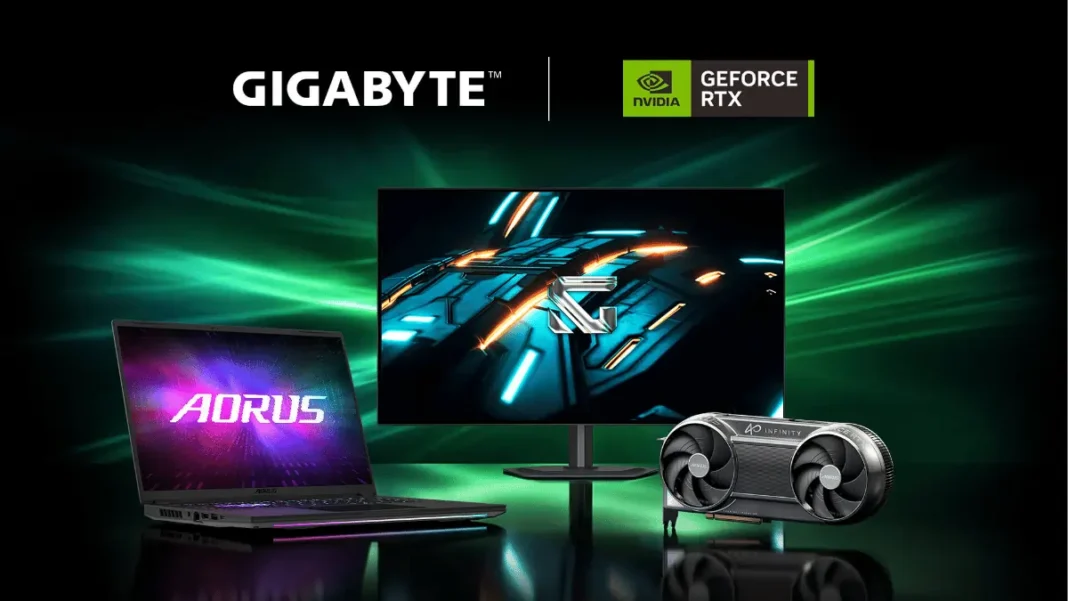
- The Partnership: GIGABYTE unveils flagship RTX 5090 graphics cards with 32GB GDDR7, AI-enabled laptops, and G-SYNC monitors built on NVIDIA’s Blackwell architecture, announced January 16, 2026.
- The Impact: Targets professional creators and gamers with integrated AI workflows through NVIDIA DLSS 4 and GIGABYTE’s proprietary GiMATE software agent.
- The Technology: AORUS RTX 5090 INFINITY features 21,760 CUDA cores and WINDFORCE HYPERBURST cooling delivering 28% improved thermal performance.
- The Context: Launch strengthens GIGABYTE’s ecosystem amid industry GDDR7 memory constraints, with confirmed bundled GPU-memory supply from NVIDIA.
GIGABYTE announced a deepened strategic collaboration with NVIDIA on January 16, 2026, introducing a product ecosystem spanning graphics cards, mobile workstations, and displays built on the Blackwell GPU architecture. The Taiwan-based hardware manufacturer positioned the launch as a response to accelerating demand for on-device AI computing in gaming and content creation workflows.
RTX 5090 INFINITY: Blackwell Architecture with Enhanced Thermal Engineering
The AORUS GeForce RTX 5090 INFINITY anchors GIGABYTE’s graphics card lineup with 21,760 CUDA cores and 32GB of GDDR7 memory on a 512-bit interface. The card leverages NVIDIA’s Blackwell architecture with 5th-generation Tensor Cores to deliver accelerated performance for real-time rendering and generative AI workloads.
GIGABYTE addresses thermal requirements through its WINDFORCE HYPERBURST system, achieving 28% improved cooling performance over previous generations. The architecture combines a separated PCB design with patented Hawk fans, an auxiliary Overdrive Fan, and superconducting heat pipes with composite metal grease. The circular heatsink design and die-cast metal backplate reflect GIGABYTE’s positioning toward premium workstation markets.
The card integrates NVIDIA DLSS 4 frame generation technology, which uses neural networks to multiply rendered frames and sustain higher frame rates without proportional GPU load increases.
Mobile AI Integration Through AORUS MASTER 16 Laptop
The AORUS MASTER 16 laptop deploys GeForce RTX mobile GPUs with NVIDIA Studio certification, ensuring driver stability across Adobe Creative Cloud, Autodesk, and DaVinci Resolve applications. GIGABYTE’s WINDFORCE Infinity EX thermal system handles 230W of thermal design power in a mobile chassis.
GiMATE, GIGABYTE’s proprietary AI agent, consolidates system profiles and application shortcuts into context-aware modes with “Press and Speak” voice activation. The software operates locally rather than cloud-dependent, positioning it for users in regulated industries or bandwidth-constrained environments. NVIDIA Studio Drivers complement GiMATE by providing application-specific optimizations and priority updates for creative software.
Display Ecosystem: G-SYNC Compatibility Across Three Monitor Lines
GIGABYTE expanded its monitor portfolio with three G-SYNC Compatible models: the ultrawide MO34WQC36, 4K MO32U24, and high-refresh MO27Q28GR. G-SYNC technology synchronizes display refresh rates with GPU frame output, eliminating screen tearing in variable frame rate scenarios common to ray-traced games.
The monitors include Tactical Switch 2.0, enabling instant resolution changes to 4:3 or 5:4 aspect ratios favored in competitive esports titles. Aim Stabilizer inserts black frames to reduce motion blur during rapid camera movements, a feature targeting first-person shooter players. These displays complement GIGABYTE’s RTX GPU ecosystem by maintaining visual fluidity across the performance spectrum.
AdwaitX Analysis: Strategic Response to Client-Side AI Computing
GIGABYTE’s partnership expansion reflects broader industry migration toward on-device AI execution. The integration of NVIDIA Studio with GiMATE addresses a persistent pain point in creator workflows: application-specific performance tuning without manual driver management. By bundling AI agents with RTX hardware, GIGABYTE positions against competitors offering GPU performance without software differentiation.
The timing coincides with GPU supply constraints, particularly for GDDR7 memory used in RTX 5090 cards. GIGABYTE CEO Eddie Lin confirmed on January 15, 2026, that the company continues receiving bundled GPU-memory packages from NVIDIA, a supply advantage over smaller manufacturers. Lin stated that NVIDIA maintains its traditional bundling approach despite industry speculation about supply chain changes.
The emphasis on local AI processing through GiMATE indicates GIGABYTE’s strategy to differentiate beyond hardware specifications. The AI agent enables personalized computing experiences while maintaining data sovereignty, critical for enterprise and professional users.
Technical Specifications
| Component | Specification | Technology Integration |
|---|---|---|
| GPU Architecture | NVIDIA Blackwell | 5th-gen Tensor Cores |
| CUDA Cores | 21,760 | RTX 5090 INFINITY |
| Memory | 32GB GDDR7 | 512-bit interface |
| Desktop Cooling | WINDFORCE HYPERBURST | 28% improved performance |
| Laptop TDP | 230W sustained | WINDFORCE Infinity EX |
| AI Framework | NVIDIA DLSS 4 | Neural frame generation |
| Display Technology | G-SYNC Compatible | Variable refresh rate |
| Software Agent | GiMATE | Local AI processing |
Product Availability
GIGABYTE showcased the RTX 5090 INFINITY series and AORUS MASTER 16 laptops at CES 2026. The RTX 5090 INFINITY is listed on GIGABYTE’s official product pages with full specifications available. The AORUS MASTER 16 appears in regional listings with confirmed RTX mobile GPU configurations.
Frequently Asked Questions (FAQs)
What does GIGABYTE’s NVIDIA partnership include?
The collaboration delivers RTX 5090 graphics cards with 32GB GDDR7, AI-enabled laptops with NVIDIA Studio certification, and G-SYNC Compatible monitors.
What is NVIDIA Blackwell architecture?
Blackwell is NVIDIA’s GPU architecture featuring 5th-generation Tensor Cores for AI workloads and DLSS 4 frame generation technology.
What is GiMATE software?
GiMATE is GIGABYTE’s AI agent providing mode-based system controls and voice-activated shortcuts, operating locally without cloud connectivity requirements.
How does WINDFORCE HYPERBURST cooling perform?
The system delivers 28% improved cooling performance using separated PCB design, superconducting heat pipes, and Overdrive Fan technology.

