

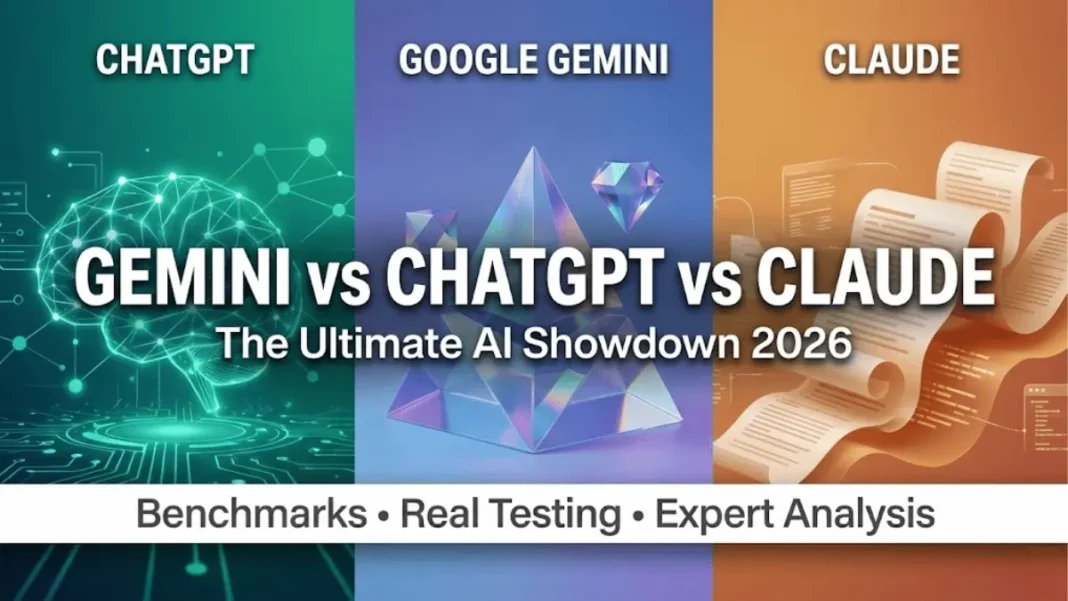
Summary: ChatGPT holds 68% market share but dropped 19 points in 2026 as Gemini surged to 18%. ChatGPT (GPT-5) leads in creative writing and versatile conversations with 95% coding correctness. Gemini 3 Pro dominates multimodal tasks with a 1M token context window and deep Google Workspace integration. Claude Sonnet 4.5 excels at long-document analysis (200k tokens), ethical reasoning, and natural writing tone with minimal hallucinations. All three cost $20/month for premium tiers. Choose ChatGPT for general use and creativity, Gemini for Google integration and research, Claude for precision writing and coding.
The AI chatbot landscape shifted dramatically in 2026, with ChatGPT losing 19 percentage points of market share while Google Gemini surged from 5.4% to 18.2%. For the first time since ChatGPT’s launch, the “best AI” answer isn’t obvious each platform now excels in different scenarios based on hands-on testing and real-world benchmarks.
Which AI Chatbot Actually Wins in 2026?
There’s no single winner ChatGPT leads in creative writing and general conversations, Gemini dominates multimodal tasks and Google integration with a 1M token context window, while Claude excels at long-document analysis and precision coding with 200k token capacity and minimal hallucinations.
The “best” AI depends entirely on your workflow. ChatGPT maintains the largest user base with 800 million weekly active users and 68% market share. However, capability gaps have narrowed substantially Google’s aggressive 2025 model releases and Claude’s ethical reasoning advances ended OpenAI’s near-monopolistic technical advantage.
According to January 2026 Similarweb data, this marks the most significant market shift in generative AI history. The duopoly of ChatGPT and Gemini now controls 86.2% of the market, with Claude carving a distinct niche among developers and writers seeking precision over speed.
Understanding the Big Three AI Models
ChatGPT (OpenAI GPT-5/4o)
OpenAI’s GPT-5 and GPT-4o power ChatGPT, offering the most versatile conversational AI available in 2026. The platform supports over 80 languages and maintains both short-term and long-term memory of user preferences. Users can ask “What do you remember about me?” to review stored information or clear data as needed.
ChatGPT’s standout feature is its natural conversational flow and ability to maintain context through complex multi-turn discussions. The platform achieved 74.9% on SWE-bench Verified coding tests and 88% on AIME 2025 mathematical reasoning benchmarks. For creative tasks like storytelling, brainstorming, and content generation, ChatGPT produces the most human-like text with varied tone and style.
Google Gemini (Gemini 3 Pro/Flash)
Gemini 3 Pro represents Google’s multimodal-first approach, natively processing text, images, audio, and video simultaneously. The platform offers a massive 1 million token context window in the Pro version equivalent to hundreds of pages processed in a single conversation.
Gemini’s Deep Research mode conducts autonomous online research across websites, PDFs, and images to produce detailed analyses. The Live feature enables real-time screen or camera sharing, allowing Gemini to answer questions about what’s currently displayed. On multimodal benchmarks, Gemini Ultra achieved a state-of-the-art 59.4% score on MMMU, measuring reasoning across diverse content types.
Google’s ecosystem integration gives Gemini unique advantages it connects seamlessly with Gmail, Google Docs, Sheets, YouTube, and other workspace tools. Monthly active users expanded from 450 million in July 2025 to 650 million by October, representing 44% growth in just three months.
Claude (Sonnet 4.5/Opus 4.1)
Anthropic’s Claude stands out for its empathetic, ethical approach to AI conversations and minimal hallucination rates. Claude Sonnet 4.5 and Opus 4.1 support approximately 200,000 token context windows (expandable to 1 million for Opus), making them ideal for processing lengthy documents like legal contracts or research papers.
Claude’s writing style tends to be more naturally human and nuanced out-of-the-box compared to competitors. In side-by-side tests, Claude produced content with more varied sentence structure, less repetitive phrasing, and superior tone matching. The platform excels at step-by-step reasoning, breaking complex tasks into manageable components for improved precision.
For developers, Claude offers advanced computer control capabilities, allowing AI agents to perform tasks directly on your system. The platform achieved 67.2% on SWE-Bench Verified with multiple attempts, though ChatGPT’s GPT-4o still provides more consistent initial coding results.

Head-to-Head Performance Benchmarks
Coding Accuracy and Speed
ChatGPT GPT-5 leads coding performance with 95% correctness vs Gemini’s 90%, 74.9% on SWE-bench Verified, and 88% on Aider Polyglot benchmarks, while executing slightly slower (0.03s vs 0.02s).
Testing results reveal clear distinctions in coding workflows:
| Metric | ChatGPT GPT-5 | Gemini 2.5 Pro | Winner |
|---|---|---|---|
| Correctness | 95% | 90% | ChatGPT |
| Execution Time | 0.03s | 0.02s | Gemini |
| Readability | 4.5/5 | 4.0/5 | ChatGPT |
| Reasoning | 4.2/5 | 3.8/5 | ChatGPT |
ChatGPT excels at multi-step logic and debugging, producing clean, readable code particularly strong for frontend tasks. Gemini 2.5 models deliver compact snippets that drop neatly into projects but occasionally skip reasoning or edge cases. Claude performs best for complex instructions and enormous document processing, making it ideal for code reviews and architectural decisions.
Writing Quality and Tone
Claude demonstrates superior natural writing with less editing required for tone and style. ChatGPT provides polished, well-structured drafts but sometimes falls into overly formal or clichéd phrasing without specific guidance. Gemini delivers precise, data-oriented responses better suited for technical content and research summaries.
One creator’s guide noted that “while ChatGPT can sometimes feel robotic or overly emphatic, Claude has the capacity to be more down-to-earth and natural in its writing style”. For creative hobbies like novel writing or RPG campaigns, ChatGPT excels at generating characters, dialogues, and plot ideas, while Claude maintains better coherence across lengthy planning sessions.
Research and Factuality
Claude leads factuality with minimal hallucinations, Gemini offers real-time web access and Deep Research mode for multi-source analysis, while ChatGPT achieves 54% on SimpleQA and 87.8% on FACTS grounding benchmarks.
Claude’s minimal hallucination rate makes it the most reliable choice for research requiring high accuracy. Gemini’s real-time information access and ability to navigate across websites, PDFs, and images provides the most comprehensive research capabilities. ChatGPT scores 54% on SimpleQA factuality tests, showing strong performance on structured questions but decreased accuracy on edge cases.
Context Windows and Memory Capabilities
Context window size directly impacts how much information an AI can process simultaneously:
- Gemini 3 Pro: 1,000,000 tokens (~750,000 words)
- Claude Opus 4.1: Up to 1,000,000 tokens
- Claude Sonnet 4.5: 200,000 tokens
- ChatGPT GPT-4o: 128,000 tokens
However, raw token counts don’t tell the complete story. ChatGPT maintains 58% performance at 128k tokens but drops to 16.4% at 1M tokens, indicating limitations for extremely long-context tasks. Claude excels at actually utilizing its large context window, maintaining reasoning quality throughout lengthy documents.
ChatGPT’s unique memory feature stores user preferences across sessions, creating personalized experiences over time. This creates “magical moments” where the AI recalls your working style, project details, or personal preferences from previous conversations.
Pricing Breakdown: What You Actually Pay
All three platforms offer competitive pricing tiers:
| Plan | ChatGPT | Gemini | Claude |
|---|---|---|---|
| Free Tier | ✓ Limited GPT-4o | ✓ Basic access | ✓ Sonnet 4.5 (limited) |
| Individual ($20/mo) | Plus (GPT-4o, o1) | Advanced (Pro access) | Pro (5x usage) |
| Premium Tier | Pro ($200/mo unlimited) | – | Max ($40-60/mo) |
| Team ($25-30/mo/user) | ✓ | Code Assist ($19-45) | ✓ (min 5 users) |
ChatGPT offers a budget option in select countries like India at ₹399/month (~$4-5 USD) with higher usage limits than the free tier. For API usage, Gemini 3 Pro costs $2 per million input tokens and $12 per million output tokens for contexts under 200k tokens.
The expensive reality: Subscribing to ChatGPT Plus ($20), Claude Pro ($20), and Gemini Advanced ($20) totals $60 monthly or $720 annually. Multi-model platforms like AiZolo consolidate access for $9.90/month, saving over $50 monthly.
Real-World Use Case Testing
Best AI for Students and Learning
ChatGPT remains the top choice for students due to its versatile explanations, instant study guides, and multilingual support. It excels at breaking down difficult subjects into simpler explanations with examples, analogies, and step-by-step reasoning. Students can request flashcards, practice quizzes, or essay outlines on any topic.
Google Gemini works best for research projects and summarizing academic topics using up-to-date information. Its integration with Google Workspace makes it convenient for students already using Google Docs and Drive. Wolfram Alpha remains essential for math, statistics, and physics problems requiring step-by-step solutions.
For programming students, GitHub Copilot combined with ChatGPT or Claude provides the most comprehensive coding support.
Best AI for Developers and Coding
Claude wins for developers needing precision, complex instruction-following, and processing enormous codebases. It excels at code reviews, architectural decisions, and debugging complex logic with minimal API hallucinations. Claude’s computer control features enable AI agents to execute tasks directly on your system.
ChatGPT provides the most consistent results for day-to-day development, particularly frontend tasks and rapid prototyping. Its tool integration and plugin ecosystem make it ideal for flexible workflows. Gemini performs well within Google-based development environments and offers predictable output for short coding tasks.
Practical developer tip: Break tasks into smaller steps and avoid letting any AI start writing code before providing full context this reduces errors and over-engineering across all platforms.
Best AI for Content Writers
Claude requires the least editing for tone and produces the most naturally human content. One practical comparison found Claude “more down-to-earth and natural in its writing style” with more varied sentence structure. For long-form content, Claude’s massive context window maintains coherence across extensive documents.
ChatGPT generates the flashiest first drafts with polished structure, making it ideal for brainstorming and creative writing. However, writers should fine-tune output for originality to avoid clichéd phrasing. Gemini works best for data-driven content, technical writing, and research-heavy articles requiring real-time information.
Best AI for Business and Research
Gemini dominates business scenarios involving Google Workspace. It can analyze sales data exported to Google Sheets, spot trends, and generate product descriptions from photos. The Deep Research mode produces comprehensive multi-source analyses ideal for market research and competitive intelligence.
Claude excels at processing lengthy business documents like contracts, compliance reports, and strategic plans. Its minimal hallucination rate makes it the safest choice for high-stakes decision-making requiring accuracy. ChatGPT provides the most versatile general business support with strong plugin integrations for CRM, project management, and automation tools.
Integration and Ecosystem Advantages
Platform integration often determines real-world utility more than raw performance metrics:
Gemini offers unmatched Google ecosystem integration Gmail, Docs, Sheets, Calendar, YouTube, and Maps. Users already working in Google Workspace experience seamless workflows without platform switching. This convenience factor drove Gemini’s 44% user growth in Q3 2025.
ChatGPT provides the richest third-party plugin ecosystem, connecting to thousands of tools for specialized tasks. Microsoft Copilot integration offers similar advantages for Windows and Microsoft 365 users.
Claude maintains a more limited integration ecosystem but offers superior API capabilities for developers building custom AI agents and automation.
Current Market Share and Adoption Trends
January 2026 Similarweb data reveals dramatic market shifts:
- ChatGPT: 68% (down from 87.2% in January 2025)
- Gemini: 18.2% (up from 5.4% in January 2025)
- Others (including Claude, Copilot, Perplexity): 13.8%
Market Share Changes (Jan 2025 → Jan 2026):
| Platform | Jan 2025 | Jan 2026 | Change |
|---|---|---|---|
| ChatGPT | 87.2% | 68.0% | -19.2 pts ⬇️ |
| Google Gemini | 5.4% | 18.2% | +12.8 pts ⬆️ |
| Others | 7.4% | 13.8% | +6.4 pts ⬆️ |
ChatGPT’s 19.2 percentage point decline marks OpenAI’s most significant competitive challenge since launch. However, 800 million weekly users demonstrates continued relevance. Gemini’s referral traffic to external websites grew 388% year-over-year compared to ChatGPT’s 52%, revealing deeper engagement patterns.
Mobile dominance drives growth platforms optimizing for mobile-first experiences show stronger adoption than desktop-focused competitors. Gemini’s monthly active user base reached 650 million by October 2025, with 77.9% of interactions occurring on mobile devices.
Pros and Cons Side-by-Side
- Most versatile general-purpose AI with natural conversations
- Superior creative writing and brainstorming
- Best memory and personalization features
- Largest plugin ecosystem and third-party integrations
- Multilingual support (80+ languages)
- Most expensive premium tier ($200/mo for unlimited)
- Occasional factual errors when citing internet sources
- Smallest context window (128k tokens)
- Performance drops significantly at extreme context lengths
- Best multimodal capabilities (text, image, audio, video)
- Largest context window (1M tokens) with real-time web access
- Seamless Google Workspace integration
- Deep Research mode for comprehensive analysis
- Most affordable API pricing
- Inconsistent response quality with potential hallucinations
- Limited third-party integrations beyond Google services
- Latency can increase 20% under heavy loads
- Higher subscription cost for advanced features ($20/mo required for best capabilities)
- Most natural, human-like writing with minimal editing needed
- Highest factual accuracy with minimal hallucinations
- Excellent long-document processing (200k-1M tokens)
- Superior ethical reasoning and instruction-following
- Best for precision coding and complex analysis
- Smallest user base and ecosystem
- Fewer integrations compared to competitors
- Can be verbose or over-cautious in responses
- No native web search (relies on training data)
Which AI Should You Choose?
Choose ChatGPT for versatile general use, creative writing, and rich plugin integrations; Gemini for Google Workspace users needing multimodal research and real-time information; Claude for precision writing, long-document analysis, and ethical AI reasoning.
Pick ChatGPT if you:
- Need the most versatile all-purpose AI
- Value creative writing and natural conversations
- Want personalized memory across sessions
- Require extensive third-party tool integrations
- Prefer the largest user community for support
Pick Gemini if you:
- Work primarily in Google Workspace
- Need multimodal processing (images, video, audio)
- Require real-time web information and research
- Want the longest context window (1M tokens)
- Value budget-friendly API pricing for development
Pick Claude if you:
- Prioritize writing quality and natural tone
- Process lengthy documents regularly
- Need minimal hallucinations for accuracy-critical work
- Focus on complex coding and architectural tasks
- Value ethical AI reasoning and transparency
Many professionals use multiple AIs strategically ChatGPT for brainstorming, Gemini for research within Google Docs, and Claude for final editing and precision tasks. Multi-model platforms consolidate access at lower cost than individual subscriptions.
Frequently Asked Questions
Is ChatGPT still the best AI in 2026?
ChatGPT maintains the largest user base (800 million weekly users) and most versatile capabilities, but “best” depends on your use case. Gemini surpassed ChatGPT for multimodal tasks and Google integration, while Claude leads in writing quality and factual accuracy. ChatGPT’s market share dropped from 87.2% to 68% in 2026 as competitors closed capability gaps.
Which AI has the longest context window?
Gemini 3 Pro and Claude Opus 4.1 both support 1 million tokens approximately 750,000 words or hundreds of pages. However, Claude utilizes its large context more effectively, maintaining reasoning quality throughout lengthy documents. ChatGPT’s 128,000 token window is the smallest but includes superior memory features that persist across sessions.
What’s the cheapest way to access all three AIs?
Individual subscriptions cost $20/month each ($60 total for ChatGPT Plus, Gemini Advanced, and Claude Pro). Multi-model platforms like AiZolo provide access to all premium models for $9.90/month, saving over $50 monthly. Free tiers offer limited access: ChatGPT provides basic GPT-4o, Gemini offers standard features, and Claude includes Sonnet 4.5 with usage resets every 5 hours.
Which AI is best for coding in 2026?
ChatGPT GPT-5 leads with 95% coding correctness and 74.9% on SWE-bench Verified tests. Claude excels at complex instructions, code reviews, and processing enormous codebases with minimal API hallucinations. Gemini performs well for predictable output in Google-based workflows but may skip edge cases. Most developers use ChatGPT for day-to-day tasks and Claude for architectural decisions.
Does Gemini or ChatGPT hallucinate more?
Claude has the lowest hallucination rate among the three. ChatGPT achieves 54% on SimpleQA factuality and 87.8% on FACTS grounding benchmarks, showing good accuracy on structured questions but decreased performance on edge cases. Gemini can produce inconsistent responses with potential hallucinations, particularly under heavy loads. For accuracy-critical work, Claude is the safest choice.
Which AI works best for students?
ChatGPT leads for students due to versatile explanations, instant study guides, multilingual support, and 24/7 availability. It excels at breaking down difficult concepts with examples and analogies. Gemini works well for research projects and real-time information. Wolfram Alpha remains essential for math and physics step-by-step solutions. Most students benefit from combining ChatGPT for general learning with specialized tools for specific subjects.
Can I use all three AIs for free?
Yes, with limitations. ChatGPT offers free access to GPT-4o with usage caps, Gemini provides basic features at no cost, and Claude includes free Sonnet 4.5 access with resets every 5 hours. Free tiers work well for casual use but lack advanced features like unlimited usage, priority access, and premium models. Students and researchers should explore educational discounts or multi-model platforms for better value.
Which AI is most accurate for research?
Claude leads in factual accuracy with minimal hallucinations, making it ideal for research requiring precision. Gemini’s Deep Research mode and real-time web access provide the most comprehensive multi-source analysis. ChatGPT offers good general research capabilities but scores lower on factuality benchmarks (54% SimpleQA). For academic or professional research, combine Claude’s accuracy with Gemini’s research breadth.

