

Quick Brief
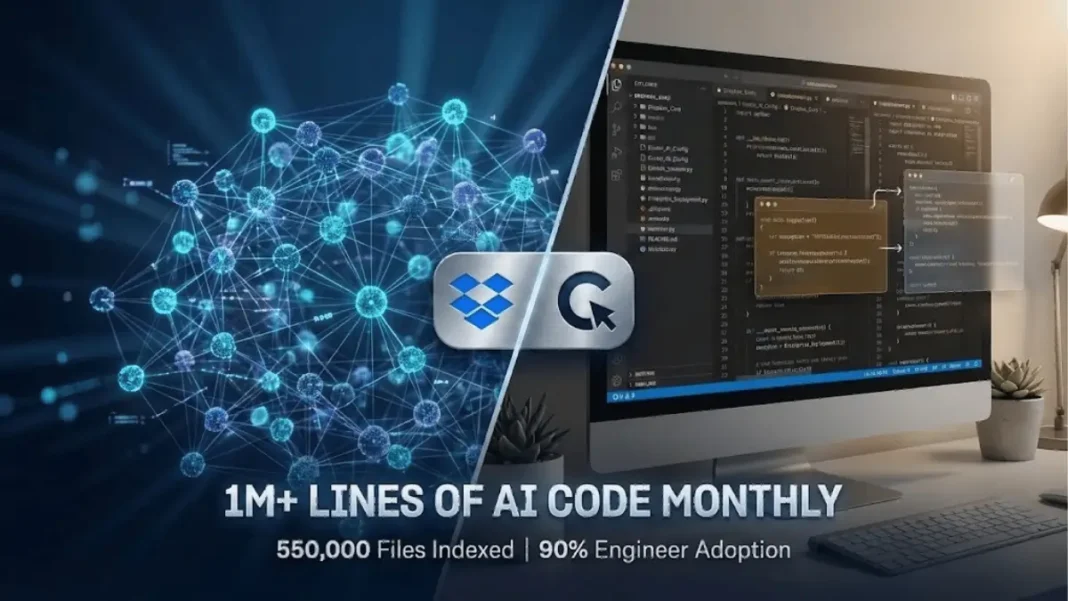
- The Deployment: Dropbox indexed 550,000+ files using Cursor AI, with engineers now accepting over 1 million lines of AI-suggested code monthly
- The Impact: 90%+ of Dropbox engineers use AI tools weekly; PR throughput and cycle time moved to upper-tier industry benchmarks
- The Context: CTO Ali Dasdan launched enterprise-wide adoption after April 2025 hackathon demonstrated velocity gains; Cursor’s $2.6B valuation reflects growing enterprise demand
Dropbox announced January 21, 2026, that its engineering organization now accepts more than one million lines of AI-generated code monthly through Cursor, marking one of the largest enterprise deployments of AI coding assistants documented to date. CTO Ali Dasdan disclosed that over 90 percent of the company’s engineers use AI tools weekly, driving measurable improvements in pull request velocity and development cycle time. The deployment required indexing a monorepo containing 550,000+ files that supports infrastructure handling 300,000 requests per second.
Enterprise-Scale Monorepo Indexing Architecture
Cursor’s deployment at Dropbox centered on semantic indexing of the entire codebase. The system scans files not marked as ignored, breaks code into structured chunks, and generates embeddings that map relationships between components. This indexing process proved critical at Dropbox’s scale, enabling the AI to generate contextually appropriate code changes that integrate naturally with existing architecture.
The indexed codebase serves dual purposes: powering AI-generated code suggestions and providing engineers with an accelerated understanding of system interdependencies. Dasdan reported that new hires can now ramp significantly faster, while senior engineers gain clearer visibility into how disparate codebase sections interconnect. AdwaitX analysis indicates this approach addresses a persistent enterprise challenge maintaining institutional knowledge within massive codebases where individual engineers understand limited subsystems.
Measured Velocity Gains and Adoption Metrics
Dropbox tracks engineering performance through an internal framework emphasizing speed, effectiveness, and quality. Since Cursor adoption, the company’s PR throughput and cycle time metrics reached the upper tier of industry benchmarks. The 90+ percent weekly adoption rate among engineers represents one of the highest documented enterprise AI tool adoption rates.
Engineers deploy Cursor across the full development lifecycle: code generation, review, testing, documentation, and migrations. The million-plus monthly accepted code lines translate to substantial engineering hour savings, though Dropbox has not disclosed specific productivity percentage gains. Industry data from DX’s Q4 2025 report shows AI coding tools save developers an average of 3.6 hours weekly, with 91% adoption rates among 135,000+ surveyed developers.
Leadership-Driven Deployment Strategy
The adoption trajectory shifted dramatically during Dropbox’s April 2025 company-wide hackathon. Dasdan, facing a deadline for a “smart finder” project with zero progress the night before submission, completed the entire build in two hours using Cursor. He shared this experience with a CTO peer group, discovering many technology leaders had not personally tested AI coding tools.
Dasdan implemented a friction-removal strategy focused on single-click access to accelerate adoption. By 2024, Dropbox engineers had begun informal experimentation, sharing learnings through Slack channels and internal documentation. Dasdan formalized this organic interest by establishing AI champions who amplified successful workflows and eliminated adoption barriers. This top-down and bottom-up combined approach drove the 90+ percent adoption rate within months.
Cursor Market Position and Enterprise Trajectory
Cursor’s revenue exploded from $1M in 2023 to $100M in 2024, with projections reaching $200M-$250M through 2025. The company achieved a $2.6B valuation by January 2025, with reports indicating discussions around a $10B valuation. Enterprise clients including OpenAI, Shopify, and Perplexity have deployed Cursor, with developers reporting 300-500% productivity gains.
The platform’s technical performance differentiators include 50-100ms code completion latency and 85-90% usable suggestion rates. This positions Cursor as the current market leader in AI-powered integrated development environments, particularly for organizations operating large-scale monorepos requiring full codebase context.
| Metric | Dropbox Deployment | Industry Benchmark |
|---|---|---|
| Engineer Adoption Rate | 90%+ weekly | 91% (DX Q4 2025) |
| AI-Generated Code Accepted | 1M+ lines/month | Not disclosed industry-wide |
| Codebase Size | 550,000+ files | Varies by organization |
| Time Savings | Not disclosed | 3.6 hrs/week average |
Infrastructure Implications for Large-Scale Organizations
Dropbox’s deployment validates AI coding assistants’ viability for infrastructure operating at hyperscale. The company’s data centers process 300,000+ requests per second, requiring code changes that maintain performance and reliability standards. Cursor’s ability to reason across the entire 550,000-file codebase while generating production-grade code represents a technical milestone for AI systems.
AdwaitX analysis suggests organizations with monorepos exceeding 100,000 files face similar challenges: fragmented institutional knowledge, extended onboarding timelines, and difficulty maintaining consistent architectural patterns. Dropbox’s documented velocity improvements provide enterprise decision-makers with quantified evidence supporting AI coding tool ROI, particularly for organizations where development speed directly impacts competitive positioning.
Strategic Roadmap and Industry Shift
Dasdan stated Dropbox is “reexamining and redesigning every part of how we build software in the context of AI”. This signals continued expansion of AI integration beyond code generation into architecture planning, technical debt management, and system design. The company’s focus on embedding AI across the complete software development lifecycle positions Dropbox as an early indicator of enterprise AI adoption patterns.
The broader industry trend shows accelerating AI coding tool adoption, with Cursor’s growth trajectory and enterprise client roster indicating a fundamental shift in development workflows. Organizations delaying adoption face accumulating competitive disadvantage, particularly in sectors where development velocity determines market position. Dasdan’s message to peer CTOs emphasized firsthand tool testing as essential for understanding AI’s organizational impact.

Frequently Asked Questions (FAQs)
How did Dropbox integrate Cursor across 550,000 files?
Cursor indexed Dropbox’s entire monorepo by scanning files, generating embeddings, and creating a semantic map enabling AI to reason across the full codebase for contextually appropriate code generation.
What productivity gains did Dropbox achieve with Cursor?
Dropbox engineers accept over 1 million AI-suggested code lines monthly, with PR throughput and cycle time reaching upper-tier industry benchmarks, though specific percentage gains were not disclosed.
How many Dropbox engineers use AI coding tools?
Over 90 percent of Dropbox engineers use AI tools weekly, representing one of the highest documented enterprise adoption rates following deployment strategy removing friction.
When did Dropbox begin Cursor deployment?
Engineers started informal experimentation in 2024, with formal adoption accelerating after April 2025 company hackathon where CTO Ali Dasdan demonstrated velocity gains.

