

QUICK BRIEF
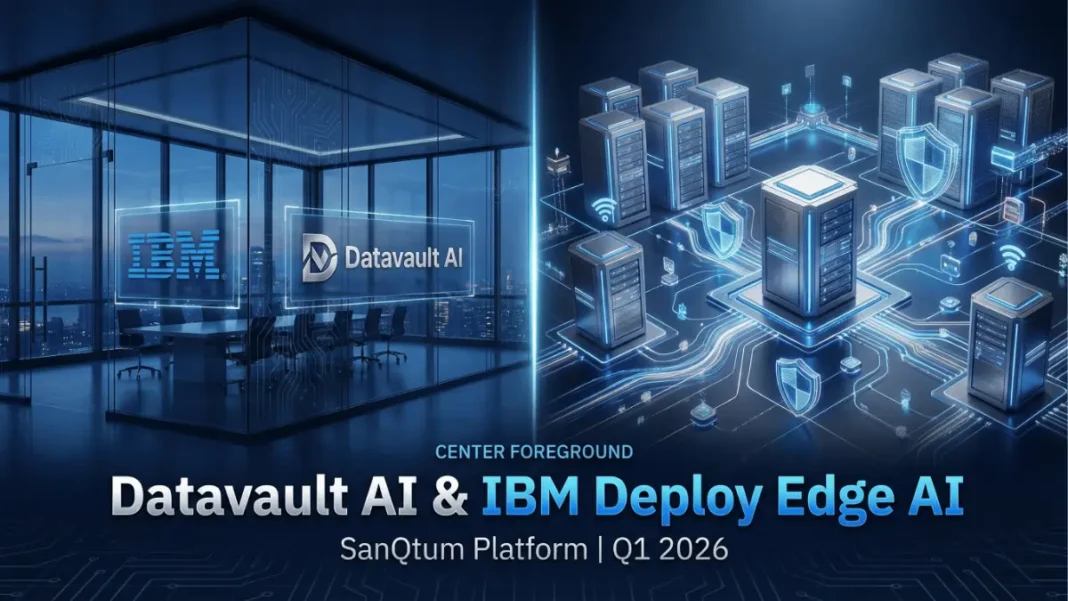
- The Deal: Datavault AI (Nasdaq: DVLT) expands IBM watsonx collaboration to deploy real-time data tokenization on Available Infrastructure’s SanQtum AI zero-trust edge platform.
- The Impact: Enterprises can process and monetize data instantly without public cloud dependency, targeting media, sports, and government sectors across the Northeast Corridor.
- The Context: Deployment launches Q1 2026 in New York and Philadelphia, eliminating lag between data creation and commercialization using GPU-rich edge architecture.
Datavault AI Inc. (Nasdaq: DVLT) announced January 8, 2026, an expanded collaboration with IBM to deploy enterprise-grade artificial intelligence at the edge using Available Infrastructure’s SanQtum AI platform. The partnership leverages IBM’s watsonx AI portfolio to enable real-time data tokenization and monetization without relying on centralized public cloud infrastructure, addressing critical security and latency concerns for enterprise clients.
The deployment targets the Northeast Corridor with operational rollout planned for Q1 2026 across New York and Philadelphia metro regions, with subsequent expansion into multiple metropolitan areas.
What’s New
Datavault AI’s Information Data Exchange and DataScore agents built with IBM watsonx now operate within SanQtum AI’s zero-trust edge environment. This infrastructure enables clients to process and tokenize data at the point of creation, transforming raw inputs into authenticated, tradable digital property in real-time.
The platform eliminates dependence on centralized cloud pipelines while preventing data tampering by keeping information inside a zero-trust local network. Target customers include media organizations, sports leagues, and government agencies requiring high-security data processing.
Nathaniel Bradley, CEO of Datavault AI, stated the combination delivers “the ability to create authenticated digital property nearly at the instant data comes into existence,” potentially changing the economics of data.

Why It Matters
The partnership addresses a critical gap in enterprise AI deployment: the security and latency limitations of public cloud infrastructure. By processing data at the edge rather than routing through centralized cloud providers, organizations can achieve faster time-to-value while maintaining stricter security controls.
Daniel Gregory, CEO of Available Infrastructure, emphasized that SanQtum AI “provides a powerful new foundation for AI and computing safety, reliability, and performance”. The platform’s GPU-rich distributed architecture enables operational scale while maintaining zero-trust security protocols.
Biz Dziarmaga, Head of Americas AI Partnerships at IBM, highlighted the deployment as demonstrating “the power of IBM’s ecosystem approach leveraging watsonx to deliver scalable AI that helps enterprises drive smarter operations and faster business outcomes”.
Technical Specifications
| Component | Details |
|---|---|
| AI Platform | IBM watsonx portfolio |
| Edge Infrastructure | SanQtum AI zero-trust platform |
| Architecture | GPU-rich distributed edge computing |
| Data Processing | Real-time tokenization at creation point |
| Security Model | Zero-trust local network |
| Deployment Regions | New York, Philadelphia (Q1 2026) |
| Use Cases | Media analytics, identity verification, tokenization, credentialing, data commerce |
Key Capabilities
- Removes dependence on centralized cloud pipelines
- Eliminates lag between data creation and monetization
- Prevents tampering via zero-trust architecture
- Enables data treatment as instant, tradable digital property
What’s Next
Datavault AI plans operational deployment at scale across New York and Philadelphia in Q1 2026, with expansion into additional metro regions thereafter. Available Infrastructure, an IBM Platinum Partner, provides the underlying SanQtum AI infrastructure designed for critical infrastructure and sensitive enterprise data.
The partnership positions Datavault AI to serve enterprises requiring high-security, low-latency AI workloads without public cloud exposure. The company’s patented Information Data Exchange technology powers enterprise intelligence, credentialing systems, and advanced analytics for authenticated digital asset creation.

Frequently Asked Questions (FAQs)
What is Datavault AI’s partnership with IBM about?
Datavault AI expands its IBM watsonx collaboration to deploy real-time data tokenization on SanQtum AI’s zero-trust edge platform, launching Q1 2026 in Northeast US.
What is SanQtum AI platform?
SanQtum AI is Available Infrastructure’s GPU-rich, zero-trust edge computing platform enabling secure AI deployment without public cloud dependency.
Which industries benefit from this deployment?
Media organizations, sports leagues, and government agencies require high-security data processing and instant monetization capabilities.
When will the deployment launch?
Operational rollout begins Q1 2026 across New York and Philadelphia, with planned expansion to multiple metro regions.
How does edge AI differ from cloud AI?
Edge AI processes data at creation point without routing through centralized cloud infrastructure, reducing latency and security risks.

