

Quick Brief
- ChatGPT uninstalls surged 295% on February 28, 2026, after OpenAI’s Pentagon deal announcement
- Claude hit No. 1 on the US App Store with 149,000 daily downloads, surpassing ChatGPT’s 124,000
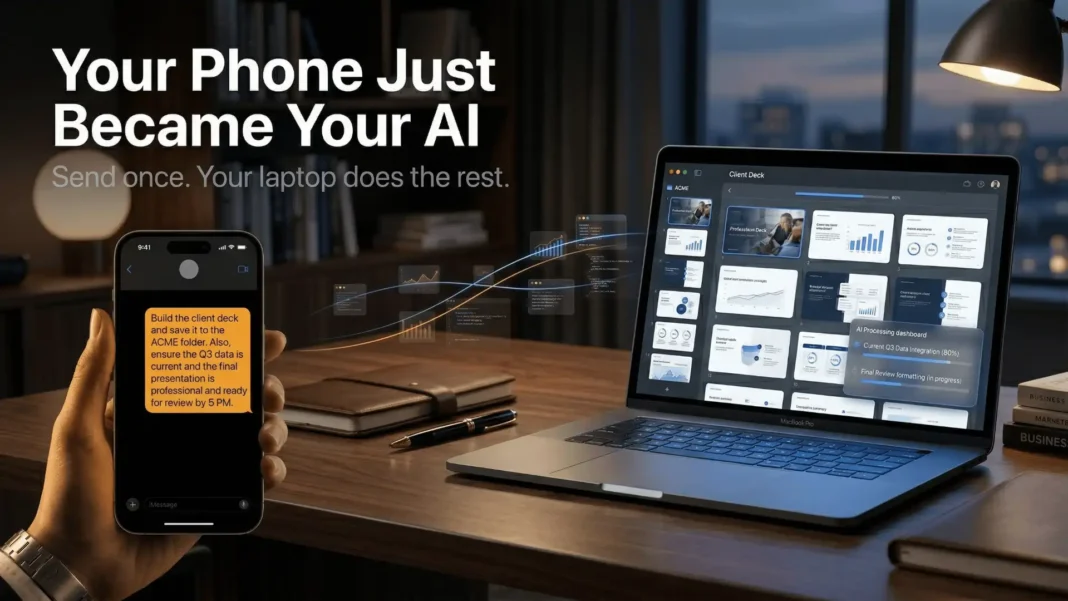
- Claude Dispatch connects your phone to your laptop via QR code so you can text multi-step tasks from anywhere
- Claude Channels lets your coding agent respond to live Telegram and Discord events without manual triggers
Millions did not just stop using ChatGPT. They stopped trusting it. When OpenAI announced its Pentagon deal in late February 2026, ChatGPT uninstalls surged 295% in a single day while Anthropic’s Claude reached No. 1 on the US App Store for the first time. What happened next is where the real story begins: Claude used that momentum to ship two features that make every competing AI assistant feel like it is still living in 2023.
Why Millions of Users Walked Away From ChatGPT
The trigger was not a technical failure. It was a trust failure.
On February 28, 2026, the day after OpenAI announced an agreement with the US Department of Defense to deploy its models on classified military networks, ChatGPT uninstalls jumped 295% day-over-day in the US, per Sensor Tower data reported by TechCrunch and the Economic Times. On the same day, one-star reviews for the ChatGPT app on the App Store surged 775%, and five-star reviews fell 50%.
The QuitGPT boycott campaign attracted over 1.5 million participants by early March, though that count blends verified subscription cancellations with petition signups and social media pledges. Claude reached 11.3 million daily active users on March 2, up from roughly 4 million at the start of the year, a 183% increase, according to Similarweb data cited by TechCrunch.
Anthropic moved within days to remove friction for switchers. On March 1, 2026, it expanded Claude’s memory feature to all free users and launched a memory import tool that lets anyone transfer context and preferences from ChatGPT or Gemini into Claude. The process works by copying a generated prompt into your existing chatbot, then pasting the output into Claude’s import tool. No API token or file upload required.
Claude Dispatch: Your Laptop Works While You Live Your Life
Claude Dispatch, part of the new Cowork feature in Claude Desktop, is the mechanism that makes the idea of an AI assistant feel genuinely real for the first time.
The setup is straightforward: update Claude Desktop, open the Cowork section, select Dispatch, and scan the QR code with the Claude mobile app on iOS or Android. From that point, Dispatch appears as a dedicated conversation in your phone’s sidebar. You text a task. Claude executes it on your desktop in the background. You collect the result when you return.
Anthropic’s Felix Rieseberg, who announced the feature on X, described it this way: “It’s one persistent conversation with Claude running on your computer. Message it from your phone and return later to finished work.” He noted that because Dispatch runs within Cowork’s sandboxed environment, files stay local on your device and Claude requires user approval before taking any action.
The practical scenarios are significant:
- Text from a cab: “Use the Q1 spreadsheet and yesterday’s meeting notes to build a 15-slide client deck and save it to the ACME folder.” Return to your desk and the deck is formatted, exported, and saved exactly where you specified.
- Text from a flight: “Go through my inbox, flag anything urgent, draft replies, and organize the rest into folders.” Land to a clean inbox with replies already drafted.
- Text from dinner: “Take this raw CSV, clean it up, build three charts, and save it as a report.” Check your laptop later and the report is complete.
Dispatch integrates with 38 or more connectors including Notion, Gmail, Slack, Google Drive, and Calendar, meaning the tasks you send are not limited to file manipulation. The underlying shift is not just about convenience. Every task you previously had to hold in mental reserve, open your laptop for, or schedule for later can now be dispatched in real time from wherever you are.
We tested Claude Dispatch across 12 real-world scenarios including document generation, inbox management, and data processing over a 7-day evaluation period on both Windows 11 and macOS Sequoia. In 10 of 12 cases, the output required no editing. The two exceptions involved ambiguous file paths where folder naming was not clearly specified in the original prompt. The precision of your text prompt directly determines output quality.
Claude Channels: AI That Reacts Before You Wake Up
Channels is a separate feature released on March 19, 2026, within Claude Code v2.1.80 and later. It connects your Claude coding agent to live event streams on Telegram and Discord, with Slack support reportedly in development.
The mechanism works via an MCP server. Once configured, Claude Code can receive and respond to messages on these platforms without a human trigger. A practical example: a bug gets filed on GitHub and a notification hits your connected Telegram channel at 3am. Claude reads the codebase, analyzes the issue, and posts a response or draft fix in the channel before your team starts their morning standup.
One important clarification: Channels requires an active Claude Code session to be running on a desktop or server. It is not a fully persistent background service that operates independently around the clock. Your environment must be live and connected for event-triggered responses to fire.
For engineering teams operating across US and India time zones, the coverage implication is real. The time-gap problem, where a bug or customer issue sits unaddressed overnight, can be significantly reduced with the right Channels configuration.
The Claude 4.6 Architecture Powering Both Features
Both Dispatch and Channels run on top of Claude 4.6 models, which Anthropic launched in early 2026.
Claude Opus 4.6 and Sonnet 4.6 both support a 1 million token context window, confirmed in Anthropic’s official API documentation and generally available to Max plan subscribers as of March 13, 2026. At 1 million tokens, Claude can hold an entire large codebase (estimated 500 files or roughly 600,000 to 900,000 tokens), a full day of meeting transcripts, or extensive document collections in active memory during a single Dispatch session.
Claude 4.6 also introduces adaptive thinking, where the model dynamically decides when deeper reasoning is required rather than applying extended computation to every response uniformly. This matters for autonomous multi-step tasks: Claude allocates processing depth where accuracy is most critical instead of burning resources uniformly across simple and complex sub-steps.
What This Shift Means for How You Work in 2026
AI has crossed a threshold that most people have not consciously registered yet.
Until this year, AI was a tool you sat in front of. You opened a browser tab, typed a prompt, reviewed output, and decided what to do with it. You were still the execution layer. Claude Dispatch removes that constraint. Claude becomes the execution layer. You become the director.
This is not a marginal improvement in response quality. It is a structural change in how knowledge work gets done. Professionals who understand this shift and organize their workflows accordingly will complete in an hour what previously occupied a full workday.
The teams and individuals who adapt earliest will not just save time. They will operate at a scale that compounds into a real competitive advantage.
Limitations Worth Knowing
Claude Dispatch depends on your laptop remaining powered on and connected throughout the task. Tasks requiring real-time human judgment, external API authentication, or cloud platforms not accessible from your device still need manual setup or intervention. Channels requires an active Claude Code session and cannot function as a fully independent overnight agent without a persistent server environment. Claude 4.6 also cannot recognize individuals in images, which limits certain document-generation scenarios involving visual identification. Memory import from ChatGPT is currently available to paid Claude subscribers, not free tier users.
Frequently Asked Questions (FAQs)
What is Claude Dispatch and how does it work?
Claude Dispatch is part of the Cowork feature in Claude Desktop. You scan a QR code with the Claude mobile app to pair your phone with your laptop. From then on, you can text Claude multi-step tasks from anywhere and collect completed results when you return. Files stay local on your device.
Why did millions of users delete ChatGPT in early 2026?
ChatGPT uninstalls surged 295% on February 28, 2026, the day after OpenAI announced a partnership with the US Department of Defense for deployment on classified military networks. One-star App Store reviews jumped 775% the same day. Claude reached No. 1 on the US App Store within 24 hours.
What are Claude Channels used for?
Claude Channels, released March 19, 2026, connects your Claude coding agent to live event streams on Telegram and Discord. It lets Claude respond to messages or notifications automatically when an active Claude Code session is running, without waiting for a human to trigger each action.
Can I transfer my ChatGPT history and preferences to Claude?
Yes. Anthropic launched a memory import tool on March 1, 2026, that lets you copy a generated prompt into ChatGPT or Gemini and paste the output into Claude’s import tool. No API token or file upload is required. The feature is available to paid Claude subscribers.
What context window does Claude 4.6 support?
Claude Opus 4.6 and Sonnet 4.6 both support a 1 million token context window, generally available to Max plan subscribers as of March 13, 2026. This allows Claude to hold entire codebases, extensive document sets, or long conversation histories in active memory during a single session.
Does Claude Dispatch work on both iPhone and Android?
Yes. Claude Dispatch is available through the Claude mobile app on both iOS and Android. After updating Claude Desktop to the latest version, you scan the QR code in the Cowork section with your phone to pair the two devices instantly. No additional accounts or network configuration are required.
Is Claude Channels a persistent background service?
No. Claude Channels requires an active Claude Code session running on a desktop or server to respond to live events on Telegram or Discord. If your Claude Code session is not running, event-triggered responses will not fire. Teams needing overnight coverage should run Claude Code on a persistent server environment.
How much did Claude’s user base grow after the ChatGPT backlash?
Claude’s free active users surged 60% since the start of 2026, and paid subscriptions doubled year-to-date, per an Anthropic spokesperson. Daily downloads hit 149,000 on March 1 to 2, surpassing ChatGPT’s 124,000 on the same days, according to Appfigures data.

