

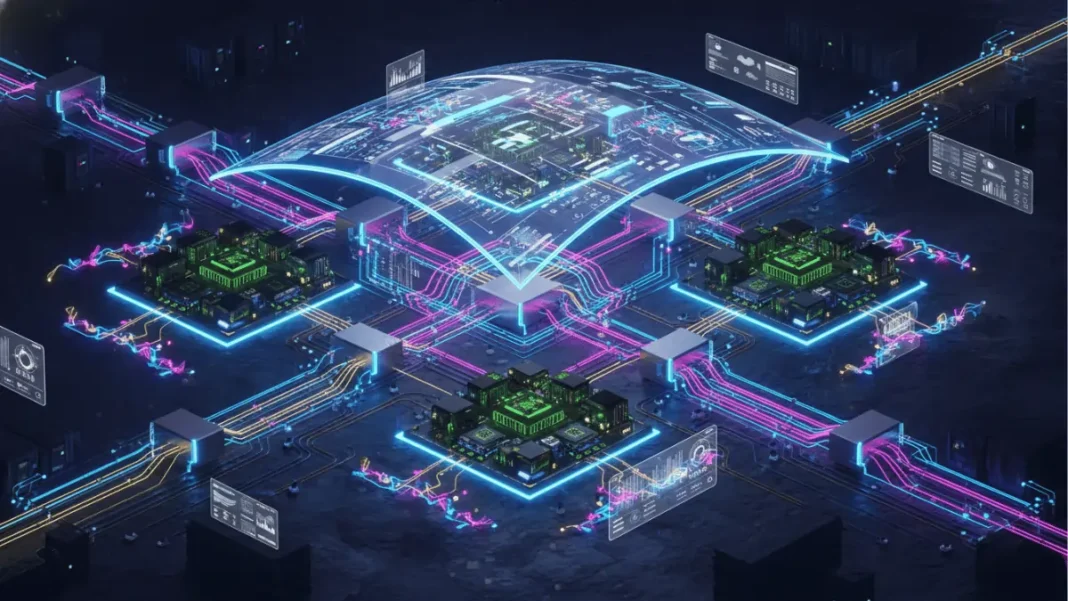
Summary: Cisco reported $1.3 billion in AI infrastructure orders from hyperscalers in Q1 FY2026, driven by Nexus Hyperfabric architecture, NVIDIA partnerships, and 800 Gbps networking capabilities. The company’s Silicon One-based switches enable low-latency GPU cluster connectivity essential for large-scale AI training and inference workloads. Organizations deploying AI need networks with 10x higher bandwidth, sub-microsecond latency, and unified management across distributed data centers.
Cisco just crossed a major milestone: $1.3 billion in AI infrastructure orders from hyperscale providers in a single quarter, signaling a massive shift in how enterprises are building networks for artificial intelligence. Traditional Ethernet and data center architectures weren’t designed for the extreme demands of distributed GPU clusters processing trillions of parameters, and organizations worldwide are racing to upgrade their infrastructure before AI workloads outpace their networks.
Quick Take: Cisco reported $1.3 billion in AI infrastructure orders from hyperscalers in Q1 FY2026, driven by Nexus Hyperfabric architecture, NVIDIA partnerships, and 800 Gbps networking capabilities. The company’s Silicon One-based switches enable low-latency GPU cluster connectivity essential for large-scale AI training and inference workloads. Organizations deploying AI need networks with 10x higher bandwidth, sub-microsecond latency, and unified management across distributed data centers.
What’s Driving the AI Infrastructure Boom
The explosion in generative AI, agentic AI systems, and enterprise AI adoption has created unprecedented demand for high-performance networking infrastructure. Cisco exceeded its annual $1 billion AI infrastructure target from hyperscalers a full quarter ahead of schedule in Q3 FY2025, then accelerated further to $1.3 billion in orders by Q1 FY2026. This surge reflects a fundamental reality: AI workloads require entirely different network architectures than traditional enterprise applications.
The Hyperscale Demand Explosion
Hyperscale cloud providers and neocloud GPU-as-a-service platforms are building massive AI training clusters with thousands of interconnected GPUs. These deployments demand ultra-low-latency fabrics capable of delivering data to GPUs fast enough to prevent idle compute time every microsecond of network delay translates to wasted GPU cycles and higher infrastructure costs. Cisco’s partnerships with major hyperscalers and neocloud providers position the company as a critical infrastructure supplier for the AI-as-a-service economy.
Why Traditional Networks Can’t Handle AI Workloads
Standard enterprise Ethernet networks struggle with AI’s unique traffic patterns: massive east-west data flows between GPUs, burst-heavy ingestion workloads, and the need for consistent sub-microsecond latency across hundreds or thousands of nodes. If network infrastructure can’t supply training data to GPU clusters fast enough, expensive hardware sits underutilized making the network the primary bottleneck in AI ROI. Technologies like InfiniBand and RoCE (RDMA over Converged Ethernet) have emerged as alternatives, while the Ultra Ethernet Consortium is developing new standards specifically for AI networking.
Cisco’s AI Infrastructure Portfolio Explained
Cisco’s approach centers on three pillars: purpose-built switching silicon, unified fabric management, and ecosystem partnerships that enable seamless AI deployments from hyperscale to enterprise.
Nexus Hyperfabric Architecture
Nexus Hyperfabric represents Cisco’s next-generation data center fabric designed specifically for AI-scale workloads. It integrates Silicon One-based switching, VXLAN EVPN overlays, and automated provisioning through Nexus Dashboard to create a cloud-managed control plane optimized for large GPU clusters. The architecture supports ultra-low-latency east-west traffic essential for distributed AI training while simplifying deployment and operational complexity.
Silicon One-Based Switching
Cisco Silicon One forms the foundation of the company’s AI networking strategy, delivering programmable, high-performance packet processing across multiple form factors. The G200 series switches based on Silicon One have demonstrated compatibility with NVIDIA Spectrum-X Ethernet networking, showcasing interoperability between leading AI infrastructure vendors. Silicon One’s flexibility allows it to power everything from hyperscale AI fabrics to service provider edge routers with consistent performance characteristics.
NVIDIA Spectrum-X Integration
At Cisco Live 2025, Cisco and NVIDIA demonstrated the first technical integration of Cisco G200-based switches with NVIDIA NICs, proving that Spectrum-X Ethernet networking can run on Cisco Silicon One platforms. This unified architecture supports NX-OS, Nexus Hyperfabric AI, and SONiC deployments, giving customers flexibility in how they build and manage AI fabrics. The partnership addresses a critical market need: seamless interoperability between best-of-breed networking and GPU infrastructure.
Technical Requirements for AI-Ready Networks
Building infrastructure that can support AI workloads requires understanding specific technical thresholds that differ dramatically from traditional data center requirements.
Bandwidth and Latency Specifications
AI training clusters require 400 Gbps networking as a baseline, with leading providers already deploying 800 Gbps links and planning transitions to 1.6 Tbps. Latency requirements are measured in microseconds, not milliseconds distributed training algorithms depend on synchronized weight updates across GPU nodes, making network jitter and tail latency critical performance factors. Cisco’s Intelligent Packet Flow technology uses real-time telemetry and congestion awareness to dynamically steer traffic, reducing latency spikes that can slow AI job completion times.
GPU Cluster Connectivity Needs
Large-scale GPU clusters generate enormous east-west traffic as data moves between compute nodes during training. Networks must support lossless Ethernet or RDMA protocols to prevent packet drops that force expensive retransmissions and stall GPU processing. Cisco’s Unified Nexus Dashboard provides end-to-end visibility across networks, GPUs, and distributed AI jobs, enabling proactive issue detection before performance degrades.
Power and Cooling Considerations
AI infrastructure consumes significantly more power per rack than traditional workloads, creating both electrical capacity and cooling challenges. Cisco’s AI-ready portfolio considers power efficiency across switching silicon and optical transceivers to reduce total infrastructure energy consumption. Organizations planning AI deployments must audit available power capacity and cooling systems before scaling GPU clusters; insufficient power infrastructure limits how aggressively networks can be upgraded.
How Cisco Compares to Competitors
The AI networking market features intense competition from specialized players and hyperscale vendors developing in-house solutions.
| Feature | Cisco (Nexus/Silicon One) | Arista Networks | NVIDIA (Spectrum-X) |
|---|---|---|---|
| Maximum Port Speed | 800 Gbps (roadmap to 1.6 Tbps) | 800 Gbps Etherlink | 400 Gbps (Spectrum-4) |
| Management Platform | Unified Nexus Dashboard | CloudVision with EOS | NVIDIA Air simulation |
| AI-Specific Features | Intelligent Packet Flow, congestion awareness | Real-time workload monitoring | GPU-network co-optimization |
| Ecosystem Integration | NVIDIA partnership, neocloud providers | Hyperscaler-focused | End-to-end NVIDIA stack |
| Target Market | Enterprise + hyperscale + service providers | Hyperscale + cloud builders | AI-native deployments |
| Latency Optimization | Real-time telemetry steering | Ultra-low latency fabric | SHARP in-network computing |
Arista Networks has gained significant market share in hyperscale AI deployments with its 800 Gbps Etherlink platforms and Linux-based EOS management, offering enhanced programmability for custom AI workflows. NVIDIA’s Spectrum-X provides tightly integrated GPU-network optimization but locks customers into NVIDIA’s ecosystem. Cisco differentiates through broader enterprise reach, service provider partnerships, and multi-vendor interoperability.
Real-World Deployment: What Organizations Need
Successfully deploying AI-ready infrastructure requires a structured approach that balances immediate needs with long-term scalability.
Step 1: Assess Current Infrastructure Capacity
Start by auditing existing network bandwidth utilization, latency characteristics, and available power/cooling capacity. Cisco’s AI Readiness Index research shows that only 46% of organizations have networks capable of scaling for AI complexity and data volume. Identify bottlenecks in north-south connectivity (data ingestion) and east-west fabric (inter-GPU communication) separately, as they require different optimization strategies.
Step 2: Plan for Scalability Requirements
Design network architecture with headroom for rapid AI workload growth Cisco’s research indicates 83% of organizations plan to deploy AI agents within 12 months, dramatically increasing infrastructure demands. Plan data center capacity expansions early, as leading organizations in Cisco’s Pacesetter category can scale instantly for new AI projects. Budget for both immediate infrastructure upgrades and phased expansions as AI use cases mature from pilot to production.
Step 3: Implement Unified Management
Deploy centralized management platforms that provide visibility across heterogeneous infrastructure Cisco’s Unified Nexus Dashboard consolidates LAN, SAN, IPFM, and AI/ML fabrics into a single interface. Unified management becomes critical as organizations run AI workloads across on-premises data centers, colocation facilities, and public cloud simultaneously. Implement automated fabric provisioning to reduce deployment time and configuration errors that can degrade AI performance.
Step 4: Monitor and Optimize Performance
Establish continuous monitoring of GPU utilization correlated with network metrics to identify when bandwidth or latency limits AI job completion. Use telemetry-driven traffic steering to dynamically optimize paths based on real-time congestion data. Track AI infrastructure ROI by measuring GPU idle time, job completion times, and cost per training run network optimizations that reduce training time by even 10% generate significant savings at scale.
Cisco’s Strategic Partnerships and Market Position
Cisco’s AI infrastructure strategy extends beyond hardware to encompass ecosystem partnerships that deliver complete solutions.
The NVIDIA Collaboration
The Cisco-NVIDIA partnership demonstrated at Cisco Live 2025 showcased interoperability between Cisco Silicon One switches and NVIDIA Spectrum-X networking, enabling customers to mix best-of-breed components. This collaboration addresses enterprise concerns about vendor lock-in while ensuring certified performance for AI workloads. Future integration roadmaps include deeper GPU-network optimization and unified orchestration across compute and fabric layers.
Neocloud Provider Ecosystem
Cisco has established strategic partnerships with neocloud providers delivering GPU-as-a-service infrastructure, positioning the company’s networking technology as foundational for AI-as-a-service platforms. These providers require multi-tenant isolation, remote site connectivity, and dynamic resource allocation capabilities Cisco addresses through VXLAN segmentation and Hyperfabric architecture. The neocloud market represents a high-growth segment as enterprises shift from owning GPU infrastructure to consuming it as a service.
Service Provider Innovations
Cisco’s Agile Services Networking introduces AI capabilities for service providers to modernize infrastructure and monetize AI-driven services. New Silicon One-based edge routers expand deployment options for distributed AI inference at the network edge. A multi-agentic framework for Cisco Crosswork Network Automation enables service providers to build custom AI agents for autonomous network operations.
Cost and ROI Considerations
AI infrastructure represents a significant capital investment that must be justified through measurable business value.
Infrastructure Investment Breakdown
Typical AI-ready network upgrades include switching fabric refresh (400G/800G capable), management platform licensing, optical transceivers, and potential rack power/cooling enhancements. Cisco’s modular approach allows phased investments organizations can start with AI PODs (pre-integrated compute-network-storage bundles) before scaling to full Hyperfabric deployments. Budget 20-30% of total AI infrastructure spend for networking components, with the remainder allocated to GPUs, storage, and power systems.
Performance vs. Price Analysis
While Cisco pricing typically runs higher than white-box alternatives, the total cost of ownership includes operational efficiency, support quality, and integration complexity. Organizations should evaluate networking costs per GPU rather than absolute switch prices; a $50K network upgrade that prevents $200K in GPU idle time delivers clear ROI. Cisco’s unified management reduces operational overhead compared to managing disparate vendor tools, offsetting higher upfront hardware costs over multi-year deployments.
Long-Term Value Metrics
Cisco’s Pacesetter organizations those most advanced in AI readiness report 90% experiencing gains in profitability, productivity, and innovation. Key ROI metrics include reduced AI training time, higher GPU utilization rates, faster pilot-to-production cycles, and ability to support larger model sizes without infrastructure redesign. Track infrastructure efficiency through metrics like GPU utilization percentage, average job completion time, and cost per training epoch to quantify network optimization impact.
Pros and Cons of Cisco AI Infrastructure
Pros:
- Proven hyperscale adoption: $1.3B in orders validates technology at the largest scale
- Multi-vendor interoperability: NVIDIA Spectrum-X compatibility plus broad ecosystem support
- Unified management: Single dashboard for diverse fabric types reduces operational complexity
- Enterprise heritage: Existing Cisco installations can incrementally upgrade rather than forklift replace
- Service provider capabilities: Extends beyond data center to edge and WAN for distributed AI
- Silicon One flexibility: Programmable architecture adapts to evolving AI networking requirements
Cons:
- Premium pricing: Higher cost than white-box or hyperscaler-specific alternatives
- Competitive latency: Arista claims performance advantages in specific hyperscale benchmarks
- Ecosystem dependency: Some advanced features require Nexus Dashboard licensing
- Market share pressure: Arista gaining ground in AI-specific deployments
- Complexity for small deployments: Full Hyperfabric architecture may overwhelm organizations with limited AI needs
Technical Specifications at a Glance
| Component | Specification | Use Case |
|---|---|---|
| Nexus Hyperfabric | VXLAN EVPN overlay, automated provisioning | Large-scale GPU cluster fabrics |
| Silicon One G200 | 25.6 Tbps switching capacity | Spine/leaf AI data center architecture |
| Port Speeds | 400 Gbps standard, 800 Gbps available, 1.6 Tbps roadmap | High-bandwidth GPU interconnect |
| Intelligent Packet Flow | Real-time telemetry, congestion-aware steering | AI workload optimization |
| Unified Nexus Dashboard | Single pane for LAN/SAN/IPFM/AI fabrics | Multi-domain management |
| NVIDIA Integration | Spectrum-X on Silicon One, NX-OS/SONiC support | Hybrid vendor deployments |
| Management Modes | Cloud-managed, on-premises, hybrid | Enterprise flexibility |
Common Challenges and Solutions
Network Scaling Issues
Organizations frequently underestimate how rapidly AI workload growth will consume available network capacity. Cisco’s research shows 54% of companies report networks that can’t scale for AI complexity. Solution: Deploy Hyperfabric with modular spine-leaf architecture that allows adding capacity without redesigning the entire fabric. Plan for 3-5 year growth curves rather than immediate needs only.
Integration with Legacy Systems
Existing data center infrastructure rarely supports the bandwidth and latency requirements of AI workloads without upgrades. Cisco addresses this through Unified Nexus Dashboard, which can manage both legacy ACI fabrics and new Hyperfabric AI deployments from a single interface. Implement AI infrastructure in dedicated PODs initially, then integrate with production networks through controlled migration paths.
Security and Compliance
AI training data often includes sensitive information requiring encryption and access controls. Cisco’s AI Readiness Index Pacesetters demonstrate higher awareness of AI-specific security risks and build protections into both identity systems and infrastructure. Apply zero-trust segmentation using VXLAN isolation between AI workloads, implement encrypted transport for sensitive datasets, and audit access to GPU resources through centralized identity management.
What to Expect in 2026 and Beyond
The AI infrastructure market will continue rapid evolution as workloads shift from pure training to distributed inference and agentic AI systems. Cisco’s roadmap includes 1.6 Tbps networking, expanded AI agent frameworks for autonomous network operations, and deeper GPU-network co-optimization through NVIDIA partnerships. Organizations should plan infrastructure refreshes on 18-24 month cycles rather than traditional 3-5 year data center lifespans to keep pace with AI technology advancement.
The rise of AI agents autonomous systems that perform complex multi-step tasks will stress infrastructure in new ways, requiring networks that can dynamically scale and reconfigure based on agent workload patterns. Cisco’s multi-agentic framework for Crosswork represents early steps toward self-managing networks that optimize themselves for AI traffic. Expect increasing integration between network management AI and workload AI, creating infrastructure that predicts and prevents performance issues before they impact applications.
Power efficiency will become a primary competitive differentiator as data center energy costs escalate. Cisco’s Silicon One roadmap prioritizes performance-per-watt improvements to enable denser AI deployments without proportional power infrastructure expansion. Organizations planning long-term AI strategies should evaluate networking vendors on total energy consumption across switching, optics, and cooling requirements, not just port speeds and latency specs.
Frequently Asked Questions (FAQs): AI Infrastructure Networking
What network speed do I need for AI workloads?
Minimum 400 Gbps for production AI training clusters, with 800 Gbps increasingly becoming the standard for hyperscale deployments. Smaller inference workloads may function on 100 Gbps, but plan headroom for growth AI data volumes typically double every 6-12 months.
Can I use my existing data center network for AI?
Most traditional networks require significant upgrades to support AI workloads. Assess current bandwidth utilization, latency characteristics, and whether switching infrastructure supports RDMA or lossless Ethernet. Cisco’s Unified Nexus Dashboard can manage hybrid deployments combining legacy and AI-optimized infrastructure.
How does Cisco compare to building custom white-box networks?
Cisco offers pre-integrated solutions with vendor support and unified management, versus white-box approaches that require in-house expertise to integrate components. White-box may have lower hardware costs but higher operational overhead evaluate based on internal networking team capabilities and scale requirements.
What’s the difference between InfiniBand and Ethernet for AI?
InfiniBand historically offered better latency and RDMA performance for HPC workloads, while Ethernet provides broader ecosystem compatibility. Modern AI deployments increasingly use Ethernet-based solutions like Cisco Hyperfabric or NVIDIA Spectrum-X that deliver comparable performance with greater flexibility. The Ultra Ethernet Consortium is standardizing Ethernet enhancements specifically for AI.
How long does it take to deploy AI-ready network infrastructure?
Timelines range from 3-6 months for AI POD deployments to 12-18 months for full data center fabric refreshes. Cisco’s automated provisioning through Nexus Dashboard can reduce configuration time versus manual switch-by-switch setup. Plan additional time for testing, validation, and integration with GPU clusters before production workloads.
What power and cooling requirements should I plan for?
AI infrastructure consumes 3-5x more power per rack than traditional workloads. Audit available electrical capacity and cooling systems before deploying AI networks insufficient power limits how many high-bandwidth switches can be installed. Cisco Silicon One designs emphasize power efficiency to reduce total data center energy consumption.
Do I need separate networks for AI training vs. inference?
Training requires ultra-low latency fabrics optimized for distributed GPU communication, while inference can tolerate higher latency with focus on throughput and geographic distribution. Many organizations deploy dedicated training clusters with Hyperfabric, then use standard data center networks for inference workloads. Cisco’s unified management allows operating both from a single platform.
How do I measure if my network is limiting AI performance?
Monitor GPU utilization alongside network metrics GPUs consistently below 90% utilization may indicate network bottlenecks preventing data delivery. Track AI job completion times and compare to theoretical minimums based on compute capacity alone. Cisco’s Intelligent Packet Flow provides telemetry showing congestion patterns that correlate with AI workload slowdowns.
Featured Snippet Boxes
What Is AI Infrastructure Networking?
AI infrastructure networking refers to high-bandwidth, low-latency data center fabrics designed to connect distributed GPU clusters for machine learning workloads. Unlike traditional networks optimized for north-south traffic, AI networks handle massive east-west data flows between compute nodes during training, requiring 400-800 Gbps links, sub-microsecond latency, and lossless transport protocols like RDMA. Technologies like Cisco Nexus Hyperfabric and NVIDIA Spectrum-X provide purpose-built architectures for AI-scale deployments.
How Much Did Cisco Make from AI Infrastructure?
Cisco reported $1.3 billion in AI infrastructure orders from hyperscale cloud providers in Q1 fiscal year 2026, accelerating from the $1 billion annual target exceeded in Q3 FY2025. This revenue stems from networking equipment including Silicon One-based switches, Nexus Hyperfabric deployments, and AI-optimized data center solutions sold to major cloud builders and GPU-as-a-service providers.
What Network Speed Do AI Workloads Need?
AI training workloads require a minimum 400 Gbps networking, with leading deployments standardizing on 800 Gbps and planning transitions to 1.6 Tbps. Latency must remain below 10 microseconds for distributed GPU synchronization during training, while inference workloads can tolerate 100 Gbps with higher latency thresholds. Insufficient network bandwidth causes GPU idle time, reducing ROI on expensive AI hardware investments.

