

Key Takeaways
- Grok’s DeepSearch accesses real-time X (Twitter) data before Google’s crawlers index most content
- Google holds 89.94% of global search market share and processes 16.4 billion queries every day
- Google Lens handles nearly 20 billion visual searches per month; Grok offers no visual search equivalent
- Grok’s vision features are limited to specific models and multimodal capabilities lag significantly behind GPT-4o
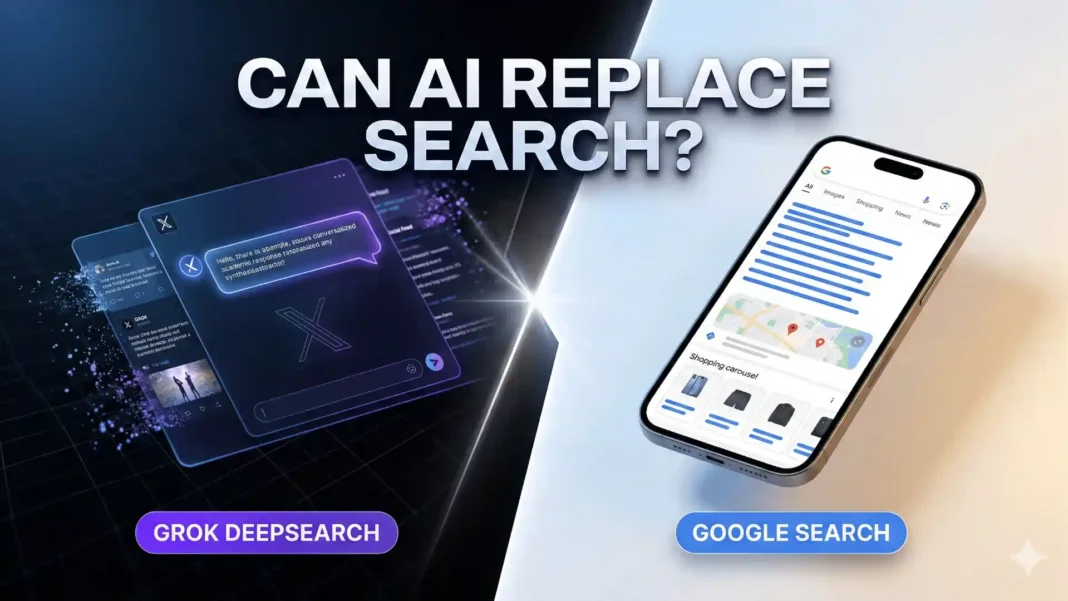
Elon Musk declared “Don’t Google it, just Grok it” in early 2025, and the debate has not slowed since. This article gives you a concrete answer built from direct testing and verified data: where Grok genuinely outperforms traditional search, and where it still cannot touch Google’s infrastructure. No guessing, no hype.
Where Grok Outperforms Traditional Search
Grok’s strongest single advantage over Google is speed on breaking information. Through its exclusive access to the X firehose, Grok surfaces public sentiment and live event data before most pages have been indexed by Google’s crawlers. For researchers and professionals tracking fast-moving topics, this is a real operational advantage, not a theoretical one.
Grok also handles complex, multi-step research queries with notable efficiency. Its conversational format allows follow-up questions to refine results iteratively, which is structurally superior to scanning ten blue links for a synthesized answer. For technical problem-solving and long-form research where context builds over multiple exchanges, Grok’s interface works in a fundamentally different way than Google Search.
On the infrastructure side, Grok offers a 2-million-token context window, which means entire codebases or large document sets can be processed in a single request without chunking strategies. No competing search interface delivers this capability. For developers and data-heavy teams, this is a concrete differentiator.
Where Grok’s search advantage is clearest:
- Breaking news and social sentiment before Google indexes source pages
- Multi-step technical research requiring conversational refinement across multiple exchanges
- Long-document and codebase analysis using a 2-million-token context window
- Trend analysis tied directly to X platform activity and real-time public discourse
- Cost-efficient API access for developers, starting at $0.20 per million tokens
Where Grok Still Falls Short of Google
Google processes 16.4 billion searches every day and holds an 89.94% share of the global search market. That scale reflects two decades of trust, a crawled index spanning hundreds of billions of pages, and an ecosystem with no current parallel. Google’s mobile search share stands at 94.03% in the United States alone.
On visual search, the gap is decisive. Google Lens handles nearly 20 billion visual searches every month, with 20% of those being shopping-related. Grok’s vision capability is limited to a single specific model variant and does not include video processing, audio analysis, or broad file format support. For any query involving images, maps, or local commerce, Google has no close competition from Grok.
Accessibility also creates a hard barrier. Google Search remains unlimited and requires no account. Grok’s full feature set, including DeepSearch, sits behind a subscription or API billing structure. For users in India or the US who rely on search dozens of times daily, that friction alone prevents any realistic displacement of Google in the near term.
Where Google maintains a structural lead:
- Universal free access with no query limits or paywalls
- Verified, cited source links across hundreds of billions of indexed pages
- 94.03% mobile search market share in the United States
- 46% of Google searches carry local commercial intent that Grok cannot serve
- Google Lens handles nearly 20 billion visual searches per month
- Google Maps and Shopping search integrated natively into one platform
- Google’s current search growth rate is estimated at around 20% annually
Head-to-Head: Grok DeepSearch vs Google Search
| Dimension | Grok DeepSearch | Google Search |
|---|---|---|
| Real-time data | X firehose plus web crawl | Indexed web, crawl-based |
| Response format | Conversational, synthesized | Links, snippets, and AI Overviews |
| Free access | Subscription or API billing required | Unlimited, no account needed |
| Visual search | Limited to specific model variants; no video | 20 billion monthly Lens searches |
| Local and commercial intent | Weak integration | 46% of queries carry local intent, served natively |
| Mobile market share | No formal search market share | 94.03% US mobile search share |
| Context window | 2 million tokens per request | Not applicable to link-based search |
| Breaking news speed | Ahead of crawl cycle via X integration | Dependent on crawl and indexing schedule |
| Enterprise integrations | Google Drive, SharePoint, GitHub, Dropbox | Full Google Workspace ecosystem |
| API pricing | $0.20 to $3.00 per million tokens | Free for end users |
Limitations Worth Knowing Before You Switch
Grok’s vision capabilities exist only in the grok-2-vision-1212 model variant and cover basic image understanding tasks. There is no audio processing, no video analysis, and limited file format support compared to what Claude or GPT-4o offer. The ecosystem is also young: no native Zapier or Make.com connectors exist yet, and pre-built integrations beyond Google Drive, SharePoint, GitHub, and Dropbox require custom development.
For non-technical users, Grok is primarily API-first and lacks a consumer-friendly chat interface outside of X. This limits its practical accessibility for the vast majority of mobile users who rely on Google through Android, Chrome, or the Google app.
What This Means for Users in 2026
The more accurate framing is not “replacement” but “specialization.” Grok excels at synthesizing real-time X data and handling research-heavy, long-context queries. Google dominates transactional, local, visual, and broad-coverage search with a 89.94% global share and 16.4 billion daily queries to prove it. Users who split their behavior across both tools are already operating at a practical advantage.
For Indian and US mobile users in a passive browsing state, this distinction is directly useful. Tracking a live political event, a product launch announcement, or a fast-moving tech story? Open Grok. Searching for a restaurant, a price comparison, or a cited fact with a source you can verify? Google still wins by a wide margin.
Mid-article: If you want weekly breakdowns of how AI tools are reshaping search for Indian and global audiences, subscribe to the AdwaitX newsletter below. Tested insights only, no filler.
Frequently Asked Questions (FAQs)
Can Grok fully replace Google Search right now?
No. Google holds 89.94% of global search market share and processes 16.4 billion queries daily, with unlimited free access and no usage limits. Grok’s subscription model, limited visual search, and absence of local intent capabilities make full replacement unrealistic for most users in 2026.
What is Grok DeepSearch and how does it work?
Grok DeepSearch is an advanced research mode that queries multiple sources simultaneously, including real-time X data and the broader web, then synthesizes results into a structured conversational response. It uses an agentic process to refine its output based on follow-up questions, making it suited for complex, multi-step research tasks.
Does Grok have access to real-time information?
Yes. Grok has exclusive access to the X firehose, allowing it to surface breaking news and social sentiment before most content is indexed by search engines. This is its most significant structural advantage over Google’s crawl-dependent index.
How does Grok perform for visual and image searches?
Grok’s vision capability is limited to the grok-2-vision-1212 model variant for basic image understanding. It does not support video, audio, or advanced visual reasoning. Google Lens handles nearly 20 billion visual searches per month, making Google the clear choice for any image or visual commerce query.
Is Grok accessible to users in India without a subscription?
Grok is accessible through X for X Premium subscribers, but full DeepSearch and API features require paid access. Google Search remains free and unlimited, with a dominant presence in India’s mobile search market, serving regional language queries and local intent far more comprehensively.
What are Grok’s biggest technical limitations compared to Google?
Grok lacks Google’s image, video, Maps, and Shopping search integrations. Its vision features are restricted to one model variant, it has no audio or video processing, and its pre-built integration ecosystem covers only Google Drive, SharePoint, GitHub, and Dropbox. No native Zapier or Make.com connectors currently exist.
What is Grok’s API pricing and how does it compare to competitors?
Grok’s API pricing starts at $0.20 per million tokens for fast models and reaches $3.00 per million tokens for advanced variants like Grok 3. In direct testing, Grok came in 40% cheaper than GPT-4 Turbo on equivalent workloads and 25% below Claude Opus. For high-volume production use, this is a meaningful cost advantage.

