

Key Takeaways
- Synchronous replication across 3+ Azure availability zones ensures zero data loss during outages
- Service-managed failover redirects traffic automatically without changing mount points or endpoints
- Optimized for smaller workloads requiring zone-level resilience without managing separate volumes
- Available now in 6 Azure regions including Central US, Australia East, and West Europe
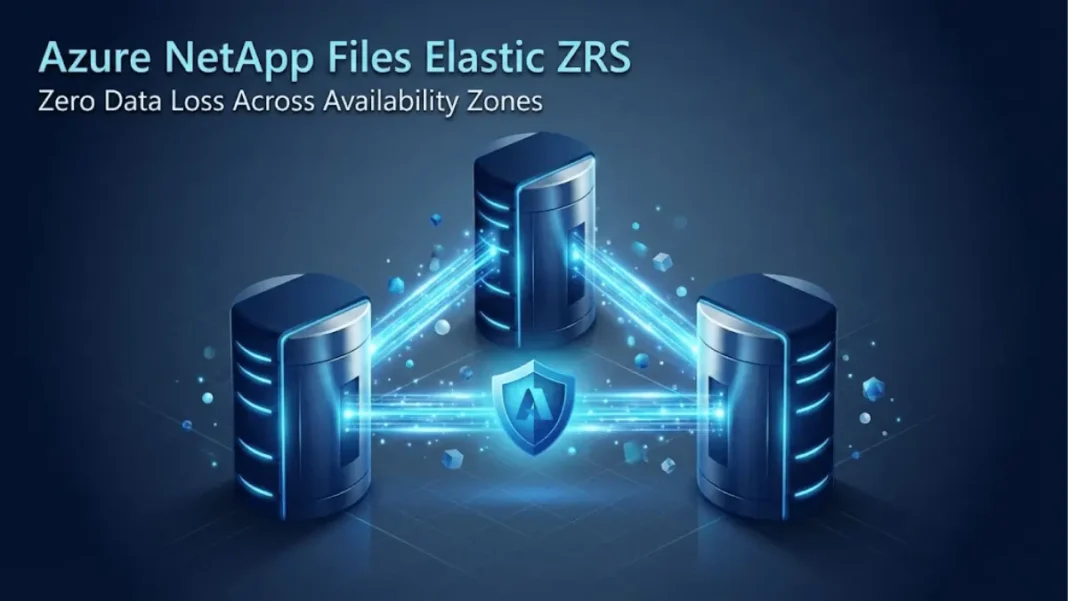
Microsoft launched Azure NetApp Files Elastic zone-redundant storage (ANF Elastic ZRS) on February 4, 2026, targeting enterprises where downtime costs thousands of dollars per minute. The service synchronously replicates data across multiple availability zones within a single Azure region, delivering zero data loss even when entire datacenters fail. Organizations running mission-critical applications from financial trading platforms to healthcare systems gain automatic failover without reconfiguring applications or changing storage endpoints.
How Azure NetApp Files Elastic ZRS Eliminates Single Points of Failure
Azure NetApp Files Elastic ZRS writes data simultaneously to three or more availability zones before acknowledging write completion. Each availability zone operates as an independent datacenter with separate power, cooling, and networking infrastructure. When an application sends data to ANF Elastic ZRS, the service confirms the write only after all zones successfully store identical copies.
Traditional zone-redundant strategies require managing multiple volumes or implementing cross-zone replication manually. ANF Elastic ZRS consolidates protection into a single service-managed volume, eliminating operational complexity while maintaining full capacity utilization.
What makes ANF Elastic ZRS different from standard zone-redundant storage?
ANF Elastic ZRS integrates NetApp ONTAP data management capabilities including snapshots, clones, and tiering with Azure’s zone-redundant infrastructure. Standard ZRS solutions replicate data but lack enterprise features like instant writeable snapshots or metadata performance optimization. ANF Elastic ZRS handles metadata-intensive operations through dynamic resource allocation that maintains low latency even during failover events.

Automatic Failover: Zero Manual Intervention Required
When an availability zone experiences power outages or datacenter failures, ANF Elastic ZRS automatically routes traffic to healthy zones within the region. Applications continue using the same mount target and service endpoint, no remounting, no IP address changes, no application reconfiguration.
Recovery Time Objective (RTO) approaches zero because failover zones already contain synchronized data. Recovery Point Objective (RPO) equals zero since synchronous replication guarantees no data loss. Financial services firms tested ANF Elastic ZRS during simulated zone failures and confirmed uninterrupted operations.
Healthcare organizations migrating mission-critical applications from on-premises to Azure adopt ANF Elastic ZRS to eliminate maintenance downtime. The service eliminates high availability cluster management complexity while improving SLA compliance.
Enterprise Data Management Features Beyond Basic Redundancy
Protocol Support and Multi-Workload Compatibility
ANF Elastic ZRS supports NFS (v3 and v4.1) and SMB protocols independently with full zonal redundancy. Kubernetes persistent volumes, containerized applications, and traditional enterprise file shares operate seamlessly across zone failures. Microsoft indicates future support for simultaneous multi-protocol access to enable NFS, SMB, and REST API access to identical datasets.
NetApp ONTAP-Powered Capabilities
Instant writeable snapshots consume minimal storage while enabling rapid recovery from ransomware attacks or accidental deletions. Space-efficient clones allow developers to spin up test environments from production data without duplicating terabytes. Automated tiering moves inactive data to lower-cost storage tiers while maintaining access through the same volume interface.
Backup integration with Azure NetApp Files backup service provides additional protection using zone-redundant storage accounts. Organizations in regulated industries satisfy compliance requirements for data retention and disaster recovery without managing separate backup infrastructure.

Cost Optimization Through Service-Managed Architecture
ANF Elastic ZRS is optimized for smaller workloads requiring zone-level resilience. Microsoft designed the service to be more cost-effective than provisioning and managing multiple duplicate volumes across availability zones. The single-volume architecture eliminates idle standby capacity while delivering identical protection.
Traditional approaches require provisioning three separate volumes and implementing custom replication logic, increasing operational overhead. ANF Elastic ZRS removes manual configuration requirements through fully managed synchronous replication.
Organizations reduce complexity by consolidating zone-redundant protection into Azure’s native service rather than building custom high availability solutions. The service handles capacity management, failover orchestration, and data synchronization without requiring dedicated DevOps resources.
Note: Specific per-region pricing for ANF Elastic ZRS is available through Azure pricing calculators. Contact Microsoft Azure support for detailed cost analysis based on your workload requirements.
Target Use Cases: When ANF Elastic ZRS Delivers Maximum Value
Financial Services and Trading Platforms
High-frequency trading systems processing millions of transactions per second require zero data loss guarantees. ANF Elastic ZRS maintains transaction integrity during zone failures while meeting regulatory requirements for data residency within single regions. Banks tested failover scenarios and confirmed trading operations continued without dropped transactions.
Kubernetes and Containerized Applications
Stateful applications running in Azure Kubernetes Service (AKS) depend on persistent volumes that survive node failures. ANF Elastic ZRS provides storage that remains accessible when entire availability zones become unavailable, preventing pod restarts and data corruption. Container orchestrators detect zone failures and reschedule pods to healthy zones while maintaining storage connectivity.
Enterprise File Shares and Home Directories
Corporate users accessing home directories and departmental shares experience uninterrupted service during maintenance windows or unexpected outages. IT teams eliminate weekend maintenance windows because ANF Elastic ZRS handles zone-level failures transparently without user impact.
SAP and Business-Critical Applications
SAP HANA shared files, transport directories, and interface systems benefit from ANF Elastic ZRS’s metadata optimization. Custom line-of-business applications developed over decades often lack built-in high availability features. ANF Elastic ZRS adds storage-layer resilience without requiring application code changes or HA cluster deployment.
Regional Availability and Expansion Timeline
ANF Elastic ZRS launched in February 2026 across six Azure regions:
- Australia East
- Central US
- South Central US
- Canada Central
- West US 3
- West Europe
Microsoft continues expanding regional availability throughout 2026. Organizations operating in other regions can request updates through Azure support channels or monitor Azure Updates for announcements.
[also_read url=”https://www.adwaitx.com/epam-microsoft-credentials-ai-training/”]Performance Characteristics: Metadata and Throughput Optimization
Dynamic Resource Allocation
ANF Elastic ZRS dynamically allocates resources across volumes during failover events, preventing performance degradation when traffic shifts between zones. Traditional storage systems experience latency spikes during failover as secondary systems absorb full workload. ANF Elastic ZRS maintains consistent latency because all zones actively participate in I/O operations.
Metadata-Intensive Workload Handling
Applications creating thousands of small files such as software builds, SAP transport directories, or log processing benefit from ANF Elastic ZRS’s optimized metadata handling. Fast file creation and enumeration operations complete efficiently compared to traditional cloud file storage. Developers running CI/CD pipelines notice improved build times when storing artifacts and test results in ANF Elastic ZRS volumes.
Service Architecture: Fully Managed Resilience
ANF Elastic ZRS operates as a service-managed storage solution eliminating manual intervention requirements. Microsoft handles capacity planning, replication configuration, and failover orchestration through automated systems.
The architecture provisions storage across multiple availability zones simultaneously, maintaining active-active data access patterns. Unlike traditional primary-secondary replication models, ANF Elastic ZRS allows applications to read and write from any zone, distributing I/O load naturally.
Failover decisions execute automatically based on Azure’s zone health monitoring. When a zone becomes unavailable, the service redirects mount points to healthy zones within seconds without requiring administrator intervention.
NetApp On-Premises Customers: Cloud Migration Simplified
Organizations running NetApp ONTAP systems in corporate datacenters face aging hardware refresh cycles and rising maintenance costs. ANF Elastic ZRS provides a migration target that preserves familiar data management workflows while eliminating infrastructure overhead.
NetApp SnapMirror technology replicates data from on-premises ONTAP systems to ANF Elastic ZRS volumes. IT teams test cloud deployments using replicated production data before cutover. Microsoft is developing migration tools to simplify the transition process.
Enterprises eliminate capital expenditures for storage array upgrades, reduce datacenter footprint, and shift to consumption-based pricing. ANF Elastic ZRS delivers the same snapshots, clones, and tiering features NetApp customers depend on without managing physical systems.
Integration with Azure Services
ANF Elastic ZRS integrates seamlessly with Azure Kubernetes Service for persistent volume claims. Kubernetes storage classes automatically provision zone-redundant volumes for stateful workloads.
Azure Virtual Desktop deployments use ANF Elastic ZRS for user profile containers and FSLogix profile management. Desktop virtualization environments maintain user session continuity during zone outages.
Azure Virtual Machines mount ANF Elastic ZRS volumes via standard NFS or SMB protocols. Enterprise applications running in VMs gain zone-level resilience without application-layer changes.
Security and Compliance Features
ANF Elastic ZRS supports Active Directory integration for SMB shares with granular access controls. Organizations enforce existing identity management policies without rearchitecting authentication systems.
Data encryption at rest protects stored information using Azure-managed keys or customer-managed keys in Azure Key Vault. In-transit encryption secures data moving between availability zones during synchronous replication.
Compliance certifications include ISO 27001, SOC 2, HIPAA, and regional standards required by financial services and healthcare sectors. Audit logs track access patterns and administrative actions for regulatory reporting.
Limitations and Considerations
ANF Elastic ZRS currently supports NFS and SMB protocols independently not simultaneously on the same volume. Organizations requiring concurrent multi-protocol access should monitor Azure Updates for future capability announcements.
Regional availability remains limited to six Azure regions at launch. Workloads deployed in other regions require alternative resilience strategies until expansion completes.
Minimum volume size of 1 GiB provides flexibility. Organizations migrating from traditional storage systems should plan capacity allocation based on workload requirements.
Getting Started with ANF Elastic ZRS
Prerequisites:
- Active Azure subscription with Azure NetApp Files enabled in supported regions
- Existing or new NetApp Account configured for zone-redundant deployment
- Network connectivity established between compute resources and ANF service endpoints
Deployment Steps:
- Navigate to Azure NetApp Files in Azure Portal and select Elastic zone-redundant storage service level
- Choose capacity pool configuration aligned with workload performance requirements
- Create volume with minimum 1 GiB size, select protocol type (NFS or SMB)
- Configure volume parameters including export policies for NFS or Active Directory integration for SMB
- Mount volume using standard NFS mount commands or SMB UNC paths
Volumes become available within minutes after provisioning completes. Applications connect using existing mount protocols without special configuration.

Frequently Asked Questions (FAQs)
What is the difference between ANF Elastic ZRS and standard Azure zone-redundant storage?
ANF Elastic ZRS integrates NetApp ONTAP data management features including snapshots, clones, and tiering with Azure’s zone-redundant infrastructure. Standard Azure Storage ZRS replicates data across zones but lacks enterprise capabilities like instant writeable snapshots or advanced metadata performance optimization. ANF Elastic ZRS also provides automatic failover with unchanged mount points.
How does ANF Elastic ZRS pricing compare to traditional multi-volume approaches?
Microsoft designed ANF Elastic ZRS to be cost-optimized for smaller workloads compared to managing multiple separate volumes. Specific pricing varies by region and service tier. Organizations should use Azure pricing calculators or contact Microsoft for detailed cost analysis.
Which Azure regions support ANF Elastic ZRS in 2026?
ANF Elastic ZRS launched in six regions: Australia East, Central US, South Central US, Canada Central, West US 3, and West Europe. Microsoft continues expanding regional availability throughout 2026.
Does ANF Elastic ZRS support both NFS and SMB simultaneously?
Currently, ANF Elastic ZRS supports NFS and SMB protocols independently on separate volumes. Microsoft has indicated future support for simultaneous multi-protocol access, though specific availability timelines have not been announced.
What happens to application mount points during zone failover?
Mount targets and service endpoints remain unchanged during failover. Applications experience a brief interruption while traffic redirects to healthy zones, then resume I/O operations without remounting or reconfiguration. The failover process is fully automated and requires no administrator intervention.
Can I migrate from on-premises NetApp ONTAP to ANF Elastic ZRS?
Yes. Organizations use NetApp SnapMirror for incremental replication from on-premises systems to ANF Elastic ZRS. Microsoft is developing migration tools to simplify the transition process. Contact Microsoft or NetApp support for migration planning assistance.
What is the minimum volume size for ANF Elastic ZRS?
ANF Elastic ZRS supports volumes starting at 1 GiB minimum size. This granularity enables precise capacity allocation for workloads of any scale without paying for unused storage.
Does ANF Elastic ZRS guarantee zero data loss during outages?
Yes. Synchronous replication across availability zones ensures zero data loss (RPO = 0) because writes complete only after all zones confirm storage. Recovery Time Objective approaches zero due to automatic failover to pre-synchronized zones.

