

The Quick Brief
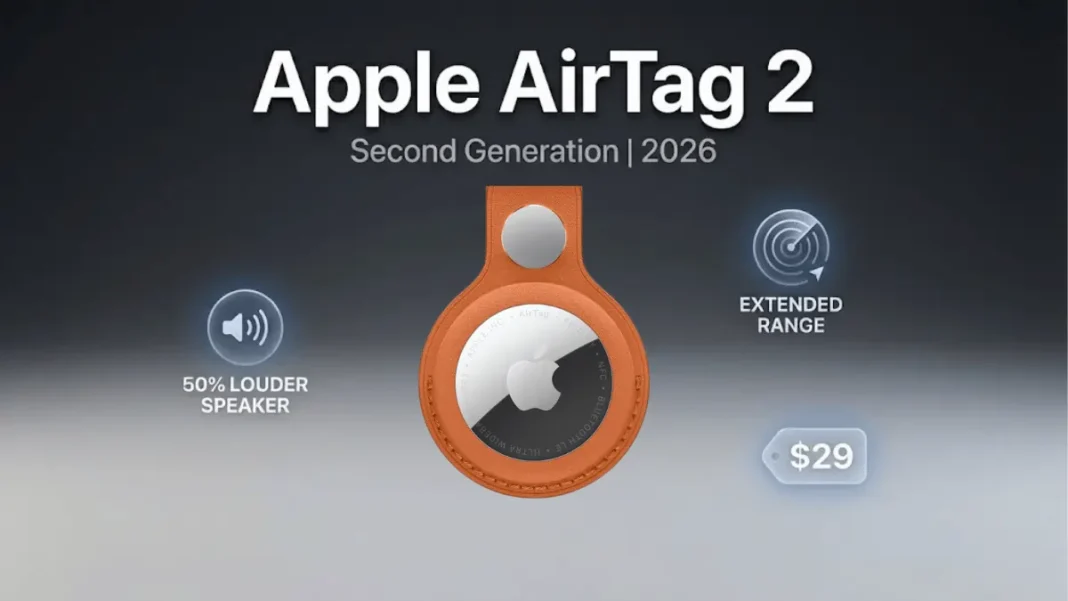
- The Launch: Apple debuts AirTag 2 with second-gen Ultra Wideband chip, 50% extended Precision Finding range, and 50% louder speaker priced at $29 (single) and $99 (four-pack), matching 2021 pricing.
- The Impact: Over 50 airline partners report 26% reduction in baggage delays and 90% drop in unrecoverable luggage using integrated Share Item Location feature.
- The Context: Five years after the original AirTag launch, Apple addresses enterprise logistics pain points while maintaining consumer accessibility through unchanged pricing and full backward compatibility.
Apple unveiled the second-generation AirTag on January 26, 2026, introducing significant hardware upgrades to its bestselling item tracker while maintaining the $29 single-unit price point established in 2021. The redesigned AirTag integrates Apple’s second-generation Ultra Wideband chip identical to the iPhone 17 lineup, iPhone Air, Apple Watch Ultra 3, and Apple Watch Series 11 delivering measurably improved findability across consumer and enterprise use cases.
The device becomes available for order immediately through apple.com and the Apple Store app, with retail availability at Apple Store locations later this week. Free personalized engraving remains available for online orders.
Hardware Upgrades Target Real-World Findability Challenges
The new AirTag incorporates three core hardware improvements designed to address common recovery scenarios. The second-generation Ultra Wideband chip extends Precision Finding range by 50% compared to the 2021 model, allowing users to locate items from significantly greater distances using haptic, visual, and audio feedback. An upgraded Bluetooth chip expands the maximum detection range for out-of-sight items.
Internal design modifications enable the AirTag to produce sound at 50% higher volume, effectively doubling the audible detection range. The distinctive new chime pattern aids identification in acoustically challenging environments such as luggage carousels or crowded spaces. For the first time, Apple Watch Series 9 or later and Apple Watch Ultra 2 or later support native Precision Finding for AirTag through watchOS 26.2.1, eliminating the need to retrieve an iPhone during active searches.

Enterprise Integration Delivers Measurable Logistics Impact
Apple’s partnership with over 50 airlines through the Share Item Location feature demonstrates quantifiable operational improvements. According to SITA, a global airline IT infrastructure provider, carriers using Share Item Location report a 26% reduction in baggage delay incidents and a 90% decrease in “truly lost” or unrecoverable luggage cases.
The Share Item Location system allows travelers to securely share real-time AirTag location data with airline customer service teams through authenticated access channels. Shared locations automatically expire after seven days or when the owner manually disables sharing, ensuring temporal data access limits. The system uses secure Apple Account or partner authentication protocols to restrict access to authorized airline personnel exclusively.
Technical Specifications Comparison
| Feature | AirTag (2026) | AirTag (2021) |
|---|---|---|
| Precision Finding Range | 50% extended | Baseline |
| Speaker Volume | 50% louder (2x audible range) | Baseline |
| Ultra Wideband Chip | 2nd generation | 1st generation |
| Bluetooth Range | Upgraded chip (expanded) | Standard |
| Apple Watch Precision Finding | Series 9+, Ultra 2+ | Not supported |
| Pricing (Single/Four-pack) | $29 / $99 | $29 / $99 |
| Recycled Plastic Content | 85% | Not disclosed |
| Form Factor Compatibility | Identical (full accessory compatibility) | Original |
Environmental Design Targets Apple 2030 Carbon Neutrality
The AirTag contributes to Apple’s 2030 carbon neutrality commitment through materials optimization. The enclosure contains 85% recycled plastic, while all magnets use 100% recycled rare earth elements. Apple-designed printed circuit boards incorporate 100% recycled gold plating, and packaging consists entirely of fiber-based materials designed for standard recycling infrastructure.
The unchanged form factor ensures compatibility with the existing AirTag accessory ecosystem, including the FineWoven Key Ring made from 68% recycled content and available in five colorways at $35.
Platform Requirements and Security Architecture
The new AirTag requires an iPhone with iOS 26 or later, or iPad with iPadOS 26 or later, with an active Apple Account signed into iCloud. The device maintains Apple’s anti-stalking architecture, including cross-platform unwanted tracking alerts and frequently rotating Bluetooth identifiers to prevent persistent tracking.
Location data never physically stores on the AirTag hardware, and end-to-end encryption protects all Find My network communication. Apple cannot access user location data or identify which devices contributed to location detection through the Find My network’s crowdsourced infrastructure.
Regulatory and Market Expansion Timeline
Precision Finding functionality remains unavailable in countries and regions where governments restrict Ultra Wideband technology deployment. The pricing strategy maintains accessibility for consumer markets while the Share Item Location enterprise features position AirTag as logistics infrastructure for global travel networks.
Frequently Asked Questions (FAQs)
How much does the new Apple AirTag cost in 2026?
The second-generation AirTag costs $29 for a single unit and $99 for a four-pack, identical to 2021 launch pricing.
What is the Precision Finding range improvement?
The new AirTag extends Precision Finding range by 50% compared to the first-generation model through its second-gen Ultra Wideband chip.
Is the new AirTag compatible with old accessories?
Yes, the AirTag maintains the identical form factor, ensuring full compatibility with all existing AirTag accessories from 2021 onward.
How much louder is the new AirTag speaker?
The redesigned internal speaker produces 50% higher volume, effectively doubling the audible detection distance in real-world environments.
When is the new AirTag available to purchase?
Orders opened January 26, 2026, on apple.com and the Apple Store app, with retail availability at Apple Store locations later this week.

