

Quick Brief
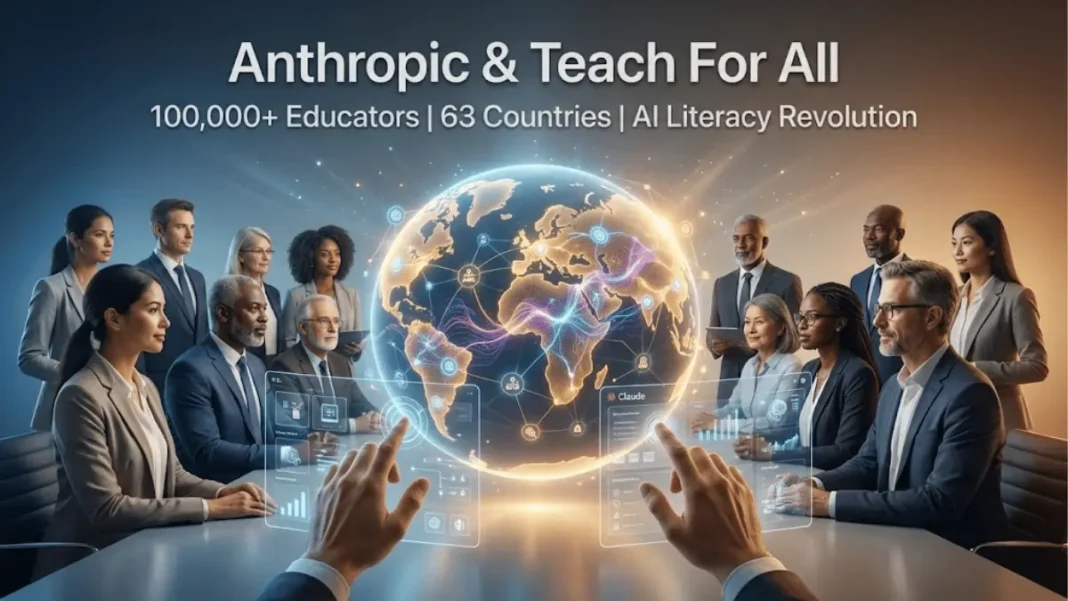
- The Partnership: Anthropic deploys Claude AI across Teach For All’s 63-country network, targeting 100,000+ teachers and alumni serving 1.5 million students through the AI Literacy & Creator Collective
- The Programs: Three interconnected initiatives: AI Fluency Learning Series (530+ educators in first series), Claude Connect (1,000+ educators), and Claude Lab (200+ applications in 4 days)
- The Context: Follows Anthropic’s national AI education pilot in Iceland and Rwanda government partnership, signaling education infrastructure expansion
- Initial Results: Educators in Liberia, Bangladesh, and Argentina have built curriculum tools using Claude Artifacts within weeks of training
Anthropic announced a global education partnership with Teach For All on January 16, 2026, deploying its Claude AI platform to over 100,000 teachers and alumni across 63 countries. The AI Literacy & Creator Collective initiative provides educators with AI training, tools, and direct input into Claude’s product development, according to Wendy Kopp, CEO of Teach For All. The partnership serves Teach For All’s network of 1.5 million students in under-resourced schools spanning organizations like Teach For India, Enseña Chile, and Teach For Nigeria.
AI Literacy & Creator Collective: Three-Program Structure
The collective operates through three interconnected programs. The AI Fluency Learning Series consists of six live episodes covering AI fluency, Claude capabilities, and practical classroom applications, with over 530 educators attending the first series in November 2025. Claude Connect serves as the ongoing learning hub where more than 1,000 educators representing 60+ countries exchange prompts, use cases, and discoveries through daily peer-to-peer conversation.
Claude Lab provides educators with Claude Pro access to test advanced implementations, monthly office hours with the Anthropic team, and opportunities to directly inform Claude’s product roadmap. The Claude Lab component received over 200 applications within four days of announcement.
Teach For All’s network spans 15 years of operations across independent, locally-led organizations. “For AI to reach its potential to make education more equitable, teachers need to be the ones shaping how it’s used and providing input on how it’s designed,” Kopp stated.

AdwaitX Analysis: Strategic Positioning in Education AI Market
Anthropic’s approach embeds educators in product development cycles by allowing teachers to provide direct feedback on Claude’s roadmap. The timing aligns with Anthropic’s broader institutional strategy. The company launched Iceland’s national AI education pilot in November 2025, providing Claude to hundreds of teachers across all regions. In Rwanda, Anthropic partnered with the government and ALX to deliver AI education to hundreds of thousands of African learners.
Michael Gilmore, COO of Teach for Australia, noted the initiative provides “significant learning around responsible AI implementation” for organizations navigating technical opportunities. Anthropic participates in the White House Taskforce on AI Education, positioning the company to influence U.S. federal AI education policy.
Classroom Implementation: Early Adoption Results
Educators are deploying Claude for curriculum development and student engagement tools. A teacher in Liberia with no prior AI experience attended AI LCC live training and built an interactive climate education curriculum for Liberian schools using Claude Artifacts within weeks. In Bangladesh, an educator designed a gamified math learning app targeting Grade 6 and 7 students with numeracy challenges.
Rosina Bastidas, a tech educator at Enseña por Argentina, developed multiple educational artifacts and interactive digital workspaces aligned with national curriculum standards. Oscar Onuoha, IT Lead at Teach For Nigeria, reported the partnership connected his organization with a community navigating similar technical opportunities.
| Implementation Area | Tool Type | Geography | Target Impact |
|---|---|---|---|
| Climate Education | Interactive Curriculum (Claude Artifacts) | Liberia | National school deployment |
| Math Literacy | Gamified Learning App | Bangladesh | Grades 6-7 numeracy improvement |
| Digital Workspaces | Curriculum-Aligned Tools | Argentina | Multi-subject implementation |
Expansion Roadmap and Policy Engagement
Anthropic participates in the White House Taskforce on AI Education, engaging with U.S. federal AI education policy while gathering insights for product development. The Teach For All partnership extends engagement to 63 countries simultaneously, creating a global feedback mechanism.
The company’s education initiatives build on its August 2025 launch of a Higher Education Advisory Board and AI Fluency frameworks for campus-level implementation. Gilmore confirmed Teach for Australia’s commitment to continued participation in 2026.
Frequently Asked Questions (FAQs)
What is the Anthropic Teach For All partnership?
A global AI training initiative deploying Claude to 100,000+ educators across 63 countries through the AI Literacy & Creator Collective, providing teachers with training and product development input.
How many students does this partnership impact?
The Teach For All network serves over 1.5 million students in under-resourced schools across 63 countries through organizations like Teach For India and Teach For Nigeria.
What are the three programs in the AI Literacy & Creator Collective?
AI Fluency Learning Series (six live episodes, 530+ educators), Claude Connect (1,000+ educators exchanging use cases), and Claude Lab (Claude Pro access with monthly Anthropic office hours).
How are teachers using Claude in classrooms?
Educators build interactive curriculum tools, gamified learning apps, and digital workspaces using Claude Artifacts. Examples include climate education in Liberia and math apps in Bangladesh.
What government partnerships does Anthropic have in education?
Anthropic operates a national AI education pilot in Iceland (launched November 2025), partners with Rwanda’s government and ALX, and participates in the White House Taskforce on AI Education.

