

Quick Brief
- The Technology: Ant Digital Technologies’ ZOLOZ platform deploys multi-layered AI eKYC combining biometric verification, liveness detection, anti-injection controls, and dynamic risk policies achieving 99.8% deepfake detection accuracy
- The Scale: Currently serves 100+ million users across GCash (Philippines), TnGD (Malaysia), bKash (Bangladesh), and Mandiri Bank (Indonesia)
- The Impact: Reduces remote onboarding from days to 3 minutes while blocking face-swap attacks, replay attempts, and forged documents
- The Market: Global eKYC market projected to reach $3.56 billion by 2033 at 17.74% CAGR, driven by digital banking growth and AML compliance demands
Ant Digital Technologies announced on January 13, 2026, a comprehensive framework for AI-driven electronic Know Your Customer (eKYC) verification designed to combat the acceleration of deepfake attacks and synthetic identity fraud. Published via Alibaba Cloud’s developer blog, the approach treats digital identity proofing as defense-in-depth rather than single-point validation, addressing the industry-wide challenge of face-swap videos, replay attempts, and forged documents bypassing traditional KYC controls.
What’s New: Four-Layer Defense Architecture
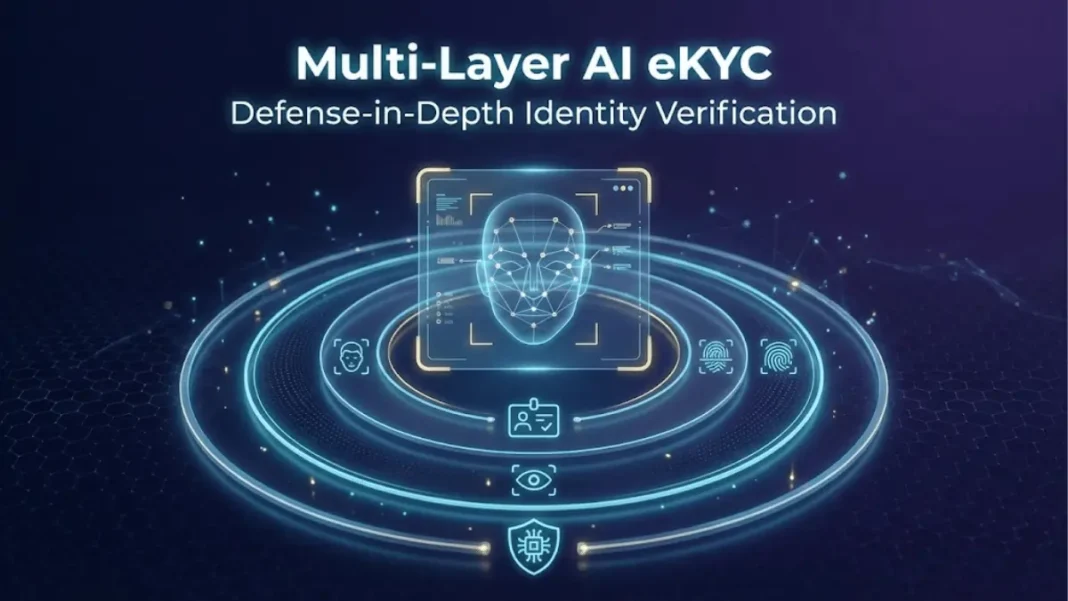
Ant Digital Technologies structures its ZOLOZ eKYC platform around four integrated verification layers. The first layer deploys AI-driven biometric verification paired with document authentication to establish a measurable trust baseline. Layer two implements active and passive liveness detection combined with anti-injection checks to deter photos, replays, and face-swap attacks technologies aligned with industry-recognized Presentation Attack Detection (PAD) standards.
The third layer introduces policy-driven risk controls that dynamically elevate verification intensity only when signals indicate elevated risk, maintaining fast user journeys for the majority of sessions. The fourth layer provides developer-friendly SDKs and APIs enabling consistent experiences across mobile and web channels with secure capture, upload, and callback handling.
Ant Digital Technologies reports the system supports configurable risk levels standard, loose, and strict adaptable by channel and use case. The platform covers over 25 countries and 10,000+ document types, with face verification completing in 2 seconds and full RealID checks finishing in 3 minutes.

Why It Matters: Enterprise Adoption at Scale
Financial institutions and digital platforms face mounting pressure as generative AI tools lower the barrier for producing convincing deepfakes. Ant Digital Technologies’ multi-layered approach directly addresses this gap: its anti-deepfake measures achieved a detection rate exceeding 99.8% in live payment fraud scenarios, according to the company’s December 2025 NeurIPS competition win.
Major deployments illustrate commercial traction. GCash in the Philippines, TnGD (16 million verified users) in Malaysia, bKash (23 million e-wallet users) in Bangladesh, Dana in Indonesia, and Mandiri Bank collectively represent over 100 million users onboarded via ZOLOZ eKYC solutions. TnGD’s CTO Leslie Lip M F confirmed ZOLOZ verifies the company’s entire 16 million user base while securing transactions and preventing money laundering.
The broader eKYC market validates this trajectory. Industry analysts forecast the global eKYC sector will expand from $805.8 million in 2024 to $3.56 billion by 2033 with a compound annual growth rate of 17.74% driven by digital banking adoption, stringent AML regulations, and rising financial fraud concerns.
Technical Specifications: How Defense Layers Integrate
| Layer | Technology | Attack Vector Blocked | Processing Time |
|---|---|---|---|
| Document Authentication | OCR + AI forgery detection | Tampered IDs, fake certificates | Real-time |
| Biometric Match | Facial recognition (99% confidence) | Identity mismatch | 2 seconds |
| Liveness Detection | Active (blink-based) + Passive (multi-frame consistency) | Photos, videos, 3D masks | Milliseconds |
| Anti-Injection | Multi-angle capture + device metadata | Replays, face-swap, presentation attacks | Real-time |
| Risk Policy Engine | Dynamic step-up based on session signals | Coordinated fraud, account takeover | Adaptive |
Ant Digital Technologies employs a Mixture of Experts (MoE) neural architecture that trains competing sub-networks one focused on detecting deepfakes, the other challenging it to ignore demographic traits ensuring the system learns manipulation signals rather than demographic patterns. This design supports fairness across 200 global markets while maintaining high accuracy.
The platform integrates with existing infrastructure via RESTful APIs and mobile SDKs, enabling progressive step-up verification that minimizes user disruption. Privacy-by-design principles include data minimization and regional controls aligned with GDPR and local data residency requirements.
Use Cases Across Verticals
Ant Digital Technologies identifies five primary deployment scenarios:
- Banking & Fintech: Remote account opening, account recovery, and high-risk transaction step-up authentication
- Payments & Marketplaces: Merchant and consumer verification, dispute control, chargeback risk reduction
- Telco & Mobility: eSIM registration, driver onboarding for ride-hailing platforms, safety controls
- Digital Assets: Dynamic step-up verification before large cryptocurrency transfers or withdrawals triggered by risk signals plus liveness checks
- Government Services: Subsidy distribution and identity verification for financial inclusion programs bKash deployed ZOLOZ to distribute COVID-19 aid to 5 million Bangladeshi families
WeLab Bank and Kenanga Investment Bank (Malaysia’s first wealth-centric super app) leverage Ant Digital Technologies’ mobile Platform-as-a-Service (mPaaS) alongside ZOLOZ for unified identity verification and user behavior analytics.
What’s Next: Adaptive Defense Roadmap
Ant Digital Technologies commits to ongoing investment in anti-deepfake defenses, adaptive risk modeling, and developer experience to sustain compliant, scalable risk management as threats evolve. The company updates models and policies continuously, employs multi-frame and multi-angle capture techniques, and monitors emerging attack vectors to maintain protection as generative AI techniques advance.
In October 2025, Ant Digital Technologies joined Hong Kong Monetary Authority’s second Generative AI Sandbox to test advanced deepfake defense mechanisms for financial institutions, working with Fubon Bank on AI-powered mobile banking assistants. The company showcased full-scenario AI solutions at Hong Kong FinTech Week (November 2025) and Dubai FinTech Summit (May 2025), emphasizing integration of large-model agents, knowledge engineering, and full-stack risk control.
Regulatory frameworks are tightening in parallel. The United States saw 72% of adults use online banking in 2023, intensifying demand for BSA and AML-compliant eKYC solutions per FinCEN guidelines. The UK is accelerating adoption through digital identity trust frameworks and data protection compliance mandates.

Frequently Asked Questions (FAQs)
How does Ant Digital Technologies’ eKYC differ from single-layer verification?
Combines document authentication, biometric match, liveness detection, and risk-based policies to address multiple attack paths, deepfakes, replays, forged IDs simultaneously rather than relying on one control.
What is the verification success rate for ZOLOZ eKYC?
Over 90% for remote onboarding, with 99.8% deepfake detection accuracy and 99% stable biometric recognition confidence.
Which industries adopt multi-layered eKYC most rapidly?
Banking, digital payments, telecommunications, ride-hailing platforms, and cryptocurrency exchanges requiring high-risk transaction step-up and AML compliance.
Does multi-layer eKYC slow down user onboarding?
No. Ant Digital Technologies reduces verification from days to 3 minutes via automation; dynamic risk policies elevate checks only for flagged sessions.
How does the system prevent bias in AI face detection?
Uses Mixture of Experts architecture training competing networks to detect manipulation not demographics validated across 200 markets for fairness and accuracy.

