

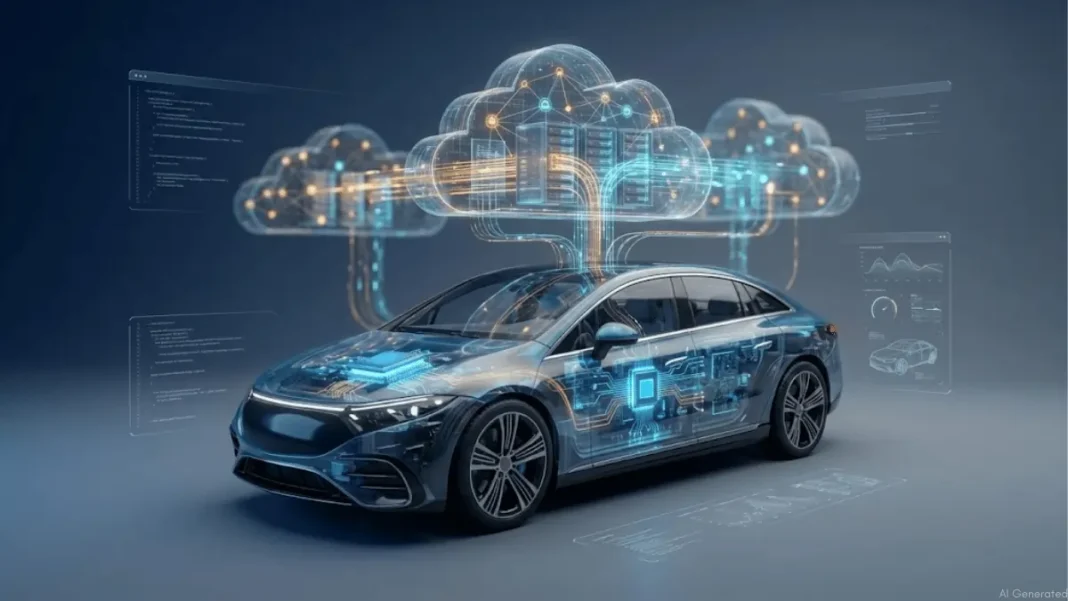
AMD announced its Virtualized Automotive Stack (VAS) on January 2, 2026, enabling automotive developers to test software-defined vehicle (SDV) code in the cloud. The stack runs on AMD Radeon PRO V710 GPUs and EPYC CPUs via Azure’s NVads V710 v5-series virtual machines, now available globally. This marks the first time nested virtualization is supported on Azure GPU instances, allowing OEMs and Tier-1 suppliers to simulate mixed-criticality workloads like safety systems and infotainment without physical hardware.
What AMD Announced
AMD introduced VAS as part of a three-way collaboration with Microsoft Azure and Siemens. The stack includes VirtIO for I/O devices and the Xen Hypervisor running atop Microsoft Hyper-V, creating a nested virtualization environment. Developers can now validate SDV software earlier in the design cycle using cloud infrastructure instead of waiting for prototype vehicles.
Siemens’ PAVE360 digital twin platform is now integrated with VAS on Azure. A CES 2026 demo showcased autonomous driving software controlling a physical RC car through PAVE360 running on AMD’s cloud stack. The NVads V710 v5-series VMs feature up to 28 GB GDDR6 memory and 4th Gen AMD EPYC CPUs clocked at 4.3 GHz.
Why This Matters for Automotive Development
Shift-left development testing software earlier in the cycle reduces costs and accelerates time-to-market. Traditional automotive workflows require physical ECUs and prototype vehicles for validation, creating bottlenecks. Cloud-based simulation eliminates those dependencies.
The nested virtualization capability is critical because modern vehicles run mixed-criticality workloads on centralized system-on-chips. Safety-critical functions like braking must remain isolated from non-critical apps like navigation. VAS with Xen provides that isolation in a virtual environment, letting developers catch integration issues before hardware builds.
How VAS Compares to Traditional Methods
| Method | Hardware Needed | Testing Phase | Scalability |
|---|---|---|---|
| Traditional bench testing | Physical ECUs required | Mid-to-late cycle | Limited by units |
| VAS cloud simulation | None (virtual instances) | Early cycle | Elastic via Azure |
| Digital twin + VAS | None | Continuous | High parallelization |
The combination of AMD graphics tech and Siemens simulation tools enables system-level validation that previously required expensive hardware labs.
What Happens Next
AMD’s VAS stack is already deployed across multiple Azure regions worldwide. Automotive developers can provision NVads V710 v5 instances today through Azure’s console. Siemens will showcase full autonomous vehicle workflows running entirely on the cloud stack at CES 2026 in booth #4352.
The broader industry trend toward software-defined vehicles depends on cloud infrastructure for early validation. AMD’s move enables smaller suppliers to access enterprise-grade simulation without capital investments in on-premises GPU clusters. Expect more OEMs to adopt cloud-first development strategies as nested virtualization matures.
Featured Snippet Boxes
What is AMD’s Virtualized Automotive Stack?
AMD’s VAS is a cloud-based software stack combining VirtIO, Xen Hypervisor, and AMD hardware (Radeon PRO V710 GPUs, EPYC CPUs) on Azure. It enables automotive developers to simulate and test software-defined vehicle workloads without physical hardware, supporting shift-left development practices.
Why is nested virtualization important for car software?
Nested virtualization lets developers run hypervisors inside Azure virtual machines, simulating how modern vehicles handle mixed-critical tasks like safety systems and entertainment on one chip. This isolation ensures safety-critical code remains secure during cloud-based testing.
Which companies can use AMD VAS on Azure?
Any automotive OEM, Tier-1 supplier, or software developer with Azure access can deploy NVads V710 v5 instances running VAS. The service is live globally and integrates with Siemens PAVE360 for digital twin workflows.
How does shift-left reduce automotive development costs?
Shift-left moves software testing from late-stage prototype builds to early design phases using simulation. Catching bugs in virtual environments costs significantly less than fixing them in physical vehicles, while cloud scalability eliminates hardware procurement delays.

