

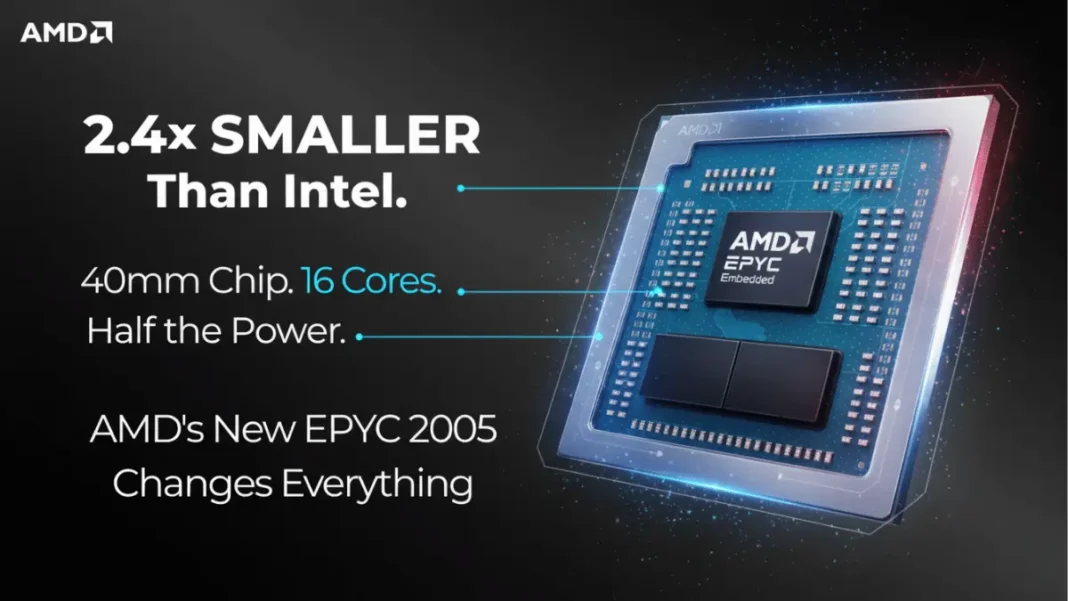
Summary: AMD announced the EPYC Embedded 2005 Series on December 9, 2025 their first BGA-packaged embedded EPYC processors since 2018. Built on Zen 5 architecture with up to 16 cores, these chips deliver 28% higher boost frequencies and 35% higher base frequencies than Intel Xeon 6503P-B at half the TDP (45-75W). The 40mm × 40mm BGA package is 2.4x smaller than Intel’s competing solution. With 28 PCIe Gen5 lanes, DDR5 support, advanced RAS features, and a guaranteed 10-year operational lifetime, the 2005 series targets networking, storage, industrial, and AI edge systems requiring compact, power-efficient, long-life designs. Mass production begins Q1 2026.
AMD has launched the EPYC Embedded 2005 Series processors, marking the company’s return to BGA-packaged embedded CPUs after a seven-year gap. These Zen 5-powered chips pack up to 16 cores into a 40mm × 40mm footprint 2.4 times smaller than Intel’s competing Xeon 6500P-B series while delivering superior performance per watt for space-constrained networking, storage, and industrial applications.
What Is AMD EPYC Embedded 2005 Series?
The AMD EPYC Embedded 2005 Series represents AMD’s first modern BGA (ball grid array) embedded processor platform since the original Zen 1-based Snowy Owl processors from 2018. Built on the proven Zen 5 architecture and Fire Range platform (the same foundation as Ryzen 9050HX gaming laptop processors), these chips bring desktop-class performance to embedded systems requiring strict thermal, space, and reliability constraints.
Key Specs at a Glance
The EPYC Embedded 2005 Series offers 8-16 Zen 5 cores, 32-64MB L3 cache, configurable 45-75W TDP, 28 PCIe Gen5 lanes, DDR5 memory support, and a 40mm × 40mm BGA package. AMD rates these processors for 10 years of continuous operation with availability guaranteed through 2036 and potential deployment through 2046.
AMD EPYC Embedded 2005 Technical Specifications
Complete SKU Breakdown
AMD is launching three SKUs differentiated by core count, cache, and TDP:
| Model | Cores/Threads | L3 Cache | Base Clock | Boost Clock | TDP (cTDP Range) |
|---|---|---|---|---|---|
| EPYC 2435 | 8C/16T | 32MB | TBD | TBD | 55W (45-65W) |
| EPYC 2655 | 12C/24T | 64MB | 2.7 GHz | 4.5 GHz | 55W (45-65W) |
| EPYC 2875 | 16C/32T | 64MB | TBD | TBD | 75W (45-75W) |
All three models feature configurable TDP (cTDP) down to 45W, enabling system designers to optimize for specific thermal envelopes.
Architecture Deep Dive: Fire Range Platform
The EPYC Embedded 2005 series utilizes AMD’s Fire Range platform, which combines TSMC 4nm Zen 5 chiplets (CCDs) with a TSMC 6nm I/O die, the same configuration used since the Zen 4 era. This isn’t bleeding-edge silicon; rather, it’s battle-tested hardware now receiving AMD’s full enterprise feature set for embedded deployments.
The 12-core 2655 model uses two 8-core CCDs (one partially disabled), explaining its 64MB L3 cache allocation 32MB per CCD.
Memory and I/O Configuration
- Memory: DDR5 support with ECC capability (DDR4 not supported, addressing end-of-life migration)
- PCIe: 28 lanes of PCIe Gen5 (engineers can aggregate up to 16 lanes for high-speed NICs, FPGAs, or networking ASICs)
- Package: FL1 BGA socket, 40mm × 40mm footprint, 1,763-ball array
Performance Analysis: AMD vs Intel Comparison
EPYC 2005 vs Intel Xeon 6500P-B
AMD’s internal benchmarks position the EPYC Embedded 2655 (12-core, 55W TDP) directly against Intel’s Xeon 6503P-B (12-core, 110W TDP):
- 28% higher boost CPU frequency (4.5 GHz vs 3.5 GHz)
- 35% higher base CPU frequency (2.7 GHz vs 2.0 GHz)
- 50% lower TDP (55W vs 110W)
- 2.4x smaller package (1,600mm² vs 3,875mm²)
These comparisons highlight AMD’s performance-per-watt advantage in constrained embedded environments where every millimeter and watt matters.
Real-World Performance Scenarios
For networking workloads like DPU control planes and switches, the combination of high clock speeds and PCIe Gen5 bandwidth enables handling AI-driven traffic management without thermal throttling. In cold storage applications, the lower TDP reduces cooling infrastructure costs while maintaining 24/7 operational reliability.
Key Features and Capabilities
Zen 5 Architecture Benefits
Zen 5 delivers improved instructions-per-clock (IPC) over previous generations, enhanced branch prediction, and optimized power gating for idle efficiency. The architecture’s modular design allows AMD to scale from 8 to 16 cores within the same thermal envelope.
PCIe Gen5 and DDR5 Support
The 28 PCIe Gen5 lanes provide 128 GT/s of raw bandwidth, double that of Gen4 enabling high-speed connectivity to 100GbE+ network cards, NVMe storage arrays, and FPGA accelerators. DDR5 memory supports future-proof designs as DDR4 reaches end-of-life, offering higher bandwidth for data-intensive embedded applications.
Advanced Security Features
AMD Infinity Guard encompasses:
- AMD Secure Processor: Dedicated on-chip security processor establishing hardware root of trust
- Platform Secure Boot: Ensures firmware integrity from power-on
- Memory Guard: Hardware-based memory encryption protecting data at rest and in transit
Reliability and RAS Features
Enterprise-grade Reliability, Availability, and Serviceability (RAS) features include:
- ECC memory support with advanced error logging
- Baseboard Management Controller (BMC) integration
- PCIe Hot Plug capability
- Multi-SPI ROM support for redundant boot paths
Target Applications and Use Cases
Networking Infrastructure
Network switches, routers, and SmartNICs benefit from the high I/O density and low latency of Zen 5 cores handling packet processing, traffic shaping, and security offloads.
Storage Systems
Cold cloud storage controllers and NAS appliances leverage the EPYC 2005’s power efficiency to manage large drive arrays without excessive cooling requirements.
Industrial and Edge Computing
Robotics, aerospace systems, and factory automation require the 10-year operational guarantee and extended temperature ranges that embedded EPYC processors provide.
AI-Driven Embedded Workloads
AI inference at the edge whether for video analytics, predictive maintenance, or autonomous systems demands the compute density that 16 Zen 5 cores deliver in a compact footprint.
Package Design and Integration
BGA Form Factor Advantages
The BGA (ball grid array) package offers several benefits over socketed designs:
- Higher I/O density: Shorter electrical paths improve signal integrity
- Superior thermal management: Direct die-to-heatsink contact possible
- Reduced system cost: Eliminates socket and mechanical assembly costs
- Vibration resistance: Critical for industrial and aerospace deployments
Thermal Management (45W-75W TDP)
Configurable TDP allows system designers to balance performance and cooling complexity. A fanless design might target 45W, while actively cooled systems can leverage the full 75W for maximum throughput.
Long-Term Support and Availability
10-Year Product Lifecycle
AMD commits to:
- 10 years of continuous operation (systems deployed in 2026 rated through 2036)
- 10 years of component ordering (parts available through 2036)
- 15 years of software maintenance (BIOS, drivers, security updates through 2041)
This longevity is essential for industries like industrial automation and defense where equipment lifespans exceed typical consumer hardware cycles.
Software Ecosystem and Compatibility
The EPYC Embedded 2005 series supports:
- Yocto Project for custom Linux builds
- Upstream kernel drivers (no proprietary modules required)
- EDK II (UEFI) for firmware development
This open-source foundation accelerates integration and reduces vendor lock-in.
AMD EPYC Embedded 2005 vs Competitors
| Feature | AMD EPYC 2005 | Intel Xeon 6500P-B | AMD EPYC Embedded 9005 |
|---|---|---|---|
| Architecture | Zen 5 | Granite Rapids-D | Zen 5c |
| Max Cores | 16 | Up to 20+ | Up to 128 |
| Package | 40×40mm BGA | 77.5×50mm BGA | SP5 Socket (LGA) |
| TDP Range | 45-75W | 110W+ | 200W+ |
| PCIe Support | 28 Gen5 lanes | Up to 64 Gen5 lanes | Up to 160 Gen5 lanes |
| Target | Space-constrained embedded | High-density edge | Data center edge |
| Availability | Q1 2026 | Available now | Available now |
Generation-to-Generation Improvement
| Specification | EPYC Embedded 3001 (2018) | EPYC Embedded 2005 (2025) | Improvement |
|---|---|---|---|
| Architecture | Zen 1 | Zen 5 | 4 generations |
| Max Cores | 16 | 16 | No change |
| PCIe | Gen3 | Gen5 | 4x bandwidth |
| Memory | DDR4 | DDR5 | ~2x bandwidth |
| Package | BGA (different) | 40×40mm BGA | Smaller footprint |
| Support | 10 years | 10 years | Consistent |
The EPYC 2005 fills the gap between Intel’s aging Ice Lake-D and the much larger Granite Rapids-D, offering a Goldilocks solution for moderate-scale embedded deployments.
Pros and Cons
Advantages
2.4x smaller package than Intel Xeon 6500P-B critical for space-constrained designs
Superior performance per watt: 28% higher boost clocks at half the TDP
10-year operational guarantee with 15-year software support
PCIe Gen5 and DDR5 future-proof connectivity
Enterprise RAS features rare in embedded processors
Open-source software ecosystem reduces integration friction
Limitations
Not shipping until Q1 2026 competitors available now
Limited to 16 cores EPYC 9005 series scales higher for data center edge
No integrated accelerators (AI, crypto) relies on discrete solutions
BGA package eliminates field upgrades commits to specific SKU
Pricing not disclosed TCO comparison incomplete
Pricing and Availability
AMD has not released official pricing for the EPYC Embedded 2005 series. The processors are currently sampling to customers, with mass production scheduled for Q1 2026. Historically, embedded processors command premium pricing due to extended support commitments and industrial qualification testing.
System integrators should expect pricing aligned with Intel’s Xeon 6500P-B series (estimated $500-$1,200 per unit depending on core count), though AMD’s power efficiency may deliver lower total cost of ownership (TCO) in high-density deployments.
What This Means for Embedded Systems
The EPYC Embedded 2005 Series represents AMD’s most aggressive play for space-constrained embedded markets in years. By pairing proven Zen 5 architecture with enterprise RAS features and a laptop-sized BGA package, AMD directly challenges Intel’s dominance in networking equipment, storage appliances, and industrial controllers.
For system architects designing the next generation of AI-driven edge infrastructure, the 2005 series offers a compelling balance: desktop-class performance without desktop-class power budgets or board real estate. The 10-year support commitment reduces long-term risk for industries where product lifecycles outlast typical consumer hardware refresh cycles.
As AI workloads increasingly migrate to the edge whether for real-time video analytics, autonomous systems, or distributed storage processors like the EPYC Embedded 2005 become the computational foundation enabling that transformation.
Featured Snippet Boxes
What is AMD EPYC Embedded 2005 Series?
The AMD EPYC Embedded 2005 Series is a family of Zen 5-based BGA processors designed for networking, storage, and industrial systems. Featuring 8-16 cores, 45-75W TDP, and a 40mm × 40mm package 2.4x smaller than Intel Xeon 6500P-B, these chips deliver 10-year operational longevity with PCIe Gen5 and DDR5 support.
When does AMD EPYC Embedded 2005 launch?
AMD EPYC Embedded 2005 processors are sampling to partners in December 2025, with mass production scheduled for Q1 2026. The three SKUs (2435, 2655, 2875) will be available for order starting early 2026 with 10-year availability commitments.
AMD EPYC 2005 vs Intel Xeon 6500P-B: Which is better?
AMD EPYC Embedded 2655 offers 28% higher boost clocks (4.5 GHz vs 3.5 GHz) and 35% higher base clocks (2.7 GHz vs 2.0 GHz) than Intel Xeon 6503P-B at half the TDP (55W vs 110W). AMD’s package is also 2.4x smaller (1,600mm² vs 3,875mm²).
What are the key features of EPYC Embedded 2005?
Key features include Zen 5 architecture (up to 16 cores), 28 PCIe Gen5 lanes, DDR5 ECC memory, AMD Infinity Guard security (Secure Processor, Memory Guard), advanced RAS, and a 40mm × 40mm BGA package. AMD guarantees 10 years of operation and 15 years of software support.
What applications use AMD EPYC Embedded 2005?
Target applications include network switches and routers, DPU control planes, cold cloud storage systems, industrial automation (robotics, aerospace), edge AI inference servers, and 24/7 embedded computing requiring compact, power-efficient designs with long-term reliability.
How long will AMD support EPYC Embedded 2005?
AMD commits to 10 years of continuous operation rating (2026-2036), 10 years of component ordering availability, and 15 years of software maintenance including BIOS, drivers, and security updates. Systems deployed in 2026 may operate through 2046.

