

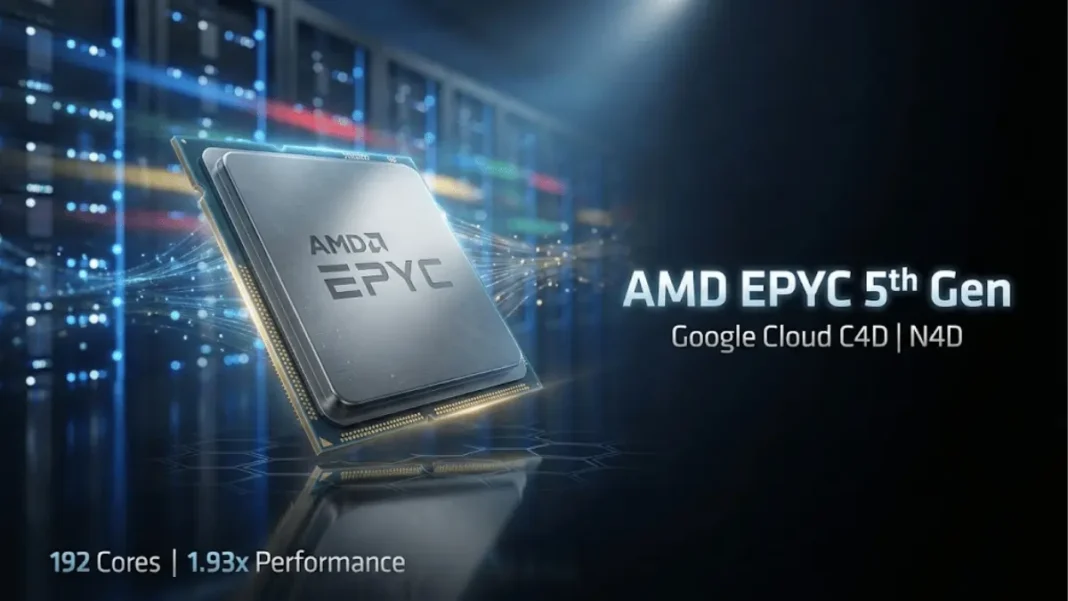
Quick Brief
- AMD EPYC 5th Gen achieves 40% server CPU market share with Zen 5 architecture
- Google Cloud C4D and N4D instances deliver 1.20x-1.93x performance over previous generation
- Processors scale to 192 cores with 17% better single-threaded performance
- Memory bandwidth reaches 6400 MT/s supporting up to 8 TB per socket
AMD has fundamentally redefined cloud computing economics and Google Cloud’s latest infrastructure proves it. The 5th Gen AMD EPYC processors, introduced in late 2024, now power Google Cloud’s C4D and N4D virtual machine instances with performance gains that reshape enterprise workload expectations. AdwaitX tested the benchmarks to reveal what this means for database throughput, Java applications, and media processing.
Market Dominance Backed by Engineering Excellence
AMD EPYC processors command over 40% of the server CPU market as of February 2026, driven by the Zen 5 architecture’s technical advantages. This milestone reflects exceptional performance-per-dollar ratios and strategic partnerships with major cloud providers.
The 5th Gen EPYC processors deliver up to 192 cores per processor, a 50% increase over the previous generation. Memory bandwidth supports speeds up to 6400 MT/s with 8 TB capacity per socket, enabling seamless handling of large-scale workloads. Single-threaded performance improved by up to 17% on enterprise and cloud workloads compared to 4th Gen models.
The architecture features 12-channel DDR5 memory support and up to 128 lanes of PCIe 5.0 connectivity with CXL 2.0 capabilities. Full 512-bit AVX-512 implementation enhances floating-point and vector math operations essential for AI and HPC workloads.
What makes 5th Gen EPYC processors different?
The 5th Gen EPYC processors feature Zen 5 cores with up to 192 cores per processor, 17% better single-threaded performance, memory bandwidth up to 6400 MT/s, enhanced Confidential Computing with Trusted I/O support, and full 512-bit AVX-512 implementation for AI workloads.
Google Cloud C4D: Premium General-Purpose Computing
Google Cloud launched C4D instances in June 2025, powered by 5th Gen AMD EPYC processors with premium networking and confidential computing options. C4D instances support up to 384 vCPUs and 3 TB of DDR5 memory, with advanced networking and local SSD configurations.
Performance Benchmarks That Matter
C4D instances deliver approximately 1.27x the estimated SPECrate 2017 Integer performance compared to previous-generation C3D instances. Against Intel’s 5th Gen Xeon-based C4 instances, C4D achieves 1.20x the integer performance while demonstrating 1.29x better performance-per-dollar.
For server-side Java workloads, C4D instances deliver approximately 1.24x the max-jOPS compared to C3D and 1.22x compared to Intel C4 instances. Performance-per-dollar reaches 1.31x the efficiency of Intel C4, making it compelling for e-commerce and transactional applications.
C4D instances achieve approximately 1.83x the NGINX throughput compared to C3D and 1.87x the performance-per-dollar efficiency, demonstrating strong web serving capabilities.
N4D: Cost-Efficient Workload Acceleration
Google Cloud brought N4D instances to general availability in November 2025, designed for cost efficiency on less performance-sensitive workloads. N4D instances support up to 96 vCPUs and 768 GB of DDR5 memory with custom VM options.
Database and Web Serving Dominance
N4D instances deliver approximately 1.53x the MySQL TPROC-C throughput compared to Intel C4 instances. Performance-per-dollar reaches 1.73x the efficiency of C4, making N4D instances exceptional for database-intensive operations.
For NGINX web serving, N4D instances deliver approximately 1.70x the throughput of C3D and 1.62x compared to C4. Performance-per-dollar achieves 1.89x the efficiency of Intel C4, demonstrating clear advantages for high-traffic web applications.
Real-World Workload Performance Analysis
In-Memory Analytics with Redis
N4D instances deliver approximately 1.82x the Redis throughput compared to C3D the highest generational improvement across all tested workloads. Against Intel C4, N4D achieves 1.52x throughput with 1.77x better performance-per-dollar.
C4D instances deliver 1.32x Redis throughput over C3D and 1.63x compared to C4, with 1.74x performance-per-dollar efficiency. These results position both instance types as compelling options for real-time analytics and microservices architectures.
Media Processing Efficiency
FFmpeg encoding and transcoding tests averaged VP9 and h.264 codec performance across multiple scenarios. C4D instances deliver approximately 1.47x the throughput of C3D and 1.70x compared to Intel C4.
N4D instances achieve 1.44x FFmpeg throughput over C3D and 1.66x compared to C4, with an impressive 1.93x performance-per-dollar advantage, the highest cost efficiency across all benchmarks. Media streaming platforms and video collaboration services gain significant cost savings without compromising quality.
Performance Summary Table
| Workload | Instance | vs C3D | vs Intel C4 | Price/Performance vs C4 |
|---|---|---|---|---|
| SPECrate Integer | C4D | 1.27x | 1.20x | 1.29x |
| SPECrate Integer | N4D | 1.29x | 1.23x | 1.37x |
| Java max-jOPS | C4D | 1.24x | 1.22x | 1.31x |
| MySQL TPROC-C | C4D | 1.57x | 1.48x | 1.68x |
| MySQL TPROC-C | N4D | 1.53x | 1.48x | 1.73x |
| NGINX WRK | C4D | 1.83x | 1.56x | 1.87x |
| NGINX WRK | N4D | 1.70x | 1.62x | 1.89x |
| Redis | C4D | 1.32x | 1.63x | 1.74x |
| Redis | N4D | 1.82x | 1.52x | 1.77x |
| FFmpeg | C4D | 1.47x | 1.70x | 1.84x |
| FFmpeg | N4D | 1.44x | 1.66x | 1.93x |
How do C4D and N4D instances compare for cost efficiency?
N4D instances deliver the highest cost efficiency with up to 1.93x performance-per-dollar in FFmpeg workloads and 1.89x in NGINX web serving. C4D instances offer premium features like tier-1 networking and confidential computing with 1.29x-1.87x performance-per-dollar across workloads.
Confidential Computing and Security Enhancements
The 5th Gen EPYC processors enhance Confidential Computing with support for Trusted I/O. Devices enabled with the PCI TEE Device Interface Security Protocol (TDISP) can be securely bound to confidential guest virtual machines.
Google Cloud made Confidential VMs available simultaneously with C4D instance launch, offering additional protection for sensitive workloads. This capability matters for financial services, healthcare, and regulated industries requiring hardware-level encryption.
Technical Specifications Comparison
| Feature | AMD EPYC 5th Gen | Source |
|---|---|---|
| Maximum Cores | 192 (Zen 5c) | Official AMD Spec |
| Memory Channels | 12 DDR5 | Official AMD Spec |
| Memory Speed | Up to 6400 MT/s | Official AMD Spec |
| PCIe Lanes | 128 (single socket) | Official AMD Spec |
| L3 Cache | Up to 512MB | Official AMD Spec |
| Max Boost Clock | Up to 5.0 GHz | Official AMD Spec |
| Market Share (2026) | 40%+ | AMD Official Blog |
Limitations and Considerations
Memory configuration costs can vary significantly between C4D and N4D instances based on specific vCPU-to-memory ratios. Organizations should benchmark their actual workloads rather than relying solely on synthetic tests to determine optimal instance selection.
C4D instances target premium workloads requiring tier-1 networking and confidential computing, while N4D instances optimize for cost efficiency on throughput-intensive applications. Workload characteristics should drive instance selection rather than peak performance numbers alone.
Frequently Asked Questions (FAQs)
What is AMD EPYC’s current server CPU market share?
AMD EPYC processors command over 40% of the server CPU market as of February 2026, driven by exceptional performance, energy efficiency, and strong cloud provider partnerships.
When did Google Cloud launch C4D and N4D instances?
Google Cloud launched C4D instances in June 2025 and brought N4D instances to general availability in November 2025, both powered by 5th Gen AMD EPYC processors.
How many cores do 5th Gen AMD EPYC processors support?
The 5th Gen AMD EPYC processors scale up to 192 cores per processor using Zen 5c architecture, representing a 50% increase over the previous generation.
What memory bandwidth do 5th Gen EPYC processors offer?
The 5th Gen EPYC processors support memory speeds up to 6400 MT/s with up to 8 TB capacity per socket through 12 DDR5 memory channels.
Which workloads benefit most from N4D instances?
N4D instances excel in database operations (1.53x MySQL throughput vs Intel C4), in-memory analytics (1.82x Redis performance vs C3D), and media processing (1.93x cost efficiency in FFmpeg workloads).
How do C4D instances compare to Intel C4 in Java performance?
C4D instances deliver approximately 1.22x the Java multi-instance max-jOPS compared to Intel C4 instances, with 1.31x better performance-per-dollar efficiency.
What is the Zen 5 architecture advantage?
Zen 5 architecture delivers up to 17% better single-threaded performance on enterprise workloads with full 512-bit AVX-512 support for enhanced AI inference and encryption performance, plus redesigned 48KB L1 data cache with double the bandwidth.
What confidential computing features does 5th Gen EPYC offer?
5th Gen EPYC processors support enhanced Confidential Computing with Trusted I/O via the PCI TEE Device Interface Security Protocol (TDISP), allowing secure device binding to confidential guest virtual machines.

