

Quick Brief
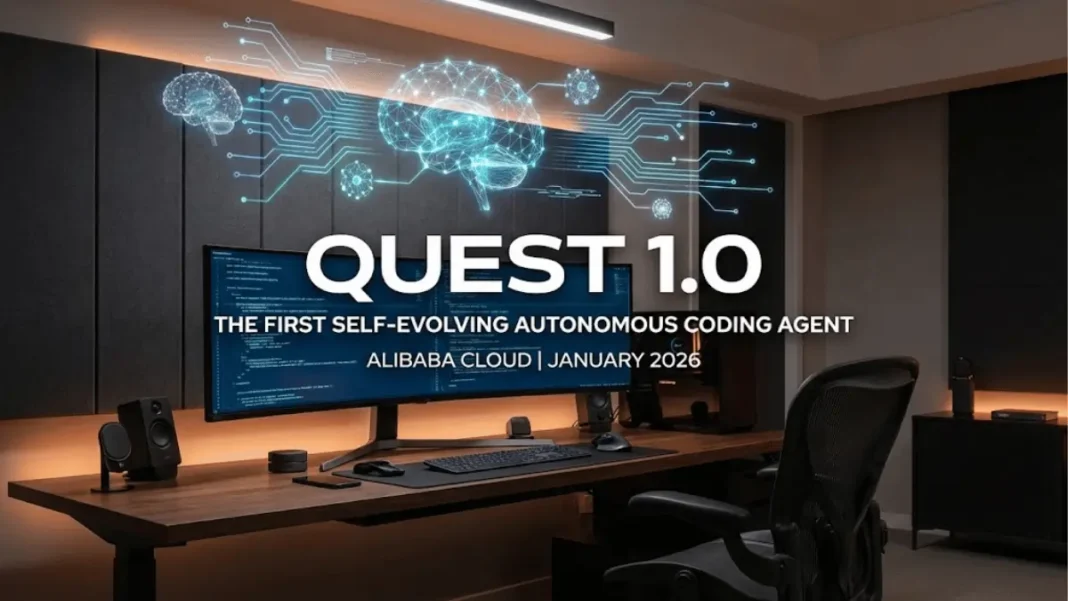
- The Launch: Qoder released Quest 1.0 on January 13, 2026 an autonomous coding agent that learns independently and executes complex development tasks with minimal human touchpoints.
- The Impact: Targets the $4.7 billion AI code assistant market, challenging GitHub Copilot’s 42% market dominance (as of mid-2025) with fully autonomous execution capabilities.
- The Context: Marks the first commercial deployment of self-evolving agent research, shifting from developer-guided tools to systems that plan, execute, and debug independently.
Qoder, Alibaba Cloud’s agentic coding platform launched in August 2025, has deployed Quest 1.0 the first autonomous coding agent capable of self-learning and continuous evolution during task execution. The platform went live January 13, 2026, with public preview access across Windows, macOS, and Linux operating systems.
Unlike GitHub Copilot or Cursor AI, which require continuous developer guidance, Quest 1.0 interprets requirements, devises implementation plans, resolves errors, and validates deliverables autonomously. The Qoder engineering team demonstrated the agent completing a 26-hour refactoring task optimizing its own long-running task execution logic with developers only describing requirements, reviewing final code, and verifying results.
Architecture: End-to-End Autonomous Execution
Quest 1.0 operates through a redesigned foundation architecture that manages the entire development stack independently. The system handles state management, core agent loops, and uninterrupted logic chains without requiring human intervention for debugging or error resolution during execution.
The agent employs three autonomous capabilities:
- Context Internalization: Analyzes project code structure, architectural history, and team conventions to build contextual understanding of module division, dependency relationships, and engineering practices.
- Adaptive Learning: Conducts self-directed exploration when encountering unfamiliar APIs or frameworks by reading documentation, attempting calls, analyzing errors, and adjusting approaches.
- Skills Acquisition: Teams can encapsulate engineering specifications and common patterns into Skills modules, enabling continuous capability expansion beyond initial training.
Performance improves with extended use as the system deepens project comprehension through accumulated learning cycles.
AdwaitX Analysis: Market Disruption in the $4.7B Coding AI Sector
The AI code assistant market reached $4.7 billion in 2025 and projected growth to $14.62 billion by 2033 at a 15.31% CAGR. GitHub Copilot commanded 42% market share with 20 million users and 1.3 million paid subscribers as of mid-2025, generating 40% year-over-year revenue growth.
Quest 1.0 targets the autonomous execution gap. While GitHub Copilot generates 46% of code for active users, developers still manage debugging, testing, and error handling. Cursor AI’s agent system handles complex tasks with minimal supervision but lacks self-evolving capabilities.
The autonomous AI agent software market will reach $11.79 billion in 2026, with enterprise adoption projected to increase from 25% in 2025 to 50% by 2027. Organizations deploying AI agents report 40-60% operational workflow cost reductions and measurable ROI within 3-6 months.
Qoder’s public preview strategy during market expansion mirrors Alibaba’s cloud infrastructure playbook establish developer adoption before implementing tiered pricing.
Technical Implementation: From Tokens to Deliverables
Quest 1.0 introduces a deliverable-focused execution model distinct from completion-based tools. The platform integrates:
| Component | Capability | Differentiation |
|---|---|---|
| Quest Mode | Autonomous task delegation across local and cloud environments | Operates independently without constant guidance |
| Agentic Chat | Collaborative planning and building through conversation | Multi-agent task distribution across project areas |
| Model Routing | Automatic selection between Sonnet, GPT, and Gemini models | Eliminates manual model selection and direct API costs |
| RepoWiki | Automated code analysis and structured documentation generation | Transforms implicit knowledge into explicit documentation |
The system validates deliverables through automated testing protocols before presenting completed work.
Deployment Timeline and Regulatory Considerations
Qoder operates in the Asia-Pacific region, projected as the fastest-growing market for AI coding assistants with China and India leading adoption. The platform launched during heightened enterprise focus on autonomous decision-making, with Gartner projecting 15% of daily work decisions made autonomously through agentic AI by 2028, up from 0% in 2024.
Flexible pricing models will follow public preview phase completion. The platform competes against GitHub Copilot Business ($19/user/month) and Enterprise ($39/user/month) tiers, and Cursor’s $500 million annualized recurring revenue run rate.
Alibaba positions Qoder within its broader Qwen App agentic AI strategy, integrating core ecosystem services into executable AI capabilities.

Frequently Asked Questions (FAQs)
What distinguishes Quest 1.0 from GitHub Copilot?
Quest 1.0 operates autonomously through complex tasks, handling planning, coding, debugging, and validation independently, while Copilot requires line-by-line developer confirmation and manual error resolution.
How does Quest 1.0’s self-learning work?
The agent analyzes project architecture, team conventions, and code patterns, then learns unfamiliar APIs through documentation reading, call attempts, and error analysis, improving performance with extended use.
What is the pricing model for Quest 1.0?
Currently in public preview; flexible pricing options will launch after preview phase completion.
Which development environments support Quest 1.0?
Windows, macOS, and Linux platforms through downloadable installation from the Qoder website.

