

Quick Brief
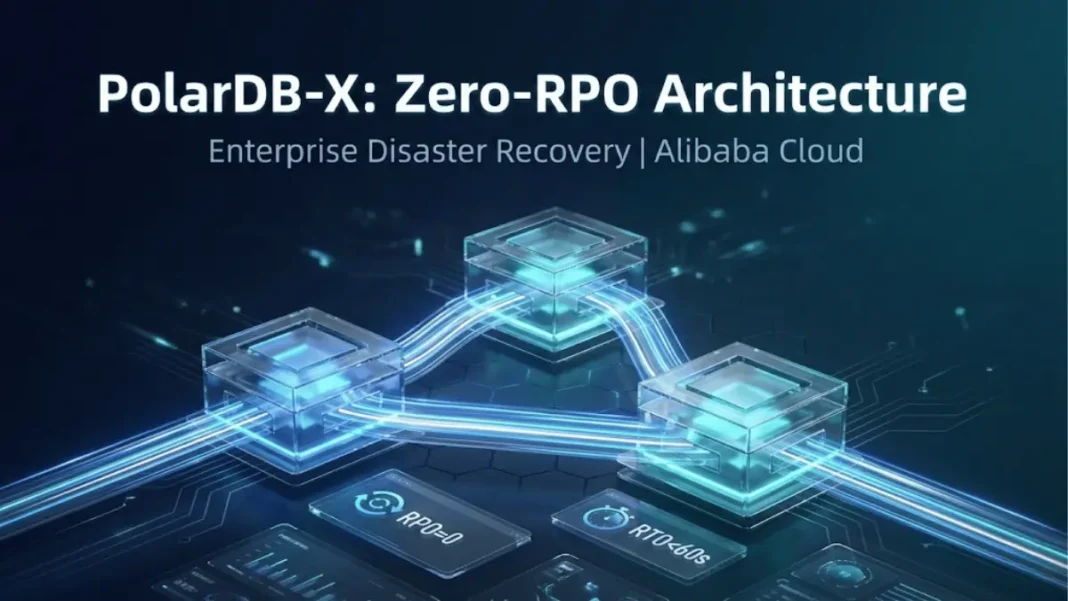
- The Architecture: Alibaba Cloud’s PolarDB-X deploys X-Paxos protocol delivering Recovery Point Objective (RPO) of 0 and Recovery Time Objective (RTO) under 60 seconds across multi-zone configurations.
- The Market: Serves 150,000 enterprise customers globally including financial services, aviation, and retail sectors with database revenue growing 50% year-over-year.
- The Technology: Three-tier deployment options spanning single data center, three zones in same region, and cross-region architectures with petabyte-scale storage capacity.
- The Investment: Enterprise Edition pricing starts at $10,254 annually with compute configurations from 4-core/16GB to multi-node clusters.
Alibaba Cloud has deployed advanced disaster recovery capabilities across its PolarDB-X distributed database platform, leveraging the X-Paxos consensus protocol to deliver zero data loss guarantees for mission-critical workloads. The cloud-native architecture serves financial institutions, logistics providers, and government agencies requiring sub-60-second failover capabilities across geographically distributed data centers. This expansion reinforces Alibaba Cloud’s position as a Gartner Magic Quadrant Leader for Cloud Database Management Systems for two consecutive years.
What’s New
PolarDB-X implements a shared-nothing architecture with decoupled compute and storage layers, enabling horizontal scaling to petabyte-level data volumes without downtime. The system deploys three to five replicas per data node using the majority-based Paxos replication protocol, requiring acknowledgment from more than half the nodes before completing write transactions. This design ensures the cluster maintains service availability even when minority nodes fail.
The platform achieved 2.055 billion transactions per minute (tpmC) in TPC-C benchmarking tests, setting a world record performance metric 2.5 times higher than previous industry standards. During Alibaba’s annual Double 11 Shopping Festival, PolarDB recorded 140 million queries per second at peak load, validating its capability to handle extreme concurrent transaction volumes.
Deployment options include three distinct configurations: single data center with three Paxos replicas for minority node failures, three data centers in one zone for zone-level protection, and three data centers across two zones for region-wide disaster scenarios. The three-zone architecture implements a “one primary, one secondary, one log” node structure combining physical replication with X-Paxos protocol for financial-grade reliability.
Why It Matters
Enterprise database failures cost organizations an average of $5,600 per minute in downtime, making zero-RPO architectures critical for sectors where data loss directly impacts regulatory compliance and revenue. PolarDB-X addresses this through strongly consistent distributed transactions using MVCC + TSO (Time Stamp Oracle) methodology and 2PC (Two-Phase Commit) protocol supporting ACID characteristics at RC/RR isolation levels.
The Global Database Network (GDN) feature extends disaster recovery beyond traditional primary-standby configurations by supporting cross-cloud synchronization compatible with MySQL master-slave replication protocols via CDC Binlog. This enables hybrid cloud deployments where enterprises maintain on-premises primary databases while replicating to public cloud standby instances.
Alibaba Cloud’s database division now generates revenue exceeding $1.5 billion per quarter, driven by enterprise adoption in aviation, insurance, logistics, manufacturing, and fintech verticals. The platform competes directly with AWS Aurora, Google Cloud Spanner, and Azure Cosmos DB in the distributed SQL database market.
Technical Specifications
| Component | Specification | Impact |
|---|---|---|
| Replication Protocol | X-Paxos majority-based consensus | RPO=0, zero data loss guarantee |
| Failover Time | RTO <60 seconds | Sub-minute service restoration |
| Storage Capacity | Petabyte-scale horizontal scaling | Eliminates single-node bottlenecks |
| Transaction Performance | 2.055B tpmC (TPC-C) | 2.5x industry benchmark record |
| Query Throughput | 140M queries/second | Validated during Double 11 peak |
| Compute Nodes (CN) | Stateless SQL parser/optimizer/executor | Distributed routing, 2PC coordination |
| Data Nodes (DN) | Multi-Paxos persistence layer | MVCC-based transaction visibility |
| Deployment Zones | 1-zone, 3-zone same region, 3-zone cross-region | Flexible disaster recovery topology |
| HTAP Capability | Native MPP with OLTP/OLAP isolation | Real-time analytics on transactional data |
| Enterprise Features | TDE, Triple Authority Separation, SQL Advisor | Compliance-ready security controls |
The architecture separates into four core components: Compute Nodes (CN) handling SQL parsing and execution, Data Nodes (DN) managing persistence, Global Meta Service (GMS) maintaining schema consistency, and CDC (Change Data Capture) enabling real-time replication. Compute nodes remain stateless to enable linear scalability, while data nodes implement Multi-Paxos for strong consistency.
What’s Next
Alibaba Cloud continues expanding PolarDB-X adoption among its 150,000-customer base with focus on regulated industries requiring compliance-ready disaster recovery documentation. The company projects further integration of its fully encrypted database system allowing clients to encrypt data before cloud upload, addressing sovereignty concerns in European and North American markets.
Upcoming enhancements target automated failover orchestration with predictive analytics for RTO optimization and AI-powered backup scheduling aligned with 2026 enterprise disaster recovery trends. The platform’s evolution toward multi-cloud backup strategies will support AWS, Azure, and Google Cloud environments alongside Alibaba Cloud infrastructure.
AdwaitX analysis indicates PolarDB-X positions Alibaba Cloud to capture market share from Oracle Database and SAP HANA deployments where licensing costs reach $11,000-$22,000 per vCPU annually. The platform’s MySQL compatibility reduces migration friction for enterprises transitioning from traditional RDBMS architectures.

Frequently Asked Questions (FAQs)
How does PolarDB-X achieve zero data loss during failover?
PolarDB-X uses X-Paxos protocol requiring majority node acknowledgment before committing writes, ensuring RPO=0 even when minority nodes fail.
What is the cost of PolarDB-X enterprise deployment?
Enterprise Edition pricing starts at $10,254 annually with 4-core/16GB configurations, scaling based on compute nodes and storage capacity.
How does PolarDB-X compare to traditional database disaster recovery?
Traditional primary-standby replication achieves minutes of data loss, while PolarDB-X delivers zero data loss with sub-60-second failover via Paxos consensus.
What industries use PolarDB-X for mission-critical applications?
Financial services, aviation, insurance, logistics, retail, manufacturing, gaming, and government agencies deploy PolarDB-X for regulatory compliance workloads.
Can PolarDB-X handle cross-region disaster recovery?
Yes, the platform supports three-zone cross-region deployments and Global Database Network for multi-cloud synchronization via MySQL-compatible replication.

