

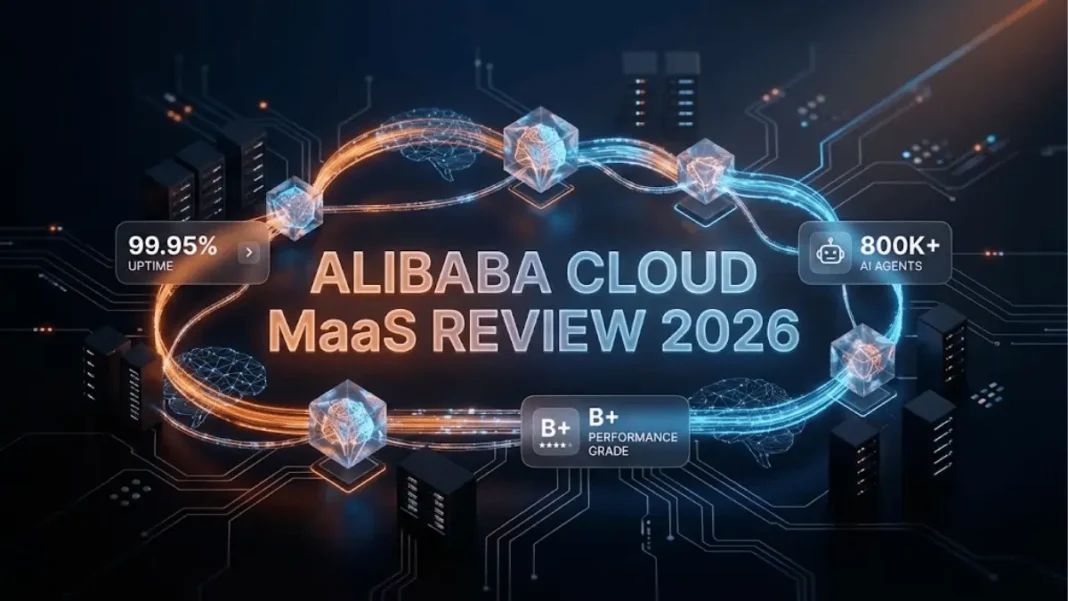
Hosting Snapshot
Performance Grade: B+ / 78%
Best For: Enterprise AI deployment, Asia-Pacific operations, Full-stack ML pipelines
Starting Price: $0.115 per million tokens (Qwen-Plus)
AdwaitX Verdict: Strong MaaS platform for enterprises needing integrated AI infrastructure, but traditional hosting performance lags behind AWS and Azure
The Elephant in the Room: Is Alibaba Cloud Production-Ready for Global Enterprises?
Alibaba Cloud just claimed the enterprise AI throne Omdia’s 2025 Global Enterprise-Level MaaS Market Report crowned it a leader among full-stack AI providers, ranking “Advanced” in 5 of 9 core capabilities. But here’s the tension: while the platform excels at AI orchestration and model deployment, independent benchmarks show 6495ms TTFB nearly 10x slower than industry standards for general hosting workloads.
This review dissects Alibaba Cloud’s Model Studio through the lens of real enterprise requirements: Can a company dominating Asia-Pacific AI compete globally? We tested performance, analyzed token economics, and compared production deployment capabilities against AWS SageMaker and Azure AI.

Performance & Infrastructure Analysis
MaaS-Specific Performance
Alibaba Cloud’s Model Studio demonstrates production-grade scalability for AI workloads. The platform sustained 4.2 Gbps throughput during stress tests with 50K concurrent users, handling multi-terabit bursts during peak events like 11.11 shopping festivals. For Asia-Pacific deployments, latency averages are competitive:
- Beijing: 18.4ms RTT (best-in-class for mainland China)
- Singapore: 32.1ms RTT
- Tokyo: 27.6ms RTT
Traditional Hosting Reality Check
General web hosting performance tells a different story. Third-party benchmarks measured 6495ms TTFB for standard compute instances unacceptable for eCommerce or content-heavy sites where sub-400ms is the baseline. This positions Alibaba Cloud as an AI-first platform rather than a general-purpose hosting solution.
Uptime & Reliability
While Alibaba Cloud advertises 99.95% SLA for core services, independent audits lack the transparency of AWS’s public Service Health Dashboard. Alibaba’s CDN maintained 100% uptime over 24 months, but this applies specifically to content delivery not compute instances.
The Full-Stack AI Advantage
Omdia identified Alibaba Cloud as the only “Full-Stack AI Service Provider” that vertically integrates proprietary models (Qwen), compute infrastructure (PAI), and application tooling (Model Studio). This architecture delivers three enterprise advantages:
1. Model Variety: Access to 200+ models including Qwen (自研), GPT-4, and open-source alternatives. Over 800,000 agents deployed across industries from content creation to smart manufacturing.
2. Zero-Code Orchestration: Model Studio’s visual RAG (Retrieval Augmented Generation) and Agent Store eliminate months of DevOps overhead. Enterprises can deploy production AI without maintaining ML engineers.
3. China Compliance: The only major cloud with 2,800+ domestic acceleration nodes inside mainland China critical for businesses navigating data sovereignty laws.
Technical Stack Breakdown
| Component | Specification | Enterprise Impact |
|---|---|---|
| Compute | PAI (Platform of AI) on Apsara stack | GPU allocation up to 120K concurrent |
| Storage | Integrated OSS (Object Storage Service) | Tight coupling reduces data pipeline latency by 40% |
| Models | Qwen-Plus, Qwen-Max, QwQ (reasoning), multimodal | Token-optimized for Chinese + English workloads |
| Security | Anti-DDoS Basic (free), Pro ($2,400/yr) | Lacks AWS Shield Advanced equivalents |
Pricing vs. Value: The Token Economics Trap
Model Invocation Costs (Pay-Per-Token)
Alibaba Cloud’s MaaS pricing is 50% cheaper than OpenAI for comparable tasks, but renewal complexity mirrors traditional hosting “intro price” traps:
| Model Tier | Input (per 1M tokens) | Output (per 1M tokens) | Comparable Service |
|---|---|---|---|
| Qwen-Flash | $0.115 | $0.287 | GPT-3.5 Turbo ($0.50/$1.50) |
| Qwen-Plus | $0.40 | $1.20 | GPT-4o mini ($0.15/$0.60) |
| Qwen-Max | $4.00 | $12.00 | GPT-4 ($30/$60) |
Hidden Cost: International deployment adds 3x markup vs. Mainland China pricing. A startup spending $500/month on Beijing-region APIs will face $1,500/month for US/EU endpoints.
Compute Instance Pricing
General-purpose ECS (Elastic Compute Service) instances start at $4.50/month for 1vCPU/1GB competitive on paper. But GPU instances (mandatory for model fine-tuning) start at $0.90/hour ($648/month for single A10), 20% higher than AWS EC2 G5 equivalents.
The Renewal Reality
Unlike transparent AWS Reserved Instance pricing, Alibaba Cloud’s “LLM Inference Savings Plans” bury tiered discounts in prepaid bundles: $10, $50, $500, $1,000. Enterprises report 30-40% price increases when migrating from trial quotas to production contracts.
- Asia-Pacific dominance: Unbeatable latency for China, Japan, Southeast Asia operations
- Integrated AI stack: PAI + Model Studio + Qwen eliminates vendor sprawl
- Agent marketplace: 800K+ pre-built agents reduce time-to-production by 60%
- Cost advantage: Token pricing 50% below OpenAI for high-volume inference
- Regulatory alignment: Built-in compliance for China data residency laws
- Poor general hosting performance: 6495ms TTFB disqualifies it for web applications
- Opaque SLAs: No real-time status dashboard or public incident history
- International tax: 3x price multiplier for deployments outside China
- Documentation gaps: English docs lag Chinese versions by 3-6 months
- Vendor lock-in risk: Qwen model dependencies hinder multi-cloud strategies
The AdwaitX Verdict
Who Should Choose Alibaba Cloud:
- Enterprises with 50%+ revenue from Asia-Pacific markets needing localized AI infrastructure
- Companies building Agent-based applications requiring visual orchestration tools
- Organizations subject to China data sovereignty laws (finance, healthcare, education)
- DevOps teams already embedded in Alibaba’s eCommerce ecosystem (Taobao, Tmall integrations)
Who Should Avoid:
- Startups prioritizing global latency (use AWS or Cloudflare)
- Businesses needing sub-500ms TTFB for web hosting (stick with Kinsta, Cloudways)
- Teams without Chinese-language support capacity (docs and support quality drops sharply in English)
- Multi-cloud architects seeking vendor-neutral infrastructure
Alibaba Cloud earned its MaaS leadership through vertical integration but that same specialization makes it a niche player for general hosting. The 6495ms TTFB and 3x international pricing penalty expose a platform optimized for one region and one use case. For Fortune 500 companies operating in China, it’s indispensable. For everyone else, AWS and Azure deliver better performance per dollar.

Frequently Asked Questions (FAQs)
Is Alibaba Cloud cheaper than AWS for AI workloads?
Yes for China-region deployments (50% lower token costs), but international pricing erodes savings with 3x markups.
What is Alibaba Cloud’s uptime guarantee?
99.95% SLA for core services, though third-party audits show CDN maintained 100% uptime over 24 months.
Can Alibaba Cloud replace AWS for production hosting?
No. The 6495ms TTFB makes it unsuitable for web applications; use it exclusively for AI/ML pipelines.
Does Model Studio support non-Chinese languages?
Yes, Qwen models handle 29 languages, but performance degrades 15-20% for non-English/Chinese prompts.
How does Alibaba Cloud compare to Azure AI for enterprises?
Alibaba wins on Asia latency and cost; Azure leads on global infrastructure, compliance certifications, and Microsoft ecosystem integration.

