

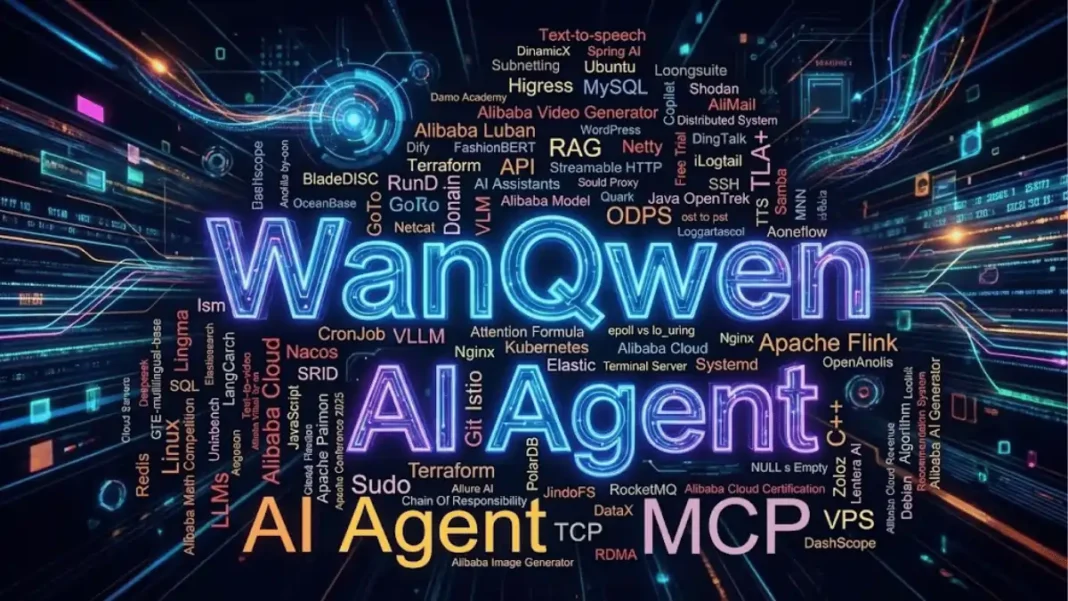
Alibaba Cloud has published an analysis of its blog community activity, revealing what developers and enterprises are actually building in 2025. The insights, based on search behavior and content engagement across 1,306 blog posts, show a sharp shift toward production-ready AI tools, standardized protocols, and real-time data architectures. Qwen AI models, Model Context Protocol (MCP), and AI agent frameworks dominate developer attention, signaling where cloud computing investment is headed this year.
Qwen AI Models Lead Developer Adoption
Qwen has emerged as the centerpiece of Alibaba Cloud’s AI strategy in 2025. Developers are moving quickly from exploration to production deployment, prioritizing fast inference, streamlined fine-tuning, and cost-efficient scaling. Alibaba Cloud reported 18% revenue growth in Q4 2024, driven primarily by AI workloads running on Qwen models.
The Qwen ecosystem now includes specialized tools for SQL generation, text embedding, multimodal processing, and agentic workflows. Qwen2.5-Max and Qwen3-Max have outperformed GPT-4o and DeepSeek-V3 in multiple benchmarks. Alibaba released Qwen3-Next in September 2025 under Apache 2.0 license, featuring improved context length scaling and total parameter optimization.
Model Context Protocol Gains Enterprise Traction
MCP has become one of the most-searched topics in Alibaba Cloud’s developer community. This standardization protocol solves the “M×N problem” by creating a universal interface for connecting AI models to data sources and tools. Instead of building custom integrations for every model-data combination, developers now build once to the MCP standard.
Alibaba Cloud has published multiple guides on deploying MCP gateways with Higress and Nacos, handling tool poisoning, and converting OpenAPI specifications to MCP servers. The protocol improves AI transparency by creating clear decision trails and maintaining contextual awareness across interactions. MCP started with Anthropic but now appears across multiple platforms including Claude Desktop and OpenAI’s Developer Mode.

AI Agents and RAG Architectures Shift to Production
Search interest in AI agents, RAG (retrieval-augmented generation), and LangChain shows developers are moving beyond demos to production-grade applications. The focus has shifted to robust evaluation patterns, tool-using capabilities, and combining retrieval with reasoning.
Alibaba Cloud’s blog highlights enterprise implementations using Elasticsearch for AI search, Spring AI integration with Ollama local models, and assessment engineering as a key focus for agent evolution. Developers want cohesive workflows from prototype to deployment using Model Studio, DashScope, and Higress.
Generative AI for Video and Voice Production
Text-to-video, image-to-video, and text-to-speech searches indicate strong demand for production-ready creative AI pipelines. Alibaba unveiled the Wan2.6 series, enabling personalized video generation where users can star in AI-created content. The company’s Model Studio now supports end-to-end workflows with quality controls for enterprise and creative applications.
Real-Time Data Streaming Architecture
Interest in Apache Fluss, Flink CDC, and real-time synchronization tools shows a community-wide push toward instant data processing. Developers are seeking ways to unify streaming and batch processing to power real-time AI and analytics.
Alibaba Cloud’s blog covers accelerated data ingestion for real-time lakehouses using Flink CDC, streaming data integration from MySQL to Kafka, and CDC implementation with MaxCompute. The focus on streaming architecture reflects the need for AI systems that work with live data, not static datasets.
Cloud Infrastructure Fundamentals Still Anchor Work
Kubernetes, Java, Linux, MySQL, Docker, Redis, and Nginx continue to dominate baseline searches. Developer interest centers on performance tuning, resilient operations, and migration best practices. Alibaba Cloud published guides on serverless Kubernetes, Redis migration to cloud, VPC networking with PrivateLink, and Nginx Ingress migration.
AI-Assisted Coding Tools Reduce Boilerplate
Searches for Tongyi Lingma and AI-native coding assistants show developers are offloading syntax-heavy work to AI. The focus is on stripping out boilerplate code, speeding up debugging, and managing legacy systems while improving maintainability. Integration with Function Compute allows developers to build efficient workflows that accelerate project delivery.
Open-Source Cloud Ecosystem Preference
Developer interest in Anolis OS, OpenAnolis, PolarDB, and Apache Paimon reflects preference for transparent, community-driven innovation. Alibaba Cloud emphasizes compatible ecosystems that avoid vendor lock-in.
Paimon 1.0 launched as a unified lake format for data and AI with Iceberg compatibility. PolarDB enhancements include data synchronization from edge nodes and seamless migration paths from MongoDB and TiDB. The open-source strategy supports developers who want flexibility without sacrificing enterprise-grade reliability.
Platform Integration From Prototype to Production
The growing interest in cohesive toolchains shows developers want documented flows that connect Model Studio, PAI (Platform for AI), and Higress. Alibaba Cloud upgraded PAI with distributed inference capabilities using multi-node architecture to handle super-large models and ultra-long-text processing.
New SaaS tools and PaaS enhancements announced at Spring Launch 2025 focus on scalable, secure, high-performance services for AI-driven digital transformation. Selina Yuan, President of International Business at Alibaba Cloud, emphasized delivering upgrades that empower businesses to scale and innovate globally.
What’s Next for Alibaba Cloud Developers
The 10 trends reveal a maturation phase where AI moves from experimentation to operational deployment. Expect continued investment in MCP adoption, Qwen model enhancements, and real-time data infrastructure through 2025.
Alibaba Cloud’s focus on standardization, open-source compatibility, and end-to-end platform integration suggests the company is positioning for broader enterprise adoption beyond its core Chinese market. Developer attention to evaluation frameworks and production-grade patterns indicates the industry is prioritizing reliability over novelty.
Featured Snippet Boxes
What are the top Alibaba Cloud trends for 2025?
The top trends are Qwen AI model deployment, Model Context Protocol adoption, AI agents and RAG architectures, generative video/voice production, real-time data streaming, AI-assisted coding, open-source cloud ecosystems, and platform integration tools.
What is Model Context Protocol (MCP) and why does it matter?
MCP is a standardization protocol that creates a universal interface for connecting AI models to data sources and tools. It solves the “M×N integration problem” by allowing developers to build once instead of creating custom integrations for every model-data combination.
How is Qwen transforming AI development in 2025?
Qwen models enable fast inference, streamlined fine-tuning, and cost-efficient scaling for production AI workloads. Qwen2.5-Max and Qwen3-Max outperform GPT-4o in key benchmarks, and the Apache 2.0 license allows flexible deployment.
What AI tools does Alibaba Cloud offer for deployment?
Alibaba Cloud provides Model Studio for generative AI workflows, PAI (Platform for AI) with distributed inference, DashScope API access, Higress AI gateway, Function Compute for serverless deployment, and Tongyi Lingma for AI-assisted coding.

