

Quick Brief
- Agent Skills enable AI agents to specialize in domains like legal review or financial analysis through modular capabilities
- Manus AI integrates Anthropic’s open standard, allowing one-click workflow capture and team knowledge sharing
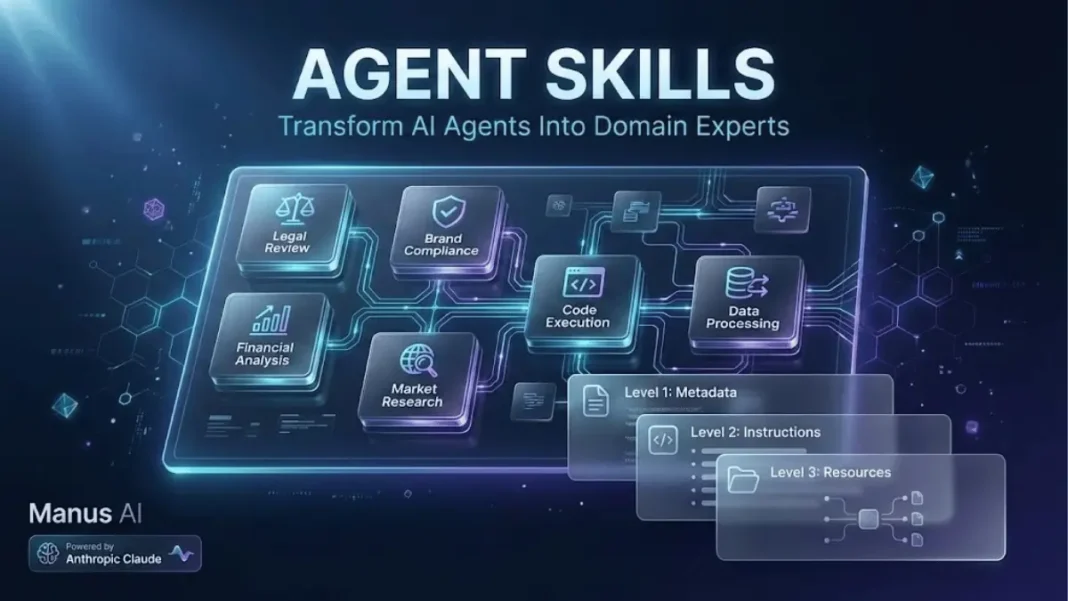
- Progressive disclosure loads metadata at ~100 tokens, instructions at <5k tokens, and resources on-demand
- Meta-backed Manus combines browser automation, code execution, and Skills for complete task automation
AI agents no longer need to be generalists struggling with specialized tasks. Manus AI now part of Meta’s acquisition valued at more than $2 billion integrates Agent Skills, an open standard by Anthropic that packages expertise into reusable, file-based resources. This transforms how teams capture workflows, share knowledge, and automate complex processes without repetitive instructions.
What Agent Skills Actually Do
Agent Skills function as “onboarding guides for new employees,” according to Anthropic’s engineering team. Unlike lengthy conversational prompts you repeat for each task, Skills are discovered and loaded by AI agents on-demand, converting a general-purpose assistant into a domain specialist within seconds.
The architecture delivers three core advantages. Specialization customizes capabilities for specific domains like branded content creation or market research. Reusability allows you to create a Skill once and deploy it automatically across conversations, projects, and even different AI platforms that support the standard. Composability combines multiple independent Skills to handle complex, multi-step workflows a market analysis Skill can trigger browser automation, Python data processing, and report generation sequentially.
Deeplearning.ai launched a course on January 27, 2026, teaching users to build Skills for different use cases across Claude.ai, Claude Code, and the Claude API. The course explores how Skills compare to Model Context Protocol (MCP) and subagents, clarifying when each approach fits specific automation needs.
Progressive Disclosure: The Context Window Revolution
Agent Skills solve a critical limitation: AI context windows remain expensive and finite. Anthropic’s “progressive disclosure” mechanism divides Skill content into three loading levels, consuming resources only when necessary.
What is progressive disclosure in Agent Skills?
Progressive disclosure loads Agent Skills content in three stages: Level 1 metadata (name and description) consumes ~100 tokens at startup, Level 2 instructions (main SKILL.md file) use <5k tokens when triggered, and Level 3 resources (scripts, files, assets) load on-demand only when referenced. This minimizes context window waste while maintaining unlimited knowledge potential.
| Level | Content Type | Load Timing | Context Cost |
|---|---|---|---|
| 1: Metadata | Name and description | Startup | ~100 tokens per Skill |
| 2: Instructions | SKILL.md file content | When triggered | <5,000 tokens |
| 3: Resources | Scripts, files, assets | On-demand reference | Only when used |
This structure allows teams to bundle unlimited procedural knowledge without bloating the agent’s working memory. A financial analysis Skill might include 50 pages of methodology documentation and 10 Python scripts but the agent only loads the 2-page summary until it needs specific calculations.
Manus AI’s Native Advantage
Manus AI’s architecture aligns perfectly with Agent Skills requirements. The platform runs in a fully isolated Ubuntu sandbox environment with complete file system access and shell execution capabilities exactly what Skills need to read directories, parse SKILL.md files, and execute embedded Python or Bash scripts.
The integration creates powerful synergies. Manus AI’s browser automation, code execution, and file operations combine with Skills’ specialized knowledge to deliver complete task automation. A “Brand Compliance” Skill can guide Manus to scrape competitor websites, extract design elements using computer vision scripts, compare them against your brand guidelines stored in the Skill’s resources folder, and generate a compliance report all without human intervention.
Meta acquired Manus in December 2025 for more than $2 billion, according to The Wall Street Journal and Reuters. The company announced it will continue operating and selling Manus services while integrating the technology into Meta AI products. The acquisition validates Manus’s approach to autonomous agents and positions Agent Skills as a strategic capability for Meta’s consumer and business offerings.
Skills vs MCP: Different Problems, Complementary Solutions
Agent Skills and Model Context Protocol (MCP) serve distinct purposes in the AI ecosystem. MCP solves data access it provides AI agents with secure, standardized connections to external data sources like Gmail, Notion, or CRM systems. MCP enforces authentication, permissions, audit trails, and scoped access tokens to ensure agents don’t have skeleton keys to your entire infrastructure.
Skills solve workflow encapsulation they teach agents how to execute multi-step processes using that data. A Skill can include Python scripts that directly call third-party APIs when appropriate.
Think of MCP as the “secure capability gateway” and Skills as the “action layer”. MCP provides the data pipelines; Skills provide the operating manuals for those pipelines. A customer onboarding workflow might use MCP to access the CRM and email system, while a Skill orchestrates the sequence: create contact record, send welcome email, schedule follow-up task, update dashboard.
Building and Triggering Skills in Manus
Manus introduces a “Build a Skill with Manus” feature that captures successful workflows with a single command. After completing a task you’re satisfied with, instruct Manus to “package this workflow into a Skill.” The platform analyzes the interaction flow, auto-generates the SKILL.md file, and bundles relevant scripts into a reusable package you can deploy repeatedly or share with teammates.
For precise control, slash commands activate specific Skills on-demand. Typing /SKILL_NAME in the chat box explicitly instructs Manus to load that Skill’s instructions, guaranteeing the agent follows the documented procedure rather than improvising.
Anthropic’s official repository includes pre-built Skills for document creation, branding guidelines, internal communications, and a “skill-creator” meta-Skill that guides you through building new capabilities. These serve as templates users can customize for their domain needs.
Two Core Benefits for Users
Manus AI identifies two primary value propositions for Skills integration. First, solidify personal best practices when you achieve a highly efficient interaction with Manus, capture that successful process as a personal Skill. This codifies your know-how for specific tasks, eliminating repetitive thinking and trial-and-error in future executions. Your “quarterly financial report” Skill might remember the exact data sources, visualization formats, and executive summary structure you prefer.
Second, lower barriers through team expertise sharing the upcoming “Team Skill Library” lets members publish validated Skills to a shared repository. Junior analysts can use Skills created by senior experts, dramatically reducing onboarding time and ensuring consistent output quality across the organization. A marketing team might share Skills for competitor analysis, content calendar creation, and campaign performance reporting, standardizing workflows that previously relied on tribal knowledge.
Limitations and Considerations
Agent Skills require structured thinking upfront. Creating effective Skills demands you articulate implicit knowledge the decision trees, edge cases, and contextual nuances experts intuitively understand but rarely document. Anthropic recommends iterating with Claude: ask the AI to capture successful approaches and common mistakes into reusable context, rather than trying to anticipate everything in advance.
Skills work best for processes that follow consistent patterns. Tasks requiring high creativity, subjective judgment, or real-time adaptation based on unpredictable human feedback may not benefit from rigid Skill structures. Additionally, while Skills enable code execution, they inherit security considerations of running scripts organizations must audit Skill contents before deploying them across teams, especially if they interact with sensitive systems or data.
The open standard means Skills created for Claude can theoretically work across compatible platforms, but practical interoperability depends on each platform’s tool ecosystem. A Skill designed for Manus’s browser automation capabilities might not function identically in environments lacking those native tools.
Real-World Applications Across Industries
Workflow automation using Agent Skills shows measurable impact in 2026. Organizations using AI-assisted workflow optimization achieve 30% faster cycle times in decision-heavy processes, according to Gartner research cited by CloudQix.
Legal teams deploy Skills for contract review that extract key clauses, compare terms against standard templates, flag non-standard language, and generate redline summaries. Financial analysts use Skills that pull market data via APIs, run valuation models, stress-test assumptions, and produce investment memos formatted to firm standards. Marketing departments create Skills for competitor monitoring that scrape pricing pages, track positioning changes, analyze ad creative, and update competitive intelligence dashboards weekly.
Manus highlights its powerful built-in data sources SimilarWeb, Yahoo Finance, LinkedIn Search now being encapsulated as discoverable Skills rather than opaque internal APIs. Users can browse these in their Skill library, understand parameters by reading the SKILL.md documentation, and invoke them reliably rather than guessing syntax through trial-and-error.
The Roadmap: Projects, Connectors, and Team Libraries
Manus outlines a phased integration strategy.
Phase 1 allows you to integrate Skills directly into Manus projects predefined workspaces for specific objectives. Combined with Connectors (integrations to external tools), this enables deeply customized standard operating procedures for recurring workflows like weekly reporting or client onboarding.
Phase 2 introduces the Team Skill Library for team plan subscribers. Members publish battle-tested personal Skills to the shared repository, enabling seamless knowledge transfer across the organization. Unlike static documentation that becomes outdated, Skills represent executable, version-controlled workflows that improve through usage and iteration.
Open Standards and the Composable Future
Anthropic, which announced Agent Skills on October 16, 2025, positions them as part of a broader movement toward interoperable AI ecosystems. The file-based format and open specification mean Skills aren’t locked to a single vendor organizations can export their Skill libraries and migrate to any compatible platform without rewriting workflows.
This contrasts with proprietary plugin architectures that trap users in walled gardens. As more AI platforms adopt the standard, the same “Legal Contract Review” Skill could function across Claude Code, Cursor, and potentially future competitors, maximizing return on the effort invested in documenting processes.
Industry observers note multi-agent architectures where specialized agents collaborate on complex tasks benefit significantly from Skills that define each agent’s domain expertise. A customer success workflow might involve a “Data Extraction” agent using a Skill to pull CRM records, a “Sentiment Analysis” agent applying a machine learning Skill to support tickets, and a “Report Generation” agent using a formatting Skill to synthesize insights.
Frequently Asked Questions (FAQs)
What is the difference between Agent Skills and AI tools?
Agent Skills are reusable workflow packages containing instructions, scripts, and resources that teach AI agents specialized tasks, while AI tools are individual functions an agent can call. Skills orchestrate multi-step processes using multiple tools a market research Skill might use browser tools, data analysis tools, and file creation tools in sequence according to documented procedures.
Can Agent Skills work with ChatGPT or other AI platforms?
Agent Skills are an open standard introduced by Anthropic for Claude-based systems. While the file-based format is theoretically portable, Skills currently work across Claude.ai, Claude Code, Claude API, Manus AI, and platforms that explicitly support the standard. Compatibility with ChatGPT or other LLMs requires those providers to adopt the specification.
How much technical knowledge do you need to create Agent Skills?
Creating basic Agent Skills requires no coding you write instructions in natural language within a SKILL.md file. Advanced Skills that include Python scripts or complex automation require programming knowledge, but Manus’s “Build a Skill” feature can auto-generate Skills from successful conversations, lowering the barrier significantly. Anthropic provides templates and a “skill-creator” meta-Skill to guide the process.
Are Agent Skills secure for enterprise use?
Agent Skills execute in Manus’s isolated Ubuntu sandbox environment, separating each task from external systems. However, Skills can include scripts that call APIs or access data sources, so organizations should audit Skill contents before team-wide deployment. Combining Skills with MCP provides an additional security layer MCP enforces authentication, scoped permissions, and audit trails for data access.
What happens to Manus Skills after the Meta acquisition?
Meta stated it will continue operating and selling Manus services while integrating the technology into Meta AI products. The Agent Skills integration represents a strategic capability Meta acquired users can expect continued development and potentially broader distribution across Meta’s consumer and business offerings.
How do Agent Skills improve team productivity?
Skills capture expert workflows as executable templates that junior team members can use without mastering every domain detail. This reduces onboarding time, ensures consistent output quality, and prevents knowledge loss when team members leave. Organizations using AI-assisted workflow optimization with Skills-like approaches achieve 30% faster cycle times, according to 2026 research.

