

Quick Brief
- Oracle Health launched its Device Validation Program in the U.S. on February 25, 2026, targeting fragmented medical device connectivity
- The program uses an EHR-agnostic architecture, enabling validated devices to connect to any EHR platform
- Launch partners Bio IntelliSense and Baxter confirm validated devices deliver seamless, day-one clinical workflow integration
- The framework reduces IT burden, minimizes integration delays, and supports compliance with interoperability standards
Hospitals run on devices, and those devices have been failing them quietly for years. Oracle Health’s new Device Validation Program, launched February 25, 2026, directly targets one of healthcare IT’s most persistent and costly pain points: medical devices that cannot reliably connect to the systems clinicians depend on. This article breaks down exactly what the program does, who benefits, and where the real impact lands.
Why Medical Device Integration Has Been a Persistent Clinical Problem
Health systems today operate dozens, often hundreds, of clinical devices from competing vendors. Maintaining consistent, accurate data connections across all of them is not a solved problem. Unreliable device data disrupts clinical workflows, forces manual workarounds, and slows the adoption of newer care models built on automated data capture.
The core technical barrier is fragmentation. EHR systems and clinical devices frequently operate on different data standards, protocols, and nomenclature conventions. Even when a device technically connects, semantic mismatches, where the same measurement is labeled or formatted differently across systems, create downstream quality issues in analytics and clinical decision support.
This is the operational gap Oracle Health’s new program is designed to close.

What the Oracle Health Device Validation Program Actually Does
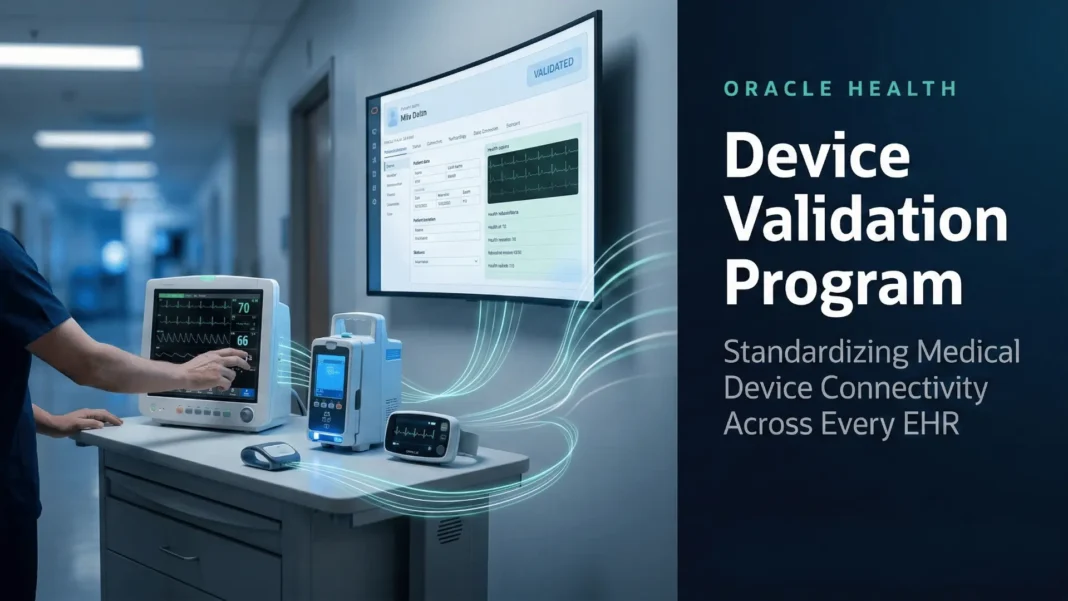
The Oracle Health Device Validation Program establishes a standardized framework for evaluating medical device connectivity, validating workflow alignment, and confirming interoperability with electronic health records. Built on Oracle Health’s proven device integration framework, the program introduces a structured evaluation process that device partners must complete before receiving validated status.
The program evaluates three core areas:
- Device connectivity and data transmission reliability
- Nomenclature alignment to reduce semantic inconsistencies across EHR platforms
- Workflow integration to confirm clinical staff can use devices without manual data re-entry
Critically, the program uses an EHR-agnostic architecture. Validated devices do not require Oracle’s own EHR to function correctly. Health organizations running any EHR platform can benefit from devices that have passed Oracle’s validation standards.
Partners Already Validated: What Bio IntelliSense and Baxter Confirm
Oracle Health announced the program alongside two launch partners: Bio IntelliSense and Baxter. Both organizations completed the validation process and are now certified under the new framework.
Michael Hawn, Senior Vice President of Data Services and Cloud Hosting at Bio IntelliSense, stated that Oracle’s validation process gives hospital customers assurance that devices are “rigorously tested for interoperability, supporting fast, reliable workflows for clinicians.”
Peter Richardson, Associate Director of Connected Care at Baxter, described the collaboration as enabling “continual validation” of their technology and building “a dependable, interoperable platform” for healthcare providers. These are not marketing endorsements. They signal that the program’s validation process is operational and producing real-world outcomes for early adopters.
How the EHR-Agnostic Architecture Changes the Competitive Dynamic
The EHR-agnostic design is the program’s most strategically significant feature. By validating devices that work across any EHR, Oracle Health positions this program as infrastructure-neutral certification rather than a loyalty play for Oracle Health EHR customers.
This separates the Device Validation Program from typical vendor lock-in strategies and gives device manufacturers a clear incentive to participate regardless of their primary EHR client base. For health IT procurement teams, a device carrying Oracle Health validation becomes a lower-risk purchasing decision. Integration uncertainty, which is a major cause of delayed device adoption, is substantially reduced when connectivity has been pre-tested and certified.
The Measurable Benefits for Health Systems and IT Teams
Oracle Health outlines four operational outcomes the program delivers for participating health systems:
- Predictable integration: Validated devices work as expected from day one, eliminating trial-and-error deployment cycles
- Reduced IT burden: Standardized integration removes the need for custom interface builds between device and EHR teams
- Faster device adoption: Pre-validated connectivity shortens the time from device procurement to active clinical use
- Compliance confidence: Ongoing validation supports accurate data transmission and adherence to interoperability standards across any connected EHR
For health system CIOs and clinical informatics teams, points one and four carry the most immediate operational weight. Custom interface development is expensive and slow. Compliance gaps in device data transmission create liability exposure. The program addresses both directly.
The Vision Behind the Program
Seema Verma, Executive Vice President and General Manager of Oracle Health and Life Sciences, framed the program’s purpose directly: “At Oracle Health, we’re not waiting for the future of healthcare connectivity, we’re setting the standard.” That framing matters in the context of 2026 health IT priorities.
The shift toward AI-assisted clinical decision support, ambient documentation, and continuous patient monitoring all depend on clean, reliable, real-time device data flowing into EHR systems. A validation program that reduces friction in that data pipeline has compounding value. Every device that connects cleanly, without custom integration work, is a device generating clinical data that analytics and AI models can actually use.
Limitations and Honest Considerations
The Oracle Health Device Validation Program, as announced, applies to the U.S. market only. Health systems operating internationally, including those in India and the EU, are not covered under the current framework. Oracle has not announced a timeline for international expansion.
The program also depends on device vendors choosing to participate and complete the validation process. A validated status only covers devices that have gone through Oracle’s testing framework. Health systems running large inventories of legacy devices from vendors not yet enrolled will still face existing integration challenges.
Additionally, Oracle’s own disclaimer makes clear that validation does not constitute endorsement or certification of compliance with medical device regulations. Oracle explicitly states it does not “review third-party products or content for compliance with applicable laws and regulations, including medical device laws.” IT teams should treat validation as a connectivity and workflow assurance, not a regulatory clearance substitute.

Frequently Asked Questions (FAQs)
What is the Oracle Health Device Validation Program?
The Oracle Health Device Validation Program is a U.S.-based framework launched February 25, 2026, that certifies medical devices for reliable connectivity, nomenclature alignment, and workflow integration across electronic health record systems. It uses an EHR-agnostic architecture, meaning validated devices work with any EHR platform.
Which medical device companies are part of the program?
Bio IntelliSense and Baxter are the confirmed launch partners as of February 2026. Both companies completed the validation process prior to the program’s public announcement. Oracle Health expects additional device vendors to join as the certified partner network expands.
Does the program work with Epic and other non-Oracle EHR systems?
Yes. The program’s EHR-agnostic architecture is a core design feature. Oracle explicitly states that validated devices can connect to any EHR, not exclusively Oracle Health’s own system. This makes validated devices a viable procurement choice for health systems running any EHR platform.
What problems does the program solve for hospital IT teams?
The program addresses unpredictable device integration, high custom-build costs, and semantic data mismatches between devices and EHR systems. Pre-validated devices reduce IT workload, shorten deployment timelines, and support compliance with interoperability standards.
Is the Oracle Health Device Validation Program available outside the United States?
No. The current program is designed specifically for the U.S. health market. Oracle has not announced a timeline for international expansion. Health systems in other regions, including India and the EU, are not covered under the current framework.
Does validation under this program replace medical device regulatory clearance?
No. Oracle explicitly states that validation does not constitute endorsement or certification of compliance with medical device laws and regulations. The program certifies connectivity and workflow integration only. Regulatory clearance from the FDA or equivalent bodies remains a separate, independent requirement.
Who leads Oracle Health’s device connectivity strategy?
Seema Verma, Executive Vice President and General Manager of Oracle Health and Life Sciences, is the executive sponsor of the program. She has publicly described the initiative as Oracle Health “setting the standard” for healthcare connectivity rather than waiting for industry consensus.

