

Key Takeaways
- Samsung ProScaler improves display image scaling quality by up to 40% on Galaxy S25 Plus and S25 Ultra
- The technology makes 480p video appear as sharp as 720p, and 720p content as clear as 1080p
- ProScaler integrates with Samsung’s mDNIe engine inside the custom Snapdragon 8 Elite for Galaxy chip
- QHD+ resolution must be manually enabled to activate ProScaler; it is not on by default
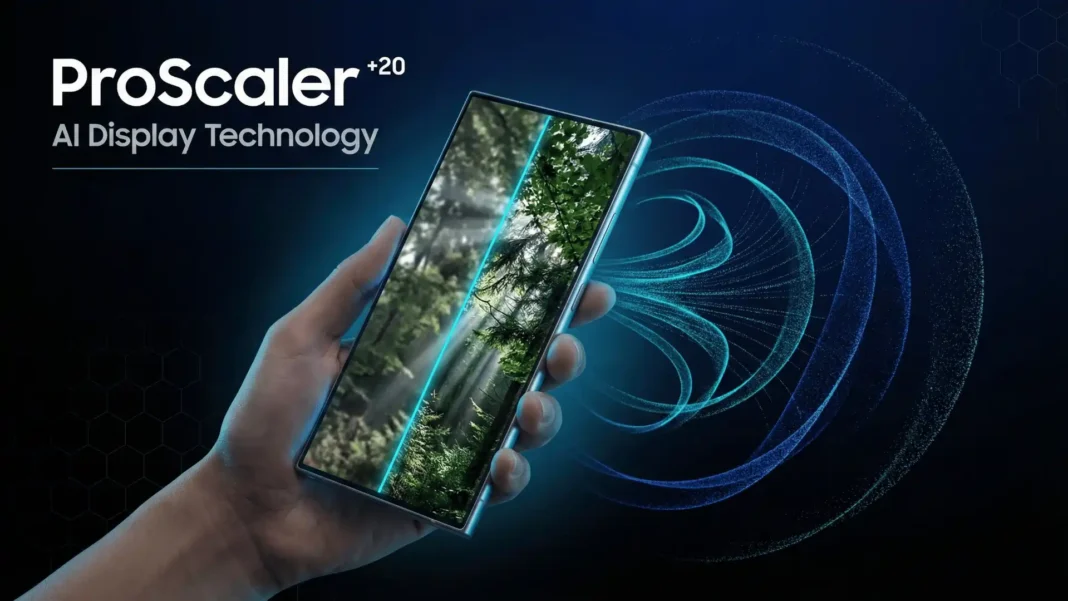
Most smartphones display video at whatever resolution the source provides. Samsung ProScaler refuses that limitation. Introduced with the Galaxy S25 series at Unpacked 2025, this AI-powered display enhancement actively reconstructs image quality in real time, turning standard HD content into something that rivals higher-resolution source footage. The result is a fundamentally different visual experience without requiring high-resolution source files.
What Samsung ProScaler Actually Does
ProScaler is a real-time AI image quality enhancement technology exclusive to the Galaxy S25 Plus and S25 Ultra, adapted from Samsung’s premium TV lineup. It uses artificial intelligence to upscale photos and videos, improving their quality by up to 40%. The Samsung Magazine confirms it can make 480p videos appear as sharp as 720p, and 720p content as clear as 1080p.
This applies to all photos and videos on the device, whether sourced from social media, streaming apps, or the phone’s own camera. The processing happens in real time using AI algorithms trained on display patterns, reconstructing detail, color gradients, and edge sharpness before the image reaches the panel.
The Engine Behind It: Snapdragon 8 Elite and mDNIe
ProScaler’s performance is built on co-engineered hardware and software specific to the Galaxy S25 series. Samsung embedded its proprietary Mobile Digital Natural Image engine (mDNIe) directly into the Snapdragon 8 Elite for Galaxy chip, rather than treating it as a separate software layer. The mDNIe suite of algorithms improves both display quality and power consumption simultaneously.
The Snapdragon 8 Elite for Galaxy is overclocked by 150 MHz compared to the standard Snapdragon 8 Elite version, reaching a peak clock speed of 4.47 GHz. This custom chip also delivers a 37% CPU performance increase, 20% GPU graphics boost, and a 40% improvement in AI performance compared to the previous-generation Snapdragon 8 Gen 3 for Galaxy.
Gaming and Graphics Performance
Beyond video content, the Snapdragon 8 Elite for Galaxy delivers measurable gains for gaming. The chip’s 20% GPU improvement and tighter AI integration through the NPU produce faster rendering and improved visual quality in supported titles. ProScaler’s AI upscaling actively benefits gaming visuals by enhancing detail in textures and improving the clarity of lower-resolution game assets displayed on the QHD+ panel.
Which Devices Support ProScaler
ProScaler requires QHD+ display resolution (3,120 x 1,440 pixels) to function, which rules out the base Galaxy S25 model.
| Device | ProScaler Support | Default Resolution | Max Resolution |
|---|---|---|---|
| Galaxy S25 | No | FHD+ | FHD+ |
| Galaxy S25 Plus | Yes | FHD+ | QHD+ |
| Galaxy S25 Ultra | Yes | FHD+ | QHD+ |
Samsung sets the default resolution to FHD+ because QHD+ draws significantly more battery power. Users must manually switch to QHD+ to unlock ProScaler.
ProScaler vs. Competing Display Technologies
Samsung is the only major Android manufacturer offering AI upscaling at the chip level for smartphones in 2025. Apple’s iPhone 16 Pro Max uses OLED panels, some manufactured by Samsung, but does not include a real-time AI content upscaling engine equivalent to ProScaler. Google Pixel phones have improved display quality over time but still lag behind Samsung in peak brightness and refresh rate options.
Samsung’s AMOLED displays lead competing flagships in brightness, color accuracy, and refresh rate. The ProScaler advantage is specifically in content rendering quality on top of those existing panel strengths.
How ProScaler Connects to Samsung TV Technology
ProScaler’s mobile implementation draws directly from AI upscaling technology found on Samsung’s high-end television lineup. Samsung adapted this processing architecture for mobile constraints including lower power budgets, smaller panels, and touch interaction latency requirements. Embedding the mDNIe engine into the Snapdragon chipset reduces power overhead and allows upscaling to happen inside the same processing pipeline as app rendering.
Limitations Worth Knowing
ProScaler only activates at QHD+ resolution, which increases power draw compared to FHD+. Samsung acknowledges this trade-off by keeping FHD+ as the default setting on both the S25 Plus and S25 Ultra. Users who prioritize maximum battery endurance will need to weigh that cost against the visual quality gains before enabling QHD+ mode.
How to Enable ProScaler on Your Device
These steps apply to Galaxy S25 Plus and S25 Ultra only:
- Open Settings
- Tap Display
- Select Screen Resolution
- Choose QHD+
- Tap Apply to confirm
ProScaler becomes active once QHD+ mode is set. The base Galaxy S25 does not support this resolution and therefore cannot use the feature.
Frequently Asked Questions (FAQs)
What is Samsung ProScaler?
Samsung ProScaler is a real-time AI display enhancement feature exclusive to the Galaxy S25 Plus and S25 Ultra. It improves image scaling quality by up to 40%, making 480p content appear as sharp as 720p and 720p content as clear as 1080p across all photos and videos.
Which Samsung phones support ProScaler?
ProScaler is available only on the Galaxy S25 Plus and Galaxy S25 Ultra. The base Galaxy S25 does not support it because ProScaler requires QHD+ screen resolution, which only the Plus and Ultra variants offer.
Does ProScaler drain battery faster?
Enabling ProScaler requires switching to QHD+ resolution, which draws significantly more power than FHD+. Samsung sets FHD+ as the default on both ProScaler-compatible devices specifically because of this trade-off.
Does ProScaler work on all photos and videos?
Yes. ProScaler enhances all photos and videos on the device once QHD+ is active, including content from social media, streaming platforms, and the phone’s own camera.
How does ProScaler compare to iPhone’s display technology?
Apple’s iPhone 16 Pro Max uses OLED technology but lacks a real-time AI content upscaling engine comparable to ProScaler. Samsung displays lead in peak brightness and AI-driven rendering quality, while Apple prioritizes color accuracy and natural tones.
Can ProScaler make 480p video look like HD?
Yes. Samsung Magazine confirms ProScaler can make 480p videos appear as sharp as 720p, and 720p videos as clear as 1080p, with further improvement applied to 1080p content as well.
Where does ProScaler technology originate?
ProScaler was adapted from the AI upscaling technology Samsung developed for its high-end television lineup. Samsung engineered a mobile version integrated with the Snapdragon 8 Elite for Galaxy chip and the mDNIe display engine.

