

Key Takeaways
- Arvind KC brings senior leadership experience across Roblox, Google, Palantir Technologies, and Meta
- KC’s mandate covers hiring, onboarding, development, collaboration systems, and AI-integrated work models
- OpenAI plans to share its AI-enabled workforce learnings with customers and partners globally
- Julia Villagra, who previously held the CPO role, departed OpenAI in August 2025
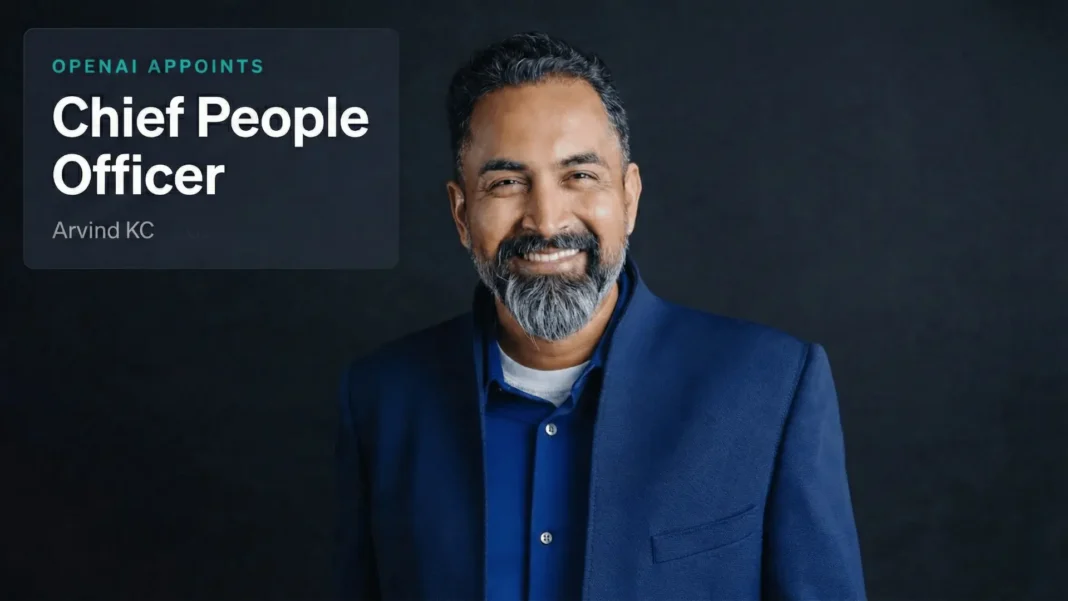
OpenAI made a people leadership decision on February 24, 2026 that signals something larger than a standard executive hire. The company appointed Arvind KC as its new Chief People Officer, placing an executive with rare engineering depth at the center of how it scales its workforce as AI reshapes the nature of work itself. KC’s profile tells you exactly what OpenAI believes its next organizational challenge requires.
Who Is Arvind KC
KC is not a conventional HR leader. Over the course of his career, he has held senior roles at Roblox, Google, Palantir Technologies, and Meta, helping build both products and the organizations behind them at meaningful scale. That combination of engineering depth and people leadership is explicitly what OpenAI cited in its announcement.
Most recently, he served as Chief People and Systems Officer at Roblox. Before that, he held senior positions at Google and served as both Chief Information Officer and Head of People Operations at Palantir Technologies, a dual mandate that required bridging technical infrastructure with organizational design.
His career began in the supply chain and semiconductor industries, giving him a process engineering foundation that most people leaders do not carry. He holds a degree in chemical engineering and an MBA from Santa Clara University.
 Claude Under Attack: How Three Chinese AI Labs Extracted 16 Million Exchanges from Anthropic
Why OpenAI Chose an Engineering-Oriented CPO
Standard HR thinking does not solve OpenAI’s talent challenge. The company competes for a finite global pool of frontier AI researchers, machine learning engineers, and safety specialists while simultaneously scaling a commercial product used by hundreds of millions of people. KC’s engineering background was explicitly cited in the company’s announcement as a central qualification for the role.
Fidji Simo, CEO of Applications at OpenAI, stated directly: “We believe the way we scale OpenAI should reflect the future we’re helping to create. KC will play a key role in ensuring our people processes, policies, and systems match our ambition, while preserving the culture and operating principles that have helped us get here.” That framing signals a CPO role built for system-building, not administration.
KC reports to Chief Strategy Officer Jason Kwon. Placing the CPO reporting line within strategy rather than directly to the CEO indicates OpenAI treats people operations as a core strategic function integrated with business direction.
What His Mandate Covers
KC’s responsibilities span four interconnected areas, each directly tied to OpenAI’s growth phase.
- Hiring and onboarding at the scale demanded by OpenAI’s current expansion
- Building development and re-skilling frameworks as AI tools reshape internal job functions
- Creating collaboration systems and policies that accelerate work without generating friction
- Developing a model for AI-enabled work that OpenAI intends to share with its customers and partners over time
That final point is strategically significant. OpenAI stated it has “both an opportunity and an obligation” to provide a model for how organizations navigate the shift to more AI-enabled work, spanning how roles evolve, how skills are developed, and how re-skilling keeps pace with technological change. KC’s role is therefore outward-facing as much as internal.
The Workforce Context KC Steps Into
OpenAI has experienced meaningful leadership turnover in its people function in recent years. Julia Villagra, who held the CPO role before KC, departed OpenAI in August 2025 after less than six months in the position. KC inherits a people function that has been in reconstruction even as OpenAI accelerates its commercial and organizational growth.
His appointment also arrives as OpenAI raises a funding round expected to exceed $100 billion and prepares for a potential public listing. Companies at that stage face acute pressure to standardize HR systems, demonstrate talent retention, and show institutional investors a stable and scalable organizational culture. KC’s background building systems at Palantir and Google maps directly onto those requirements.
What This Signals for the AI Industry
KC’s own words on the appointment frame the challenge clearly: “This is a moment where every organization is being asked to rethink how work happens, what teams need, how people grow, and how to adapt as the tools change. I’m excited to join OpenAI as we work through those questions ourselves, and alongside our ecosystem of users, customers, and partners building the future with us.”
When the most prominent AI company places a technical systems leader in its top people role, it communicates that workforce management in the AI era requires a different skill profile than traditional HR has demanded. KC joins other Indian-origin executives at OpenAI, including Vijaye Raji and Srinivas Narayanan, reflecting the increasingly global character of AI leadership at the highest levels.
For organizations watching OpenAI’s internal moves as a reference for their own AI integration strategies, the frameworks KC builds around re-skilling, role evolution, and AI-enabled collaboration may become practical models well beyond OpenAI itself.
Limitations and Considerations
KC enters a leadership environment that carries structural complexity no hiring process eliminates. OpenAI is managing simultaneous pressures: aggressive commercial scaling, an ongoing transition to a public benefit corporation structure, and a people function that has seen recent turnover at the top. Building durable systems within that environment requires time and organizational stability that a new executive must first earn before implementing at scale.

Frequently Asked Questions (FAQs)
Who is Arvind KC?
Arvind KC is a technology executive who has held senior roles at Roblox, Google, Palantir Technologies, and Meta. He brings a rare combination of engineering leadership and people operations experience. He holds a degree in chemical engineering and an MBA from Santa Clara University.
What is Arvind KC’s role at OpenAI?
KC serves as OpenAI’s Chief People Officer, responsible for hiring, onboarding, employee development, collaboration systems, and building AI-integrated work models. He reports to Chief Strategy Officer Jason Kwon. His mandate also includes developing workforce frameworks that OpenAI plans to share externally with customers and partners.
What did Arvind KC do before joining OpenAI?
Most recently, KC was Chief People and Systems Officer at Roblox. Before that, he held senior roles at Google and served as both CIO and Head of People Operations at Palantir Technologies. He also held senior positions at Meta and began his career in supply chain and semiconductor operations.
Who held the OpenAI CPO role before Arvind KC?
Julia Villagra served as OpenAI’s Chief People Officer before KC. She departed the company in August 2025 after less than six months in the role. KC’s appointment in February 2026 fills the position she vacated.
Why did OpenAI appoint an executive with an engineering background as CPO?
OpenAI explicitly cited KC’s engineering depth as a core qualification for the role. The company requires a people leader who can build systems that scale at the same velocity as its models and products, rather than a traditional HR administrator. His background at Palantir and Google demonstrates that capability.
What is OpenAI’s plan for AI-era workforce transitions?
OpenAI stated it has both an opportunity and an obligation to provide a model for how organizations navigate the shift to AI-enabled work. This includes guiding how roles evolve, how new skills are developed, and how re-skilling keeps pace with AI change. OpenAI plans to share those frameworks with its customers and partners over time.
Who does Arvind KC report to at OpenAI?
KC reports to Jason Kwon, OpenAI’s Chief Strategy Officer. This reporting structure positions people operations as a strategic function aligned with business direction, distinct from the more typical arrangement of a CPO reporting directly to the CEO.

