

Quick Brief
- Apple blocks 18+ app downloads in Australia, Brazil, and Singapore starting February 24, 2026
- The updated Declared Age Range API now signals whether age-related regulations apply to a specific user
- Utah’s App Store Accountability Act takes effect May 6, 2026; Louisiana’s House Bill 570 follows July 1, 2026, both applying only to new Apple Accounts
- Developers face fines up to $1,000 per violation in Utah and up to $10,000 per violation in Louisiana after a 45-day grace period
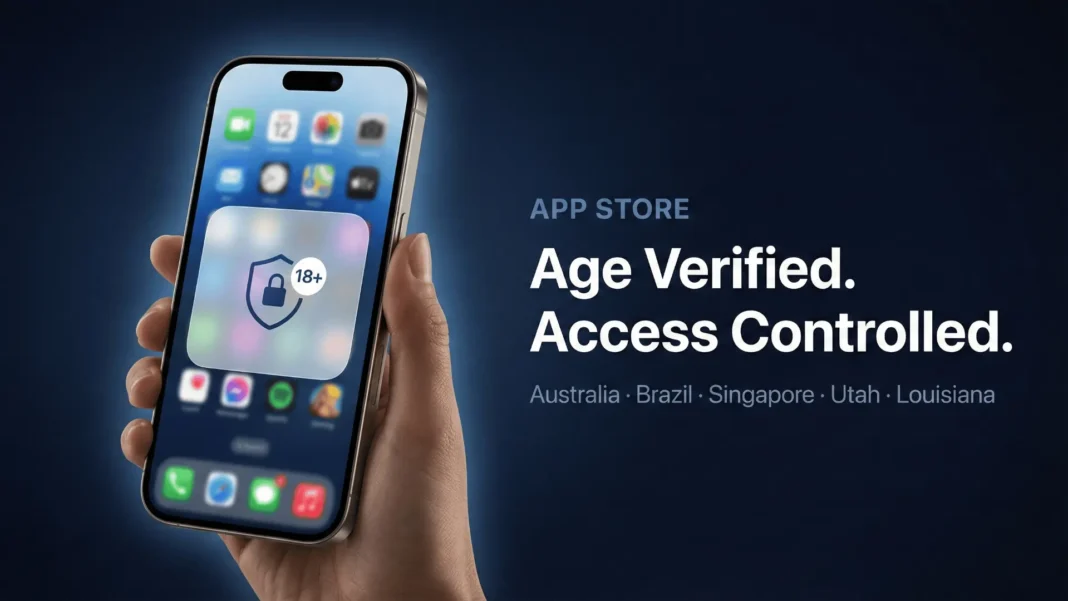
Apple has drawn a firm line on age-restricted content, and the enforcement is already live in three markets. Starting February 24, 2026, any user in Australia, Brazil, or Singapore attempting to download an app rated 18+ on the App Store must first pass an adult confirmation check before the download proceeds. The updated Declared Age Range API, now available in beta on iOS, iPadOS, and macOS, gives developers a privacy-preserving signal about a user’s age category without exposing personal identification data. This is the first wave of a multi-region compliance rollout that sets new standards for how app stores handle minor protection globally.
How Apple’s Age Verification System Works
The App Store performs the adult confirmation automatically at the point of download, but Apple is explicit that developers may carry separate legal obligations to independently confirm adult status. To support this, Apple provides the Declared Age Range API, which returns a user’s age category and a signal from the user’s device about the method of age assurance used.
Critically, age categories are only shared when the user, or a parent or guardian where relevant, actively agrees to share that information with the developer. No personal identification data, date of birth, or document scan passes to the developer. The API also returns new signals indicating whether age-related regulatory requirements apply to a specific user and whether that user is required to share their age range.
Region-by-Region Enforcement Timeline
Each jurisdiction operates under its own legal framework, and Apple’s rollout reflects those differences precisely.
Australia, Brazil, and Singapore (Live: February 24, 2026)
Apple began blocking users in these three markets from downloading apps rated 18+ unless adult status is confirmed through reasonable methods. The App Store handles this confirmation automatically at the storefront level. Brazil adds one additional layer: any app that declares it contains loot boxes through Apple’s age rating questionnaire will have its Brazil storefront rating automatically updated to 18+.
Utah (Effective: May 6, 2026)
Utah’s App Store Accountability Act applies only to users with new Apple Accounts created on or after May 6, 2026. Age categories for these users will be shared with a developer’s app when requested through the Declared Age Range API. Utah also requires parental permission for significant app updates when the app was downloaded by a child, and that permission must be re-obtained even if it was previously granted for the same app.
Louisiana (Effective: July 1, 2026)
Louisiana’s House Bill 570 follows the same structure as Utah and likewise applies only to new Apple Accounts. Age categories will be shared through the Declared Age Range API upon developer request starting July 1. The same parental consent requirement for significant app updates applies in Louisiana as in Utah.
The Developer Compliance Toolkit
Apple expanded its compliance toolkit to help developers meet obligations in all five regions. The full set of tools currently available includes:
- Declared Age Range API: Returns a user’s age category and age assurance method signal; now includes signals on whether regulations apply to the user and whether age sharing is required; available on iOS, iPadOS, and macOS
- Significant Change API under PermissionKit: Enables developers to prompt parents for consent when a major app update ships to a child user’s device
- New age rating property type in StoreKit: Allows programmatic declaration of age-sensitive content at the storefront level
- App Store Server Notifications: Delivers real-time signals to developers when parental consent status changes or is withdrawn
- Significant Update Action (beta): Allows developers to present significant update notifications to adult users in Utah and Louisiana
Developers using the Significant Update Action must follow Apple’s Human Interface Guidelines and provide users with a meaningful description of what changed in the update.
Developer Fines for Non-Compliance
The financial stakes for non-compliance are substantial and vary by jurisdiction. In Utah, parents can recover damages of up to $1,000 per violation. In Louisiana, developers can be fined up to $10,000 per violation, with a 45-day grace period after the July 1, 2026 effective date.
Apple itself faces potential fines running into millions of dollars for non-compliance at the platform level in Brazil, Australia, and Singapore, where governments have introduced requirements directly targeting app store operators. This direct exposure is part of why Apple moved to platform-level enforcement in these three markets before the US state laws take effect.
Apple’s Position on Privacy
Apple has historically opposed platform-level age verification legislation, citing the data collection risks inherent in methods like government ID submission. The Declared Age Range API reflects Apple’s preferred approach: delivering a useful compliance signal without creating a centralized repository of user identification data.
The opt-in consent structure, where users or guardians must actively agree before any age data reaches a developer, is Apple’s direct response to the tension between child protection mandates and user privacy. Developers receive only what they need to establish compliance, nothing more.
What Developers Must Do Now
Developers distributing apps in any of the five named regions face a concrete action list before their relevant enforcement date:
- Complete the age rating questionnaire accurately, including loot box disclosures for the Brazil storefront
- Integrate the updated Declared Age Range API to receive age category signals and regulatory applicability signals
- Implement the Significant Change API under PermissionKit to handle parental consent workflows for major updates
- Set up App Store Server Notifications to receive real-time alerts when parental consent is granted or withdrawn
- Review all app age ratings currently active in Australia, Brazil, and Singapore for 18+ compliance
- Test the Significant Update Action beta for apps distributed in Utah and Louisiana before enforcement dates
Developers in Utah and Louisiana should note that both laws apply only to new Apple Accounts, not to users with existing accounts.
Limitations and Considerations
Apple’s enforcement covers the App Store layer, but it does not replace in-app age verification obligations that some jurisdictions impose independently. Developers should seek legal counsel specific to each market, as Brazil’s Digital ECA, Australia’s Online Safety Act, and Singapore’s Children’s Code each carry distinct requirements beyond the App Store confirmation step.
Apple’s stance against ID-based verification means the current system relies on the age assurance method already on file with the user’s Apple Account, which may not satisfy the highest-bar jurisdictions for all use cases. Developers targeting markets with strict independent verification mandates should treat the Declared Age Range API as a compliance signal, not a legal substitute for full verification where laws require it.

Frequently Asked Questions (FAQs)
What is Apple’s Declared Age Range API?
The Declared Age Range API is a developer tool on iOS, iPadOS, and macOS that returns a user’s age category and a signal about the age assurance method used. It also indicates whether age-related regulations apply to a specific user. Age data is only shared when the user or guardian actively consents.
Which regions does Apple’s new age verification apply to?
As of February 24, 2026, age verification for 18+ app downloads is live in Australia, Brazil, and Singapore. Utah’s enforcement starts May 6, 2026, and Louisiana’s starts July 1, 2026. The Utah and Louisiana rules apply only to new Apple Accounts, not existing ones.
Does Apple share personal data with developers for age verification?
No. The API shares an age category and an age assurance method signal only. Developers never receive a user’s date of birth, government ID, or document scan. The user or their guardian must actively agree before any age data passes to the developer’s app.
What happens to apps in Brazil that contain loot boxes?
Any app distributed in Brazil that identifies itself as containing loot boxes through Apple’s age rating questionnaire will have its Brazil storefront rating automatically updated to 18+. This means the adult confirmation requirement applies before any user in Brazil can download that app.
What fines do developers face for non-compliance?
In Utah, parents can recover damages up to $1,000 per violation. In Louisiana, developers can be fined up to $10,000 per violation, with a 45-day grace period from July 1, 2026. Apple itself faces potential fines in the millions in Brazil, Australia, and Singapore for platform-level non-compliance.
Do Utah and Louisiana rules apply to existing Apple Account holders?
No. Both Utah’s App Store Accountability Act and Louisiana’s House Bill 570 apply only to users who create new Apple Accounts on or after the respective enforcement dates: May 6, 2026 for Utah and July 1, 2026 for Louisiana. Existing Apple Account holders are not affected.
What is the Significant Update Action and when is it required?
The Significant Update Action, currently in beta, allows developers to notify adult users of major app updates in Utah and Louisiana. Developers must follow Apple’s Human Interface Guidelines and describe changes meaningfully. A separate Significant Change API under PermissionKit handles parental consent notifications for child users.
What are the parental consent requirements for app updates?
In Utah and Louisiana, if a child downloads an app, parents must give permission for significant updates to that app, even if consent was previously granted. Apple will notify developers if parental consent is later withdrawn. Developers must handle these withdrawal signals through App Store Server Notifications.

