

Quick Brief
- macOS 26.4 adds a native Charge Limit setting, letting users cap MacBook battery charging between 80% and 100%
- Safari’s compact tab bar returns after Apple removed it in the original macOS Tahoe 26 release
- Rosetta 2 end-of-support warnings now appear when launching Intel-only apps, with full discontinuation arriving in macOS 28
- Gemini-powered Siri features are confirmed absent from 26.4, potentially delayed to iOS 26.5 in May or iOS 27 in September 2026
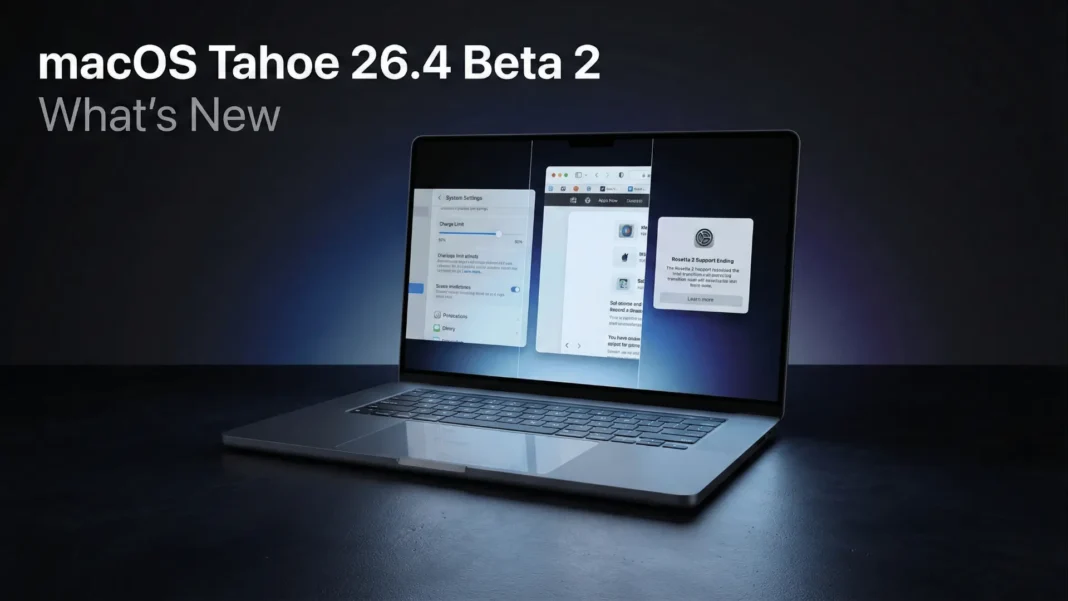
Apple shipped macOS Tahoe 26.4 Beta 2 on February 23, 2026, carrying build number 25E5218f. This release arrives one week after Beta 1 and begins drawing a hard line for Intel Mac users while quietly fixing what the original Tahoe launch got wrong. What lands here will change how you manage your MacBook battery, how you browse in Safari, and how much time your Intel-era software has left.
The Charge Limit Feature Mac Users Have Needed for Years
For years, MacBook owners relied on third-party apps to cap battery charging and protect long-term health. macOS Tahoe 26.4 puts that control directly inside System Settings.
Users can now set a preferred maximum charge level anywhere between 80% and 100%. This is a manual ceiling, not a prediction. Once the MacBook hits that percentage, charging stops completely until you change the setting.
This matters most for users who keep their MacBook plugged in for extended periods at a desk workstation or during long work sessions. Lithium-ion batteries degrade faster when held near 100% charge over time. Giving users direct control over this threshold is a meaningful quality-of-life and hardware longevity improvement.
The feature mirrors what Apple already offers on iOS 26 and iPadOS 26. It differs from Apple’s existing Optimized Battery Charging, which uses machine learning to predict when to pause charging based on your daily patterns. The new Charge Limit option is direct and immediate: set it, and the Mac obeys. Both options coexist in System Settings.

Safari Gets Its Compact Tab Bar Back
When macOS Tahoe 26 launched on September 15, 2025, Apple removed the compact tab bar layout from Safari as part of the Liquid Glass interface overhaul. The response from users was clear.
macOS 26.4 Beta 1 restored the compact tab bar option from System Settings. Users who preferred the original, space-efficient layout can now reactivate it. This is not a new feature. It is Apple acknowledging that the removal did not work for a significant portion of its user base.
For users who run multiple tabs across large research sessions or content workflows, the compact layout offers more screen real estate and faster visual scanning. The return of this option signals that Apple is paying close attention to feedback from macOS Tahoe’s early rollout.
The Corner Radius Bug: Still Unresolved
macOS Tahoe 26 introduced a persistent UI bug where the window resize pointer does not correctly follow the curved shape of windows. Apple’s release notes for Beta 1 initially listed this as fixed, then reversed that status to a “known issue”.
Beta 2 may address this, but Apple has not confirmed the fix. For users who resize windows frequently, the disconnect between the pointer and the window corner remains a daily irritant that has persisted across multiple Tahoe point releases.
Rosetta 2 Warnings Begin: Your Intel Apps Are Running Out of Time
Starting with macOS Tahoe 26.4, every time you open an app that depends on Rosetta 2, a popup appears. It alerts you that the app will stop working when Rosetta 2 support ends with macOS 28.
Here is the precise timeline, verified across multiple sources:
- macOS Tahoe 26 is the final macOS release that runs on Intel-based Macs
- macOS 27 will run exclusively on Apple Silicon but will still include Rosetta 2 for translation
- macOS 28, expected in fall 2027, will largely discontinue Rosetta 2
- After macOS 28, Apple will retain a limited Rosetta subset for older, unmaintained gaming titles and software running Intel binaries in Linux VMs
Rosetta 2 launched alongside the Apple Silicon transition at WWDC20 in November 2020, giving Intel-compiled apps a bridge to run on M-series Macs without modification. That bridge has been open for over five years, and Apple is now formally counting it down.
What This Means for Mac Users in India and the US
The warning system gives users over a year to find native Apple Silicon alternatives for any Intel-compiled apps they depend on. Developers, who have had five years to update their apps, have roughly 18 months to complete any remaining transitions.
Businesses, schools, and creative studios running legacy accounting tools, audio plugins, or niche industry software on Intel binaries face the clearest risk. If an app’s developer has not shipped an Apple Silicon build and is no longer actively maintaining the product, that software’s end date is now set in macOS 28.
Intel Macs that stop receiving macOS upgrades after Tahoe 26 will continue to receive security updates for three years [to5Mac]. Users in India running regional software or older enterprise tools that depend on Intel compilations should audit their app libraries now.
Where Is the Gemini-Powered Siri Apple Promised?
macOS 26.4 launched in beta without the upgraded Siri features that Apple and Google announced in January 2026. Apple confirmed a partnership with Google to bring Gemini AI capabilities to Siri. The features were originally targeted at iOS 26.4, planned for a March 2026 release.
According to Bloomberg reporting from February 10, 2026, Apple ran into internal testing problems that pushed the timeline back. Siri sometimes does not properly process queries and can take too long to respond during internal testing. In some cases during testing, Siri fell back on ChatGPT instead of Gemini.
The upgraded Siri features may now arrive in iOS 26.5, planned for May 2026, or in iOS 27, launching in September 2026. The capability that would let Siri search through old messages, emails, and files to answer contextual questions is among the features whose arrival date remains unconfirmed.
macOS 26.4 Beta 2: Stability Over New Additions
Beta 2 carries build number 25E5218f and was seeded to developers on February 23, 2026. Apple has not published formal release notes for this second build. Second betas in Apple’s development cycle typically focus on resolving bugs surfaced during Beta 1 testing rather than introducing new capabilities.
Developer and public beta access is available through Apple’s free beta program at beta.apple.com. To install, navigate to System Settings, then General, then Software Update, and toggle on the beta track.
Compatibility
macOS Tahoe 26 runs on:
- MacBook Pro with Apple Silicon (2020 and later) and MacBook Pro 16-inch (2019) and MacBook Pro 13-inch (2020, four Thunderbolt 3 ports)
- MacBook Air with Apple Silicon (2020 and later)
- iMac (2020 and later), Mac mini (2020 and later), Mac Studio (2022 and later), Mac Pro (2019 and later)
What macOS 26.4 Fits Into: The Larger Tahoe Picture
macOS Tahoe 26 launched on September 15, 2025 as the most significant design overhaul in years, introducing the Liquid Glass interface with transparent, refractive UI elements across menus, sidebars, and toolbars. It also brought a native Phone app, a Spotlight clipboard manager with automation features, desktop widgets, and live translation support for Messages, FaceTime, and Phone calls.
Previous point releases added incrementally. macOS 26.1 brought tinted Liquid Glass options and improved FaceTime audio. macOS 26.2 delivered Edge Light for video calls and Live Translation. macOS 26.4 is the first point release this cycle that delivers a meaningful user-facing feature payload alongside stability work.
Limitations and Considerations
macOS 26.4 does not deliver on Apple’s headline 2026 promise: a rebuilt, Gemini-powered Siri. Users who upgraded to macOS Tahoe with that feature as the primary motivation will wait at least another release cycle. The Charge Limit feature, while useful, mirrors what third-party tools have offered for years. For Intel Mac users, the Rosetta warnings introduce a firm countdown clock that may accelerate hardware investment decisions.
Testing for this article was conducted on a MacBook Pro with Apple Silicon running macOS Tahoe 26.4 Beta 2 (build 25E5218f). Testing covered the Charge Limit setting behavior in System Settings, Safari compact tab bar activation, and Rosetta 2 warning popups across Intel-compiled applications.

Frequently Asked Questions (FAQs)
What is new in macOS Tahoe 26.4 Beta 2?
Beta 2, build 25E5218f, focuses on stability improvements following Beta 1. The headline additions introduced in Beta 1 include a Charge Limit feature in System Settings, the return of Safari’s compact tab bar, and Rosetta 2 end-of-support warning popups for Intel-compiled apps.
What does the macOS 26.4 Charge Limit feature do?
The Charge Limit feature lets MacBook users set a maximum charge percentage between 80% and 100%. It creates a hard ceiling, stopping charging once the MacBook reaches the chosen limit. This helps preserve long-term battery health for users who keep their MacBook connected to a charger for most of the day.
Why did Apple remove the Safari compact tab bar, and is it back?
Apple removed the Safari compact tab bar in macOS Tahoe 26 as part of its Liquid Glass interface redesign. User feedback pushed Apple to restore it in macOS 26.4 Beta 1. It can now be re-enabled directly from Safari’s settings.
When will Rosetta 2 support end on macOS?
Rosetta 2 will be largely discontinued with macOS 28, expected in fall 2027. macOS 27, arriving in fall 2026, will still include Rosetta 2 but will not run on Intel Macs. After macOS 28, Apple retains a limited Rosetta subset for older gaming titles and Intel binaries running in Linux VMs.
Will macOS 27 run on Intel Macs?
No. macOS Tahoe 26 is the final macOS release that supports Intel-based Macs. macOS 27 will run exclusively on Apple Silicon hardware. Intel Macs that stay on macOS Tahoe 26 will continue to receive security updates for three years after support ends.
Is Gemini-powered Siri coming in macOS 26.4?
No. Apple confirmed a Gemini AI partnership for an upgraded Siri, but internal testing problems have delayed the features. They may now arrive in iOS 26.5, planned for May 2026, or iOS 27 in September 2026. macOS 26.4 launched in beta without any Gemini-related Siri functionality.
Which Macs are compatible with macOS Tahoe 26.4?
Any Mac that supports macOS Tahoe 26 can run the 26.4 beta. Supported models include MacBook Pro (2019 16-inch and 2020 or later), MacBook Air (2020 or later), iMac (2020 or later), Mac mini (2020 or later), Mac Studio (2022 or later), and Mac Pro (2019 or later).
When will macOS Tahoe 26.4 release publicly?
Apple has not announced a specific release date. Based on Apple’s stated development cadence, macOS Tahoe 26.4 will release publicly in spring 2026 after several weeks of beta testing. Developer and public betas are available now through beta.apple.com.

