

Quick Brief
- GitHub confirms open source faces “Eternal September” endless contributor flood overwhelming maintainers
- 60% of maintainers work unpaid while 44% report burnout severe enough to quit projects
- GitHub launched February 12-13, 2026: maintainers can now disable pull requests or restrict to collaborators only
- New controls aim to make maintaining “quieter and more sustainable” after projects like Kubernetes Ingress NGINX retired
The Original Eternal September Returns
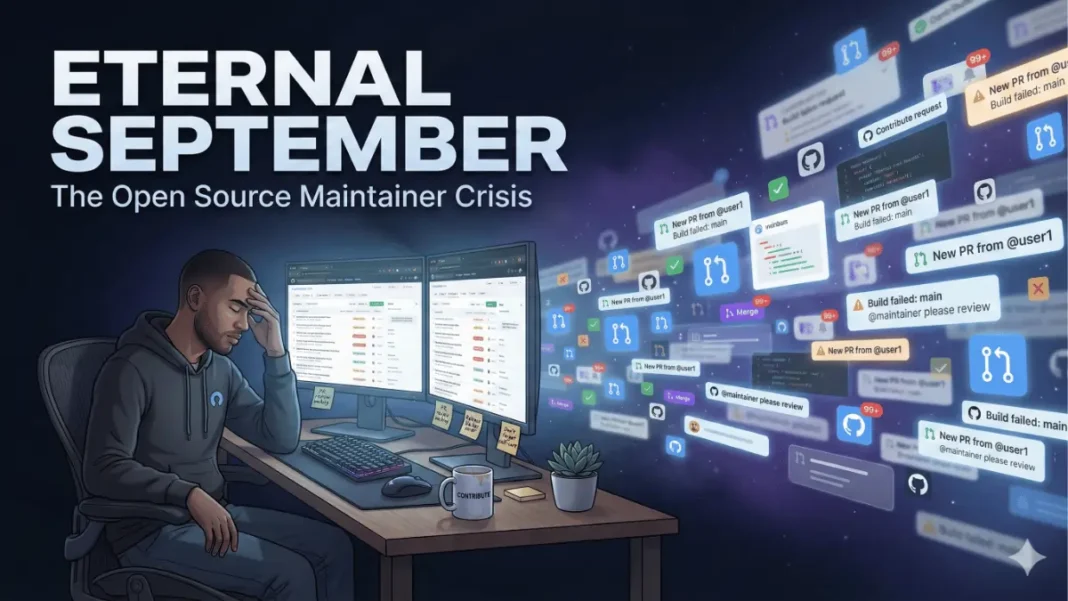
GitHub borrowed a 33-year-old internet term to describe what’s breaking open source right now. In September 1993, AOL flooded Usenet with millions of new users who didn’t understand community norms. Veteran users watched their carefully maintained discussion forums collapse under the weight of endless newcomers asking the same questions, ignoring etiquette, and drowning out meaningful conversation.
Open source hit its own Eternal September in 2025. AI coding assistants, simplified workflows, and reduced contribution friction brought waves of new contributors but maintainers lack the infrastructure to manage the volume. The 2024 Tidelift State of the Open Source Maintainer Report revealed 60% of maintainers remain completely unpaid for work that powers the global software supply chain.
When Contribution Becomes Crushing
Kubernetes retired Ingress NGINX in November 2025 not because the software failed, but because maintainers working nights and weekends couldn’t sustain it anymore. One of the platform’s most widely used components stopped receiving security patches after March 2026. This wasn’t an isolated incident but a symptom of systemic collapse.
Sixty percent of maintainers have quit or seriously considered quitting their projects, up 2% from 2023. When asked to identify the primary reason for leaving, 44% of maintainers cited burnout specifically. Competing life demands affected 54% while 51% reported loss of interest both consequences of unpaid labor expectations.
The mathematics is brutal. Three hundred million companies extract value from open source projects. Only 4,200 companies pay anything back through GitHub Sponsors. That represents a 99.999% freeloading rate across the industry. Harvard Business School research values commercial programs’ open source dependencies at $8.8 trillion, yet 96% of these programs rely entirely on unpaid maintainers.
GitHub’s Drastic Intervention Now Live
GitHub announced February 11, 2026 it would implement “drastic steps” to protect maintainers from the contribution tsunami. Within 48 hours, the platform launched the solution. On February 12-13, 2026, GitHub released new repository settings allowing project owners to disable pull requests completely or restrict submissions exclusively to collaborators.
This creates a fundamental shift from the collaborative ethos that built open source. Maintainers now control who can submit pull requests at the repository level. The changes also include the ability to delete pull requests directly from the user interface. GitHub’s announcement described the goal as making maintenance “easier, quieter, and more sustainable”.
The changes address a platform design problem identified by The Register in early February 2026. Current GitHub infrastructure assumed unlimited maintainer capacity to review, respond, and integrate contributions. When repositories receive hundreds of pull requests weekly, the review queue becomes unmanageable. GitHub’s own documentation acknowledges delays and performance issues when repositories exceed 1,000 open pull requests against the same branch.
How do the new pull request controls work?
Repository administrators access the new settings under repository configuration options. They can choose three levels: unrestricted access (default), collaborators only, or disabled entirely. The collaborators-only setting limits pull request creation to users with write access or above. Disabling pull requests removes the functionality completely while keeping issues available.
Trust Barriers Replace Open Access
The new restriction system inverts traditional open source philosophy. Instead of “anyone can contribute,” the model becomes “anyone with collaborator status can contribute”. This mirrors how the original Usenet communities distinguished between September newcomers and year-round contributors.
GitHub also announced plans for additional triage tools, more granular repository permissions, and AI attribution mechanisms. These features aim to help maintainers identify contribution quality before accepting pull requests. Implementation timelines for these additional tools have not been announced.
Critics argue this could exclude newcomers and reduce diversity. Supporters counter that burnout already excludes maintainers permanently. The platform’s rapid implementation less than 48 hours from announcement to launch signals the urgency GitHub perceives around the maintainer crisis.
The Funding Crisis Nobody Solved
Microsoft discontinued Azure Sponsored Subscriptions on September 1, 2025, shifting to funding only “strategic” projects. This eliminated free hosting and infrastructure for thousands of maintainers who suddenly faced monthly bills. GitHub Sponsors participation increased but remains negligible only 4,200 companies participate compared to 300 million using open source software.
The 2024 Tidelift report identified “not financially compensated enough/at all for my work” as the second most common maintainer complaint. Maintainer Month 2025 emphasized “Securing Open Source” as its theme, acknowledging that security vulnerabilities multiply when burned-out maintainers abandon projects. The TODO Group and Open Source Initiative partnered with GitHub to highlight maintainer security best practices. Financial sustainability discussions, however, remained secondary to technical solutions.
The Open Source Pledge emerged in 2025 as a certification for companies funding maintainers proportional to their dependency usage. Sentry leads with $2,000 per developer per year minimum, committing $750,000 in 2026. About 20 companies participate, pledging approximately $1.3 million collectively. Adoption rates remain microscopic compared to the 300 million companies benefiting from open source.
Community-Led Solutions Emerge
Several projects implemented their own triage systems before GitHub’s announcement. CodeRabbit offers free AI-powered code reviews for public repositories, reducing human maintainer load. JetBrains provides free IDE licenses to open source maintainers, cutting operational costs.
Some communities adopted contribution limits voluntarily before GitHub formalized the option. Projects created tiered access where new contributors handle documentation and testing before gaining code commit privileges. This apprenticeship model distributes maintenance work while building trust gradually.
Early Adoption and Implementation
GitHub’s new pull request controls became available February 12-13, 2026 to all repositories. Maintainers can enable restrictions immediately through repository settings. The platform has not disclosed adoption statistics or which major projects have implemented the controls.
The rapid deployment suggests GitHub prioritized maintainer protection over extended beta testing. Projects experiencing high pull request volume and documented maintainer burnout now have immediate relief options. The controls offer graduated responses from complete disabling to collaborator-only access allowing projects to calibrate restrictions to their specific needs.
Early implementation poses transition risks. Disabling pull requests could fracture communities used to open contribution models. Projects might lose valuable contributors who lack collaborator status but possess critical skills. Communication about the new controls will determine whether communities view restrictions as protective infrastructure or exclusionary gatekeeping.
What This Means for Open Source
The Eternal September metaphor captures both the problem and solution. Original Usenet eventually stabilized through moderation, community norms, and technical tools that scaled human capacity. Open source requires the same evolution of technical solutions matched with cultural shifts and economic models that don’t assume infinite free labor.
GitHub’s implementation speed 48 hours from announcement to launch reflects the severity of the maintainer crisis. Kubernetes Ingress NGINX’s November 2025 retirement served as a wake-up call that critical infrastructure components can collapse when maintainers burn out. The new controls provide immediate relief but don’t address the fundamental economic imbalance where 99.999% of companies freeload on unpaid maintainer labor.
Projects can now protect maintainers from contribution overload through technical restrictions. Financial sustainability remains unsolved. The 4,200 companies paying anything to maintainers represents a rounding error against 300 million beneficiaries. Until the industry treats maintainer compensation as infrastructure cost rather than optional charity, technical tools will only delay not prevent the next wave of critical project retirements.

Frequently Asked Questions (FAQs)
What does Eternal September mean in open source?
Eternal September refers to the overwhelming influx of new contributors flooding open source projects, similar to 1993 when AOL users overwhelmed Usenet forums. GitHub uses this term to describe how reduced contribution friction from AI tools creates unmanageable pull request volumes that burn out maintainers.
Why are 60% of open source maintainers considering quitting?
Maintainers face burnout while working completely unpaid on software infrastructure. Sixty percent have quit or seriously considered quitting (up 2% from 2023). When asked the primary reason for leaving, 44% cited burnout, 54% cited competing life demands, and 51% cited loss of interest. Projects like Kubernetes’ Ingress NGINX retired in November 2025 specifically due to maintainer burnout.
Can GitHub really disable pull requests on repositories?
Yes. GitHub launched this feature February 12-13, 2026. Repository administrators can now disable pull requests completely or restrict submissions to collaborators only through repository settings. This represents a fundamental shift from open access contribution models to protect maintainer sustainability.
How do GitHub’s new pull request restrictions work?
Repository administrators access new settings under repository configuration. They can choose unrestricted access (default), collaborators only, or disabled entirely. The collaborators-only setting limits pull request creation to users with write access or above. Pull requests can also be deleted directly from the user interface.
What happened to Microsoft’s Azure Sponsored Subscriptions?
Microsoft discontinued Azure Sponsored Subscriptions on September 1, 2025, shifting to funding only “strategic” projects. This eliminated free hosting for thousands of maintainers who previously received infrastructure support. Maintainers now explore alternative funding through GitHub Sponsors, Open Source Pledge, and service providers like JetBrains.
When did Kubernetes retire Ingress NGINX?
Kubernetes officially announced Ingress NGINX retirement November 11, 2025. The project provided best-effort maintenance until March 2026, after which it receives no further releases, bugfixes, or security updates. Maintainer burnout caused this retirement of one of Kubernetes’ most widely used components.
How does the 99.999% freeloading rate affect open source?
Three hundred million companies use open source while only 4,200 pay anything back through GitHub Sponsors, creating a 99.999% freeloading rate. Harvard Business School research values commercial programs’ open source dependencies at $8.8 trillion. This financial imbalance forces 60% of maintainers to work unpaid on infrastructure powering the global software supply chain. When maintainers quit from burnout, security vulnerabilities multiply and critical projects retire.

