

Quick Brief
- Xcode 26.3 integrates Claude Agent and OpenAI Codex for autonomous app development
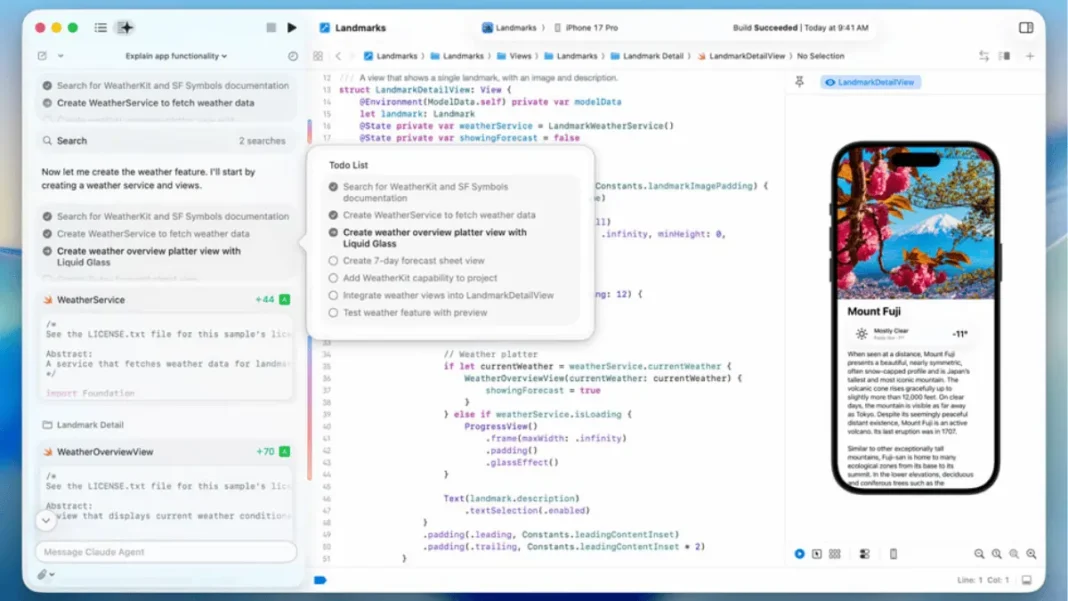
- Agents independently search documentation, explore files, build projects, and verify work visually
- Model Context Protocol enables any compatible AI agent to access Xcode capabilities
- Available as release candidate February 3, 2026 for Apple Developer Program members
Apple has fundamentally redefined iOS development and Xcode 26.3 proves it. The latest update introduces agentic coding, allowing developers to harness autonomous AI agents like Anthropic’s Claude Agent and OpenAI’s Codex directly within Xcode to tackle complex, multi-step tasks without constant supervision. These agents work with unprecedented autonomy, from breaking down development goals to making architectural decisions and verifying work visually through Xcode Previews.
What Agentic Coding Actually Means for Developers
Agentic coding represents a shift from AI assistants that respond to prompts to autonomous agents that execute complex workflows independently. Unlike Xcode 26’s coding assistant that helped with writing and editing Swift code, version 26.3 grants agents access to more Xcode capabilities throughout the development lifecycle. Agents can search documentation, explore file structures, update project settings, build projects, run tests, and identify errors without direct user involvement.
Susan Prescott, Apple’s vice president of Worldwide Developer Relations, states: “Agentic coding supercharges productivity and creativity, streamlining the development workflow so developers can focus on innovation”. The distinction lies in autonomy agents determine which files require modifications, execute lengthy tasks independently, and iterate through builds and fixes until completion or user input becomes necessary.
Claude Agent and OpenAI Codex: Dual Integration Strategy
Xcode 26.3 provides seamless built-in access to both Anthropic’s Claude Agent and OpenAI’s Codex, giving developers flexibility to work with the model that best fits their project requirements. Claude users can connect their Anthropic account to access Claude Sonnet 4 capabilities directly in Xcode, with features including natural language interaction, automatic context gathering, conversation history, and file attachments. The integration generates documentation, explains code sections, creates SwiftUI previews and playgrounds, and makes inline editor changes.
Both agents combine their reasoning power with Xcode’s native capabilities to deliver optimal results when developing for Apple platforms. Claude subscription usage limits are shared across platforms, with a portion allocated for Xcode usage. The integration enables developers to leverage powerful AI models within their familiar development environment without switching contexts.
Model Context Protocol: Open Standard for Agent Flexibility
Beyond Claude and Codex, Xcode 26.3 makes its capabilities available through the Model Context Protocol (MCP), an open standard that grants developers flexibility to use any compatible agent or tool. MCP provides a standardized interface for programmatic interaction with Xcode projects, simulators, devices, and Swift packages. This approach removes reliance on manual command-line invocations and ensures reliable agent-driven development processes.
The protocol enables AI agents to independently validate code changes by building projects, inspecting errors, and iterating autonomously. MCP servers expose Xcode operations as tools and resources, facilitating integration into AI-driven workflows for more efficient mobile development. Dynamic tool loading optimizes context window usage by starting with minimal essential tools and intelligently loading relevant workflow groups based on development tasks.
Autonomous Capabilities That Accelerate Development
Agents in Xcode 26.3 perform complex operations that previously required multiple manual steps and constant developer oversight. Once an agent model is selected, it can delve into file structures, comprehend overall project architecture, and intelligently determine modification requirements. The agent builds projects, executes tests, and identifies errors independently, performing lengthy tasks until completion.
Visual verification capabilities represent a significant advancement agents can capture Xcode Previews and iterate through builds and fixes while verifying work visually. AppleInsider’s hands-on testing describes the experience as “astoundingly fast, smart, and too convenient,” noting that features are delivered quicker than traditional development approaches. Community feedback highlights the planning feature where agents automatically open action plans that developers can review and annotate.
Real-World Impact on Development Workflows
The update facilitates swifter iterations, minimizes manual processes, and ensures tighter integration with Apple’s specific coding environment requirements. ZDNET characterizes Xcode 26.3 as “Apple’s biggest leap in AI coding tools,” shifting from assistant prompts to autonomous agents that build, test, and debug independently. Industry analysts note that agents collaborate throughout the entire development lifecycle, enabling developers to streamline workflows and bring ideas to life faster than previous methods.
The integration allows developers to focus on innovation while agents handle repetitive, time-consuming tasks. During pre-launch briefings, Apple’s Xcode leadership confirmed that version 26.3 transcends mere prompts and responses, granting agents greater autonomy and enhanced access to project context. This represents a fundamental shift in how developers interact with their tools and manage complex application development.
Availability and Requirements
Xcode 26.3 is available as a release candidate for all Apple Developer Program members starting February 3, 2026, with a full App Store release coming soon. Anthropic and OpenAI’s terms of service may apply when using their respective agents. Developers can download the release candidate immediately to begin integrating agentic coding into their workflows and experience the new autonomous capabilities firsthand.

Frequently Asked Questions (FAQs)
What is agentic coding in Xcode 26.3?
Agentic coding allows autonomous AI agents like Claude Agent and OpenAI Codex to work independently on complex development tasks. Agents can break down goals, make architectural decisions, build projects, run tests, and debug code without constant developer supervision.
Which AI agents work with Xcode 26.3?
Xcode 26.3 includes built-in integration for Anthropic’s Claude Agent (powered by Claude Sonnet 4) and OpenAI’s Codex. Through Model Context Protocol support, developers can also connect any MCP-compatible agent or tool.
How does Xcode 26.3 differ from Xcode 26?
Xcode 26 introduced a coding assistant for writing and editing Swift code. Xcode 26.3 expands this to agentic coding, granting agents access to more Xcode capabilities including building projects, searching documentation, exploring file structures, updating settings, and visual verification.
What is the Model Context Protocol?
Model Context Protocol (MCP) is an open standard that provides a standardized interface for AI agents to interact with Xcode projects, simulators, devices, and Swift packages. It enables any compatible agent to access Xcode’s capabilities programmatically.
Can agents in Xcode 26.3 run tests and fix bugs autonomously?
Yes. Agents can build projects, execute tests, identify errors, and iterate through builds and fixes independently. They verify work visually by capturing Xcode Previews and continue until task completion or user input is required.
When is Xcode 26.3 available?
The release candidate became available to all Apple Developer Program members on February 3, 2026. A full public release on the App Store is coming soon. Anthropic and OpenAI terms of service may apply when using their agents.
Does agentic coding work for all Apple platforms?
Yes. Xcode 26.3 agents combine their reasoning capabilities with Xcode’s native features to provide optimal results when developing for iOS, iPadOS, macOS, watchOS, and visionOS platforms.
How do I connect Claude or Codex to Xcode 26.3?
Developers can log into their Claude account within Xcode to access Claude Sonnet 4 features. For OpenAI Codex, developers connect through OpenAI’s authentication. Usage limits are shared across platforms for Claude subscriptions.

