

Key Takeaways
- Microsoft researchers advocate for open agentic economy where AI agents transact freely across platforms, not trapped in walled gardens
- AI agents market projected to reach $236 billion by 2034, up from $5.4 billion in 2024 a 4,270% growth
- Google launched Universal Commerce Protocol (UCP) in January 2026 to standardize agent-to-agent shopping communications
- Gartner forecasts 40% of enterprise applications will embed task-specific AI agents by 2026, up from single-digit adoption
Microsoft just redefined how AI assistants will operate in digital commerce and the implications extend far beyond simple chatbots. In a paper published January 29, 2026, in Communications of the ACM, Microsoft researchers argue that an open agentic economy, where AI agents freely interact across platforms to shop, negotiate, and transact on your behalf, is the only path that maximizes benefits for both businesses and consumers. The alternative walled gardens controlled by a few platforms risks stifling innovation and limiting consumer choice.
What Is the Agentic Economy?
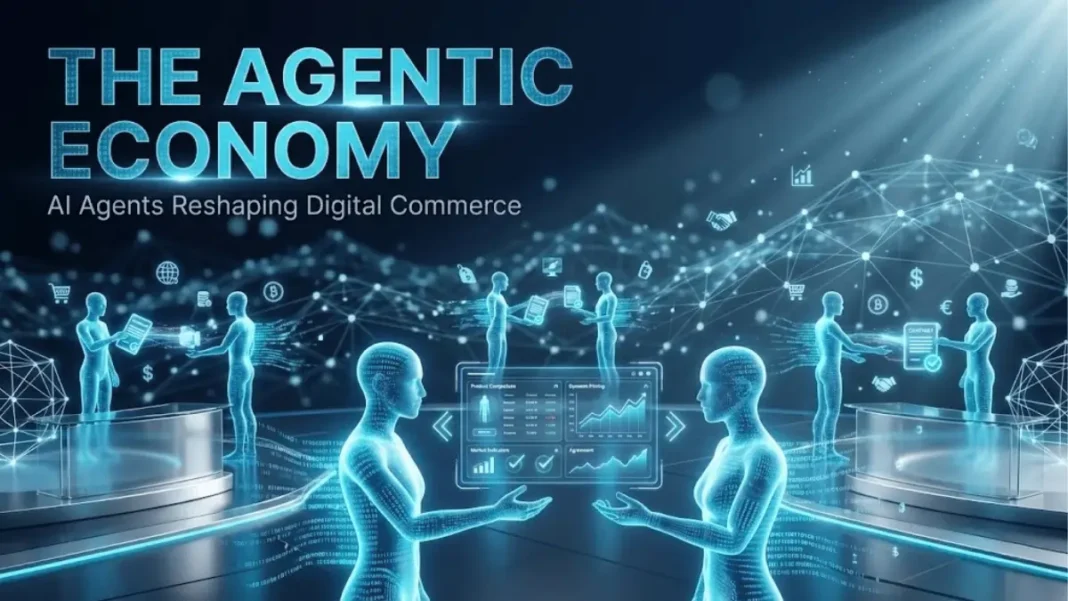
The agentic economy represents a fundamental shift from human-driven transactions to agent-mediated commerce. Instead of manually comparing prices, booking flights, or negotiating contracts, you deploy personal AI agents that autonomously handle these tasks.
These agents don’t just provide recommendations, they execute decisions within parameters you set. Your agent could negotiate your apartment lease terms with a landlord’s agent, compare grocery prices across six retailers and place orders, or manage recurring service subscriptions by switching providers when better deals emerge.
What makes agentic AI different from today’s chatbots?
Current AI assistants exist in “walled gardens” confined to individual platforms like airline websites or shopping apps. Agentic economy agents operate in decentralized ecosystems where any agent can transact with any other. Microsoft researcher David Rothschild compares this to the World Wide Web’s promise: assistant agents function like web browsers, service agents like websites, creating an open marketplace for agent-to-agent commerce.

Open vs. Walled Garden: The Critical Choice
Microsoft researchers warn that momentum could push the industry toward walled gardens, a few dominant platforms capturing users’ digital attention and restricting agent interactions to their ecosystems.
“There are very few companies that have captured all of our digital time,” explains Rothschild. “They have an enormous percentage of our attention, and they will do everything they can to keep you siloed into their platforms“.
The open agentic economy alternative allows agents to discover each other through standardized protocols, communicate without scripts, and transact in neutral digital marketplaces similar to how the International Space Station was created through cooperation rather than single-company ownership.
Why Open Markets Matter
Open agentic ecosystems benefit consumers and businesses in three ways:
- Reduced switching costs – Consumers find businesses matching their needs and easily change providers without platform lock-in
- Product-focused competition – Companies improve products rather than spending on attention-grabbing advertising; shift from “attention economy” to “preference economy”
- Decentralized access – More people and businesses access digital commerce tools without gatekeepers extracting rents
Program Manager Matt Vogel notes that open markets let “consumers find the best business that matches their needs and very easily switch between them. They’re not stuck and locked into one of them“.
The $236 Billion Market Taking Shape
The agentic economy isn’t theoretical, it’s materializing rapidly with substantial financial backing. The global AI agents market was valued at $5.4 billion in 2024 and is projected to reach $236 billion by 2034.
World Economic Forum analysis suggests agentic AI could deliver $3 trillion in corporate productivity gains globally over the next decade, expanding access for small businesses and enabling entirely new economic activity layers. McKinsey’s October 2025 report pegged the retail opportunity alone at $3 trillion to $5 trillion by 2030 due to AI-driven tools and agentic commerce.
Goldman Sachs identifies 2026 as the year personal agents transition from experimentation to operational deployment, with companies shifting from human-centric staffing to “human-orchestrated fleets of specialized multi-agent teams“. Billing will evolve from hours worked to tokens consumed the units of data AI models process.
Real-World Deployments in 2026
Three major initiatives launched in early 2026 demonstrate the agentic economy’s momentum:
Google’s Universal Commerce Protocol (UCP) – Unveiled January 11, 2026, at the National Retail Federation event, UCP establishes an open framework for AI agents, retailers, and payment systems to communicate using common digital language. Google deployed UCP in the US through AI Mode in Search and the Gemini app, letting shoppers buy directly from retailers using stored Google Pay and PayPal details.
OpenAI’s Agentic Commerce Protocol – Developed with Stripe, this open-source protocol enables ChatGPT users to complete purchases through Instant Checkout (launched September 2025). OpenAI earns commissions on facilitated transactions, positioning the protocol as a potential UCP competitor.
Amazon’s “Shop Direct” and “Buy for Me” – This feature lets consumers explore items from various brands’ websites on Amazon, with an AI agent completing purchases on shoppers’ behalf from external platforms.
How AI Agents Negotiate and Decide
Agentic AI systems in 2026 possess capabilities beyond simple task automation. They make autonomous decisions within defined boundaries using four core competencies:
1. Contextual Understanding – Agents analyze business requirements, constraints, and objectives before acting. In procurement, they factor in cost, risk, quality, and timing to optimize outcomes.
2. Real-Time Market Intelligence – Agents access dynamic pricing benchmarks, competitive landscape analysis, supply-demand indicators, and economic trends to inform negotiation strategies.
3. Adaptive Strategy Adjustment – During multi-round negotiations, agents plan strategic concessions, generate counter-offers with optimal timing, and preserve relationships while maximizing value.
4. Multi-Dimensional Optimization – Rather than single-metric decisions, agents balance trade-offs across price, delivery speed, supplier reliability, and terms.
Gartner data shows that by 2026, 40% of enterprise applications will embed task-specific AI agents up from low single-digit adoption signaling decisive movement from experimentation to operational deployment.
What makes these agents “intelligent” versus automated?
Intelligence lies in adaptation, not just rule-following. AI negotiation agents use historical data patterns (past proposals, contracts, discounts), external macroeconomic indicators (material prices, inflation), and supplier behavior models to dynamically adjust strategies mid-negotiation. They don’t execute scripts they respond to context.
Building the Infrastructure
Microsoft researchers identify five requirements for a functioning open agentic economy:
- Widespread adoption of assistant agents (consumer-side) and service agents (business-side)
- Programmatic inter-agent communication enabling unscripted interactions between agents
- Neutral digital marketplaces not controlled by single companies, created through public-private cooperation
- Standardized frameworks and protocols for agent discovery and secure interactions
- Multi-stakeholder governance involving technology companies, standards bodies, businesses, governments, and regulators
Rothschild emphasizes that this architecture requires carefully constrained agent environments that balance autonomy with safety and control. “This is a tradeoff that we think is important to confront in an open way, an open research way and an open development way“.
Microsoft’s Magentic Marketplace, an open-source simulation environment released alongside the agentic economy paper, provides researchers and developers a testbed for studying agent behaviors in market conditions.
Enterprise Adoption Patterns
EY’s “A Idea of India 2026” report reveals that 91% of business leaders cite deployment speed as the key factor in AI agent buy-versus-build decisions, with India shifting from GenAI pilots to scaled adoption.
Three consistent patterns emerge across industries in 2026:
- Production deployment – AI agents moving from pilots into live systems handling actual transactions
- Expanded authority – Execution power extending beyond recommendations to autonomous action
- Platform redesign – Enterprise software being rebuilt for autonomous execution rather than human-driven workflows
Task-specific agents now manage functions like autonomous cloud cost optimization, security incident remediation, and financial reconciliation without human prompts. Organizations using intelligent agents achieve faster procurement cycles, higher savings, and stronger supplier alignment compared to manual processes.
Attention Economy to Preference Economy
Microsoft’s research predicts a fundamental business model shift. In the attention economy, brands spent billions to place ads in front of consumers. In the preference economy, brands invest in product quality and transparent information that agents can evaluate.
“The hope is that there is still money being spent by brands to make them more successful, but they’re doing it in a way that really both improves the product and improves our understanding of the product rather than simply getting in front of us,” Rothschild explains.
This changes marketing dynamics. When an AI agent compares 47 hotel options based on your preferences, visual branding matters less than structured data about amenities, reviews, policies, and real-time pricing. Companies compete on substance evaluated by algorithms, not attention captured through creative advertising.
How will small businesses compete against large corporations in agent-driven markets?
Open agentic markets theoretically level the playing field. Small businesses gain access to the same agent infrastructure as large competitors, and agents evaluate options based on merit (price, quality, service) rather than brand recognition or ad spending. However, this assumes standardized protocols prevent dominant platforms from favoring preferred partners, a governance challenge requiring active oversight.
Two Possible Futures
The World Economic Forum outlines divergent paths for the next decade:
Scenario 1: Open, accountable agent commerce – Frictionless cross-border digital commerce where agents transact with high accountability and minimal friction. This unlocks $3 trillion in corporate productivity gains, expands small business access, and creates new economic activity layers.
Scenario 2: Platform-controlled walled gardens – A few dominant companies control agent interactions, extracting rents through gatekeeping. Innovation slows as startups can’t access markets, and consumers face limited choice within siloed ecosystems.
Microsoft researchers argue that starting the open agentic economy discussion in 2026 is critical because “otherwise, momentum and ease are going to push us into that version of walled gardens. And that would mean less overall welfare and opportunity for society“.
Limitations and Trade-Offs
An open agentic economy introduces challenges alongside benefits:
Security and fraud risks – Agent-to-agent transactions create attack surfaces for malicious actors. Standardized protocols must include robust authentication, encryption, and fraud detection mechanisms.
Privacy concerns – Personal agents accumulate deep knowledge of user preferences, financial status, and behavioral patterns. Data governance frameworks must prevent unauthorized access or exploitation.
Accountability gaps – When an agent negotiates unfavorable terms or makes purchasing errors, liability becomes complex. Clear legal frameworks defining responsibility across agent developers, platform providers, and users remain undeveloped.
Bias propagation – Agents trained on historical data may perpetuate existing market biases, favoring established providers over new entrants or certain demographics over others.
Implementation costs – Businesses must invest in agent infrastructure, protocol compliance, and staff retraining. Small companies may struggle with upfront costs despite long-term benefits.
Rothschild acknowledges that “more technology needs to be developed to create a very close space in which the agents are highly constrained, but that also adds to some safety and some control“.

Frequently Asked Questions (FAQs)
What is the agentic economy?
The agentic economy is a commercial system where AI agents autonomously transact on behalf of individuals and businesses. Instead of humans manually shopping or negotiating, personal AI agents handle these tasks by interacting with service agents from companies across open digital marketplaces.
How do AI agents negotiate prices?
AI agents analyze historical transaction data, market pricing benchmarks, supplier performance metrics, and real-time economic indicators to develop negotiation strategies. They adjust tactics dynamically during multi-round negotiations, planning concessions and counter-offers to optimize outcomes across price, quality, and terms.
What’s the difference between open agentic markets and walled gardens?
Open agentic markets let any agent transact with any other through standardized protocols in neutral marketplaces, similar to the open web. Walled gardens confine agents to single platforms controlled by individual companies, restricting interactions and limiting consumer choice.
When will AI agents start shopping for consumers?
AI shopping agents are already operational in limited forms. Google launched its Universal Commerce Protocol in January 2026, OpenAI introduced ChatGPT Instant Checkout in September 2025, and Amazon deployed “Buy for Me” agents. Widespread adoption is expected to accelerate throughout 2026 as infrastructure matures.
How big is the AI agents market?
The global AI agents market was valued at $5.4 billion in 2024 and is projected to reach $236 billion by 2034. McKinsey estimates the retail opportunity alone at $3 trillion to $5 trillion by 2030, with the World Economic Forum forecasting $3 trillion in corporate productivity gains over the next decade.
What companies are building agentic commerce infrastructure?
Microsoft released research and Magentic Marketplace simulation tools, Google launched Universal Commerce Protocol, OpenAI developed Agentic Commerce Protocol with Stripe, Amazon deployed Shop Direct and Buy for Me features, and enterprise platforms are embedding task-specific agents in applications.
Are AI agents secure for financial transactions?
Security remains a developing concern. Microsoft researchers emphasize that open agentic economies require standardized frameworks for secure interactions, authentication, and fraud prevention. Current implementations use established payment systems like Google Pay and PayPal, but robust security protocols for agent-to-agent transactions are still being developed.
Will agentic AI eliminate jobs?
Goldman Sachs predicts a shift from human-centric staffing to “human-orchestrated fleets” combining people and AI agents. Rather than eliminating jobs, roles evolve toward oversight, strategic direction, and handling complex cases that agents escalate. The focus shifts from task execution to agent management and exception handling.

