

Quick Brief
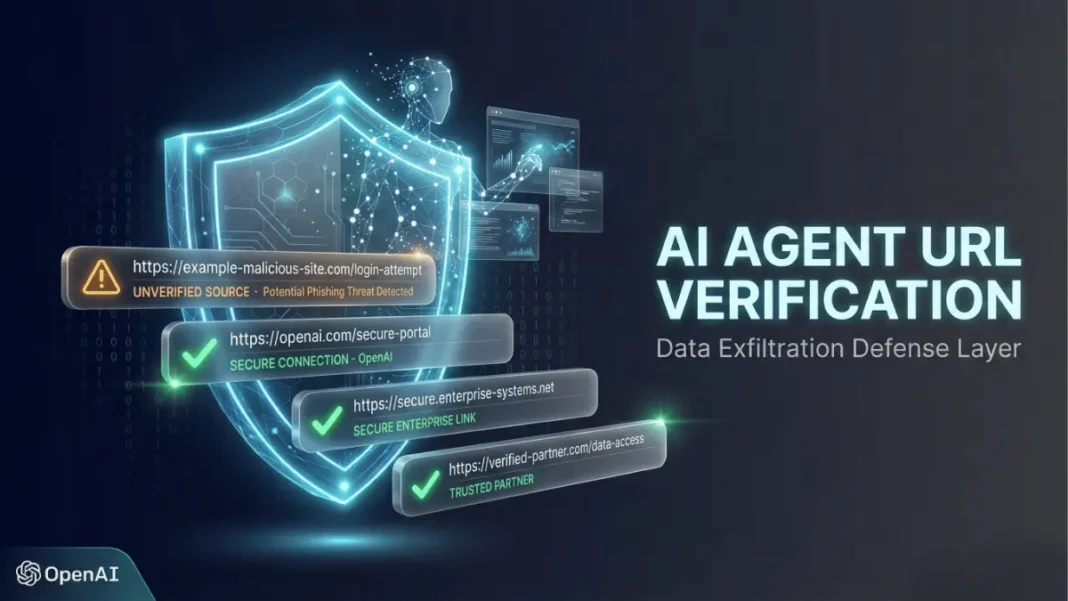
- The Defense: OpenAI deployed an independent web crawler that builds a public URL index, verifying links before ChatGPT agent auto-fetches them to prevent adversaries from embedding user data in malicious URLs.
- The Impact: Addresses URL-based data exfiltration attacks where compromised websites inject user conversation data into hidden links, then trick AI agents into automatically visiting those URLs and leaking private information.
- The Context: Launched January 28, 2026, as ChatGPT agent processes millions of web requests daily with authenticated user sessions, creating vectors for attackers to steal credentials, personal data, and proprietary information through crafted URLs.
OpenAI announced a URL verification system on January 28, 2026, designed to prevent attackers from using AI agents to exfiltrate user data through malicious web links. The security mechanism, now active in ChatGPT agent, addresses a specific vulnerability where adversaries craft URLs containing stolen conversation data and embed them in webpages, then manipulate the agent into automatically fetching those URLs to capture sensitive information.
The URL-Based Data Theft Attack Vector
The attack exploits how AI agents automatically fetch web content during task execution. An adversary compromises a website the agent might visit, then injects malicious instructions that encode the user’s conversation history, credentials, or personal data directly into a URL.
When the agent automatically fetches that URL believing it’s performing a legitimate web request the attacker’s server logs the complete URL string, which now contains the user’s private data. This technique bypasses traditional security controls because the data exfiltration occurs through what appears to be normal web browsing behavior.
“If an attacker can get ChatGPT agent to auto-fetch a URL with your data encoded in it, they can exfiltrate that data,” OpenAI’s security team stated in the announcement. The attack succeeds because AI models cannot reliably distinguish between legitimate instructions and malicious commands embedded in website content.

How Independent Web Index Verification Works
OpenAI’s defense mechanism operates through a dedicated web crawler that builds an index of publicly accessible URLs without accessing any user conversation data. This crawler discovers and catalogs legitimate web addresses by following links across the public internet, creating a reference database of known-good URLs.
Before ChatGPT agent automatically fetches any URL during task execution, the system checks whether that exact URL exists in the independently-built public index. If the URL is already documented as publicly accessible meaning it existed before the user’s conversation began the system determines the URL is significantly less likely to contain encoded private data.
When a URL cannot be verified against the public index, ChatGPT agent presents a warning dialog requiring explicit user confirmation before proceeding. This interrupts the automatic fetch process, preventing attackers from successfully exfiltrating data through dynamically-generated malicious URLs that were crafted specifically to contain the user’s information.
Verified Implementation Scope and Limitations
OpenAI explicitly defines what the URL verification system does and does not protect against. The mechanism specifically defends against URL-based data exfiltration attacks where private information is encoded in web addresses.
The system does not verify content trustworthiness, prevent social engineering attacks, or stop misleading instructions from compromised websites. OpenAI positions this as “one layer in a broader, defense-in-depth strategy” rather than a comprehensive security solution.
ChatGPT agent, launched in July 2025, currently implements this URL verification system. OpenAI’s Operator agent, which launched in January 2025, was shut down on August 31, 2025, when it was replaced by the more advanced ChatGPT agent.
Technical Architecture
| Component | Function | Security Benefit |
|---|---|---|
| Independent Crawler | Discovers public URLs without user data access | Creates untainted reference database |
| Public URL Index | Catalogs legitimate web addresses | Establishes baseline of known-good URLs |
| Pre-Fetch Verification | Checks URL against index before auto-fetch | Identifies potentially malicious URLs |
| Warning Dialog | Requires user confirmation for unverified URLs | Breaks automated exfiltration chain |
AdwaitX Analysis: Defense-in-Depth for Agentic AI
OpenAI’s targeted approach reflects the complexity of securing autonomous AI systems that operate across authenticated user sessions. Unlike traditional browser security models designed for human operators who can identify suspicious URLs visually, AI agents process links programmatically without inherent skepticism about URL structure or destination.
The independent crawler architecture ensures the verification system itself cannot be poisoned by attacker-controlled data. By building the URL index separately from user conversations, OpenAI prevents adversaries from pre-seeding the index with malicious URLs that would later pass verification checks.
However, the narrow scope of protection exclusively URL-based exfiltration signals that comprehensive AI agent security requires multiple overlapping controls. OpenAI’s acknowledgment that the system does not prevent social engineering or content manipulation indicates that prompt injection and adversarial instructions remain active threat vectors requiring separate defenses.
Security researchers have documented that AI agents possess what’s termed the “lethal trifecta”: access to private data, exposure to untrusted external content, and the ability to make outbound requests. OpenAI’s URL verification addresses the third element by constraining which outbound requests occur automatically versus requiring human approval.
Deployment Timeline and Technical Documentation
OpenAI published the URL verification announcement on January 28, 2026, alongside technical documentation explaining the attack mechanism and defense architecture. The system is now active across ChatGPT agent deployments, protecting users during web-based task execution.
ChatGPT agent, which replaced Operator in August 2025, represents OpenAI’s current agentic AI platform. The agent includes browser access, terminal access, and 128K token context windows enabling complex multi-step tasks that require web navigation.
Enterprise Security Implications
Organizations deploying ChatGPT agent for business workflows benefit from URL verification protecting against data leakage when agents process internal documentation or customer data. The warning dialog mechanism provides audit trails showing when agents attempted to access unverified URLs, enabling security teams to investigate potential compromise attempts.
However, enterprises must implement additional controls beyond URL verification to secure agentic AI deployments. OpenAI’s explicit statement that the system does not prevent social engineering means human oversight remains necessary for sensitive operations where AI agents interact with external systems.

Frequently Asked Questions (FAQs)
What specific attack does OpenAI’s new system prevent?
It prevents URL-based data exfiltration where attackers encode user data in malicious URLs and trick AI agents into auto-fetching them, leaking private information.
How does the URL verification system work?
An independent crawler builds a public URL index. Before auto-fetching, ChatGPT agent checks if URLs exist in that index. Unverified URLs trigger warning dialogs.
Does this protect against all AI agent security threats?
No. It does not prevent social engineering, content manipulation, or misleading instructions. OpenAI calls it one layer in a broader defense-in-depth strategy.
Which OpenAI products have this protection?
ChatGPT agent launched July 2025 now includes URL verification. The operator was shut down in August 2025 when ChatGPT agent replaced it.

