

The Quick Brief
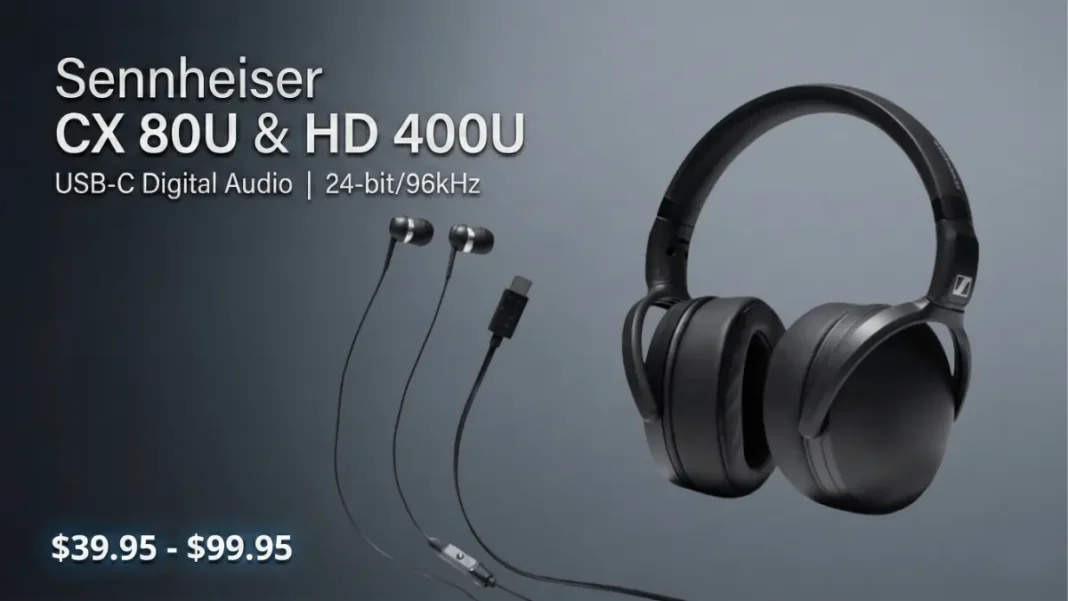
- The Launch: Sennheiser releases CX 80U earbuds ($39.95) and HD 400U headphones ($99.95) with native USB-C connectivity and 24-bit/96kHz digital audio
- The Impact: Targets mobile, gaming, and productivity users migrating from discontinued 3.5mm analog ports to USB-C standard across iOS, Android, Windows, and gaming platforms
- The Context: Launch follows industry-wide elimination of analog jacks; models replace Sennheiser’s CX 80S and HD 400S with direct digital connectivity
Sennheiser announced on January 27, 2026, the immediate availability of CX 80U earbuds and HD 400U headphones from its Hanover, Germany headquarters. Both models deliver class-compliant digital audio at 24-bit/96kHz resolution across iOS, Android, Windows, macOS, ChromeOS, and SteamOS platforms without requiring proprietary drivers.
USB-C Audio Architecture and Technical Specifications
The CX 80U and HD 400U replace the 3.5mm analog connection of their predecessors (CX 80S and HD 400S) with USB Type-C digital transmission that eliminates digital-to-analog conversion losses. Christian Ern, Senior Product Manager at Sennheiser, stated the models prioritize “plug-and-go convenience” while maintaining sound quality.
Technical Specifications:
| Specification | CX 80U (In-Ear) | HD 400U (Over-Ear) |
|---|---|---|
| Audio Resolution | 24-bit/96kHz playback | 24-bit/96kHz playback |
| Frequency Response | 17-20,000 Hz | 18-20,000 Hz |
| Impedance | 28 Ohms | 18 Ohms |
| SPL | 119 dB @ 1kHz, 1V RMS | 120 dB @ 1kHz, 1V RMS |
| THD | <0.5% @ 1kHz, 100 dB | <0.5% @ 1kHz, 100 dB |
| Driver Size | 9.7mm | 32mm |
| Cable Length | 1.2m | 1.4m detachable |
| Weight | 14.3g | 217g |
| Microphone | MEMS, 100-10,000 Hz | MEMS, 100-10,000 Hz |
| Voice Recording | 24-bit/48kHz | 24-bit/48kHz |
| MSRP (USD) | $39.95 | $99.95 |
Both models integrate omnidirectional MEMS microphones optimized for remote work and gaming communication, capturing voice at 100-10,000 Hz with 24-bit depth at 48kHz sampling rate. The USB-C connection delivers sub-1ms latency on compatible devices, enabling tight audio-video synchronization for gaming and video editing.

Cross-Platform Compatibility and Deployment
The class-compliant USB Audio implementation enables native recognition across operating systems without manufacturer-specific software. Supported platforms include iOS (iPhone 15 and later), iPadOS, Android smartphones, Chromebooks, Windows PCs, macOS devices, and SteamOS gaming handhelds.
The HD 400U features a closed-back design providing passive noise isolation for office and hybrid work environments. The detachable 1.4m cable (part number RCU 400, SKU 800127) will be sold separately for HD 400S owners seeking USB-C upgrades. A storage pouch accompanies the HD 400U for transport.
The CX 80U includes three ear-tip sizes for fit optimization across consumer and professional use cases. The 1.2m fixed cable and 14.3g weight position it for mobile and portable applications.
Pricing Structure and Regional Availability
North American pricing establishes the CX 80U at $39.95 USD / $49.95 CAD and the HD 400U at $99.95 USD / $139.95 CAD. Both models ship immediately through authorized dealers and sennheiser-hearing.com.
European availability commenced January 27, 2026, with Thomann Music listing the CX 80U at €37 and the HD 400U at €97. Asian markets receive parallel distribution through regional authorized partners.
Digital Audio Performance Standards
The 24-bit/96kHz specification aligns with USB Audio Class 1.0 standards, which support PCM digital audio up to 96kHz sampling rates. This provides lossless transmission for high-resolution audio files and streaming services offering 24-bit FLAC or ALAC formats.
Total harmonic distortion below 0.5% at 100 dB SPL maintains signal integrity across both models. The CX 80U’s 28-ohm impedance and HD 400U’s 18-ohm impedance enable direct operation from mobile device USB-C ports without external amplification.
Strategic Product Positioning
The CX 80U and HD 400U target users requiring zero-latency wired connections for gaming consoles, handheld devices, video conferencing, and professional audio monitoring where wireless protocols introduce unacceptable lag. The sub-$100 pricing addresses budget-conscious consumers and enterprise IT deployments.
Sennheiser’s decision to exclude active noise cancellation (ANC) and wireless features reduces bill-of-materials costs while maintaining acoustic performance. The passive isolation approach trades adaptive noise control for zero-latency operation critical in timing-sensitive applications.
The HD 400U’s foldable design and single-sided cable routing enhance portability while the closed-back architecture prevents sound leakage in shared workspaces.

Frequently Asked Questions (FAQs)
What is the price of Sennheiser CX 80U in USD?
The CX 80U retails at $39.95 USD and $49.95 CAD, available immediately from authorized dealers and sennheiser-hearing.com.
Does the HD 400U support Hi-Res Audio certification?
Yes, the HD 400U supports 24-bit/96kHz playback, meeting industry standards for Hi-Res Audio lossless digital transmission via USB-C.
Are these USB-C headphones compatible with iPhone 15?
Yes, both models work with iPhone 15 series and later models featuring USB-C ports as class-compliant devices on iOS without additional software.
What is the latency of USB-C audio compared to wireless?
The USB-C connection delivers sub-1ms latency on compatible devices, significantly lower than Bluetooth’s typical 100-200ms delay.
Can I use the HD 400U cable on the older HD 400S model?
Yes, Sennheiser will offer the RCU 400 cable (SKU 800127) separately for HD 400S owners wanting USB-C connectivity upgrades.

