

THE QUICK BRIEF
The Core Technology: Prompt engineering is the systematic practice of designing and refining input instructions to guide large language model (LLM) behavior without modifying model weights.
Key Performance Metrics:
- Accuracy Impact: Up to 76-point variance in model accuracy based solely on prompt structure
- Security Improvement: Security-focused prompts reduce code vulnerabilities by 56% (GPT-4o)
- Cost Range: GPT-3.5: $0.50-$1.50/M input tokens; GPT-4o: $2.50/M input, $10/M output; GPT-4: $30/M input, $60/M output
- Prompt Stability: Score sensitivity reduced from 4-5% (MMLU) to 2% (MMLU-Pro) across prompt variations
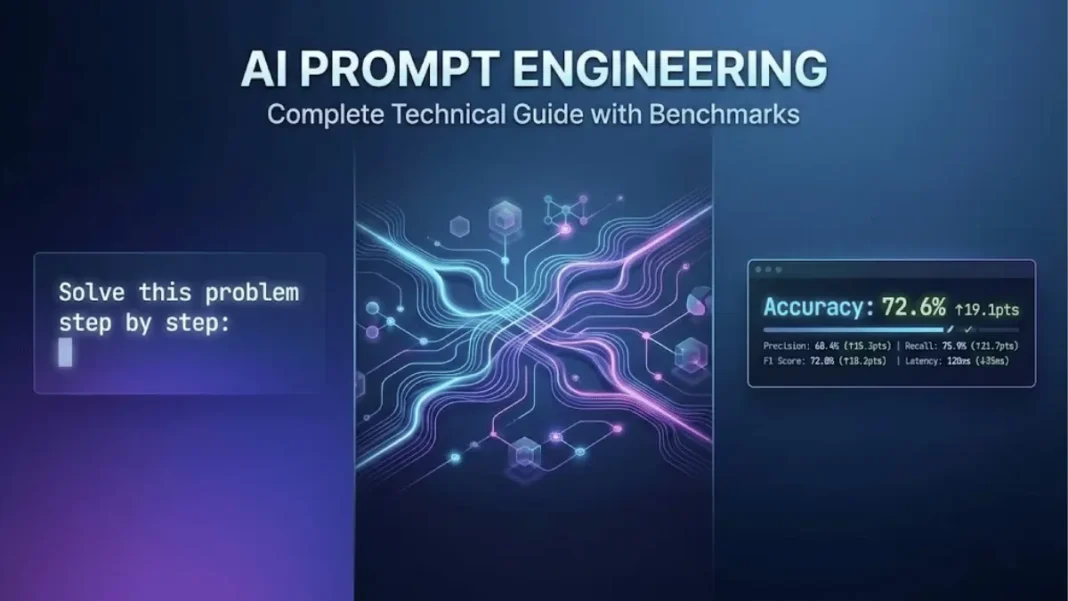
- CoT Benefit: Chain-of-Thought improves GPT-4o accuracy from 53.5% to 72.6% on MMLU-Pro
The Bottom Line: Production-ready for enterprise deployment. Prompt engineering techniques like Chain-of-Thought and ReAct demonstrably improve reasoning accuracy on standardized benchmarks, but require systematic evaluation frameworks to maintain performance at scale.
Prompt engineering has evolved from ad-hoc experimentation into a systematic discipline backed by rigorous research. Recent systematic surveys catalog 58 distinct prompting techniques, with empirical evidence showing that prompt quality directly impacts application performance across reasoning tasks, code generation, and domain-specific applications. Organizations deploying AI at scale now treat prompt management as core infrastructure, not disposable code.
AI prompt engineering is the systematic discipline of designing input instructions to guide large language model behavior without modifying model weights. Techniques like Chain-of-Thought improve reasoning accuracy by 19.1 percentage points on MMLU-Pro benchmarks, while security-focused prompts reduce code vulnerabilities by 56% in GPT-4o.
Foundational Prompting Techniques
Zero-Shot Prompting
Zero-shot prompting provides models with direct instructions without additional context or examples. This approach leverages the insight that all NLP tasks can be cast as question-answering problems over context, enabling models to generalize without task-specific training.
Performance Context: Effective for simple factual queries, translations, and summarizations, but complex reasoning tasks require more sophisticated techniques. Zero-shot approaches work best when task requirements align closely with patterns seen during pre-training.
Example Structure:
Task: Classify the sentiment of this product review.
Review: "The battery life is disappointing, but the camera quality exceeded my expectations."
Output format: Positive/Negative/Mixed
Few-Shot In-Context Learning
Few-shot prompting provides 2-5 examples demonstrating the desired pattern, enabling temporary learning without parameter updates. This emergent ability scales with model size, with larger models extracting patterns more reliably from fewer examples.
Key Characteristic: In-context learning is temporary learned patterns disappear once conversation context resets. This distinguishes it fundamentally from fine-tuning, which permanently updates model weights.
Example Structure:
Translate French to English:
maison → house
chat → cat
chien → dog
oiseau →
| Technique | Examples Required | Best Use Case | MMLU Performance | Cost Efficiency |
|---|---|---|---|---|
| Zero-Shot | 0 | Simple classification, translation | Baseline | Highest |
| Few-Shot (3-5) | 3-5 | Pattern recognition, formatting | +5-15% vs. zero-shot | High |
| Chain-of-Thought | 3-5 with reasoning | Multi-step reasoning | +19.1% (GPT-4o) | Medium |
| ReAct | 2-3 with actions | Tool use, iterative problem-solving | +12-18% on reasoning | Medium |
Advanced Reasoning Frameworks
Chain-of-Thought (CoT) Prompting
Chain-of-Thought prompting instructs models to solve problems through intermediate reasoning steps before providing final answers. Google Research demonstrated that CoT enables large models to answer multi-step problems with reasoning that mimics human thought processes.
Benchmark Evidence: On MMLU-Pro, GPT-4o with Chain-of-Thought achieves 72.6% accuracy compared to 53.5% with direct prompting a 19.1-point improvement. The technique proves particularly effective on complex domains: Business (39.2% → 78.6%), Chemistry (34.5% → 73.9%).
Two Variants:
- Few-shot CoT: Includes reasoning examples in the prompt
- Zero-shot CoT: Simply appending “Let’s think step-by-step” activates reasoning
Example Implementation:
Question: A company's revenue grew 15% in Q1, then declined 8% in Q2. If Q1 revenue was $2M, what is Q2 revenue?

Think step by step:
1. Calculate Q1 revenue: Given as $2,000,000
2. Calculate Q2 starting point: $2M × 1.15 = $2,300,000
3. Apply Q2 decline: $2,300,000 × 0.92 = $2,116,000

Final Answer: $2,116,000
ReAct (Reasoning + Acting)
ReAct alternates between reasoning (thinking) and acting (executing tools), creating a dynamic interaction loop that mimics human problem-solving. Unlike pure Chain-of-Thought, ReAct enables models to gather information iteratively and adjust reasoning based on observations.
Framework Structure:
- Thought: Model reasons about the current state
- Action: Model executes a specific tool or query
- Observation: System returns action results
- Repeat: Cycle continues until task completion
Comparative Advantage: ReAct outperforms CoT on tasks requiring external information retrieval, real-time data access, or multi-step decision-making in dynamic environments.
Example Pattern:
Task: Find the current stock price of Tesla and calculate 15% discount.

Thought 1: I need current Tesla stock price data.
Action 1: search_stock_price("TSLA")
Observation 1: Tesla (TSLA) current price: $242.50

Thought 2: Now calculate 15% discount on $242.50
Action 2: calculate(242.50 * 0.85)
Observation 2: $206.13

Answer: A 15% discount on Tesla stock ($242.50) equals $206.13
Chain-of-Table for Structured Data
Chain-of-Table explicitly uses tabular data as a proxy for intermediate reasoning steps, applying structured operations (select, filter, group, sort) to transform tables iteratively. Unlike text-based CoT, this framework maintains structural integrity throughout reasoning.
Performance Gains: Chain-of-Table improves accuracy by 8.69% on TabFact and 6.72% on WikiTQ benchmarks. This approach proves particularly effective for financial analysis, data analytics, and scenarios requiring explicit computational representation.
Application Domains: SQL-like queries, DataFrame operations, spreadsheet analysis, financial modeling.
The Prompt Sensitivity Problem
LLMs exhibit extreme sensitivity to prompt variations, with research demonstrating up to 76-point accuracy differences across formatting changes in few-shot settings. This sensitivity persists even with larger models, additional examples, or instruction tuning.
Empirical Evidence: The original MMLU benchmark shows score sensitivity of 4-5% across different prompt variations. MMLU-Pro reduces this sensitivity to approximately 2%, representing a significant improvement in prompt stability.
Benchmark Design: MMLU-Pro, with 12,032 questions across 14 disciplines, demonstrates improved robustness to prompt variations while maintaining challenging difficulty levels.
Production-Grade Prompt Management
The Prompt Engineering Maturity Model
Organizations progress through five distinct stages in prompt engineering sophistication:
- Ad-hoc Experimentation: Individual developers craft prompts via trial-and-error with limited documentation
- Template Standardization: Teams develop prompt templates with basic version control
- Systematic Evaluation: Quantitative frameworks enable data-driven optimization
- Production Observability: Real-time monitoring identifies regressions using production data
- Continuous Optimization: Closed-loop systems where production data informs systematic improvements
Current State: Most organizations operate between stages 1-2, creating technical debt as AI applications scale.
Evaluation Infrastructure
Production environments demand quantitative metrics beyond subjective assessment. Essential measurements include:
- Accuracy: Correctness against ground truth datasets
- Faithfulness: Adherence to source information without hallucination
- Relevance: Response alignment with user intent
- Safety: Absence of harmful, biased, or inappropriate content
- Task-Specific Metrics: Domain-dependent measures (F1 scores, ROUGE, BLEU)
Tooling Ecosystem: Platforms like Maxim AI, LangSmith, and specialized prompt engineering suites provide experimentation engines, bulk testing across prompt variations, and automated evaluation with multiple evaluator types.
Cost Optimization Strategies
Token-based pricing creates direct correlation between prompt length and expenses. Effective cost management requires strategic model selection and prompt optimization.
Pricing Context (January 2026):
- GPT-3.5-Turbo: $0.50/M input tokens, $1.50/M output tokens
- GPT-4o: $2.50/M input tokens, $10.00/M output tokens
- GPT-4: $30.00/M input tokens, $60.00/M output tokens
Optimization Techniques:
- Reduce system prompt verbosity (repeated on every call)
- Limit max_tokens in API parameters
- Use few-shot examples only when necessary
- Implement caching for repeated prompt components
- Reserve expensive models (GPT-4) for complex reasoning; use GPT-4o or GPT-3.5 for simpler tasks
Domain-Specific Applications
Code Generation and Security
Recent benchmarks reveal that security-focused prompt prefixes reduce vulnerabilities in GPT-4o and GPT-4o-mini generated code by up to 56%. Additionally, iterative prompting techniques enable models to detect and repair 41.9%-68.7% of vulnerabilities in previously generated code.
Prompt Agent Framework: Researchers introduced a “prompt agent” demonstrating effective technique application in real-world development workflows. This approach combines security-focused prefixes with iterative refinement for production code generation.
Medical and Scientific Applications
Medical domain prompting requires specialized attention due to complex terminology, privacy compliance (HIPAA), and high-stakes accuracy requirements. A scoping review of 114 recent studies found prompt design is the most prevalent paradigm in medical AI applications.
Critical Requirements: Factual accuracy verification, source citation, explicit uncertainty communication, and compliance with regulatory standards.
Tabular Data and Financial Analysis
Structured data analysis across finance, healthcare, and scientific domains demands techniques that maintain data integrity. LLMs trained primarily on text struggle with tabular reasoning, making Chain-of-Table and similar structured approaches essential for accurate analysis.
Advanced Techniques and Future Directions
Self-Consistency
Self-Consistency generates multiple Chain-of-Thought rollouts, then selects the most common conclusion through majority voting. This technique addresses inherent output variability, improving reliability on complex reasoning tasks.
Tree-of-Thought
Tree-of-Thought generalizes Chain-of-Thought by generating multiple reasoning paths in parallel, enabling backtracking and exploration using tree search algorithms (breadth-first, depth-first, beam search). This proves valuable when multiple valid solution approaches exist.
Automated Prompt Optimization
Meta-prompting approaches use one LLM to compose and optimize prompts for another LLM through beam search over prompt space. These techniques may reduce manual engineering effort but require careful evaluation to ensure improvements generalize.
Soft Prompting and Prefix Tuning
Soft prompting searches floating-point vectors directly via gradient descent to maximize output likelihood. This blurs the boundary between prompting and fine-tuning, offering middle ground for organizations needing more customization than pure prompting but less infrastructure than full fine-tuning.
Security Considerations
Prompt injection attacks craft inputs that appear legitimate but trigger unintended model behavior. As prompt engineering advances, defensive prompting becomes equally critical.
Mitigation Strategies:
- Input validation and sanitization
- Privileged instruction separation from user inputs
- Output filtering and safety checks
- Rate limiting and anomaly detection
- Regular security audits of prompt templates
AdwaitX Verdict: Deploy with Systematic Management
Deployment Recommendation: Production-ready for organizations with systematic evaluation infrastructure.
Prompt engineering delivers measurable performance improvements 19.1-point MMLU gains, 56% vulnerability reduction, 76-point accuracy variance making it essential for AI application development. However, the extreme sensitivity to formatting variations demands production-grade management systems, not ad-hoc experimentation.
Strategic Implementation Path:
- Immediate (0-30 days): Implement Chain-of-Thought for reasoning tasks; establish baseline metrics on representative test sets
- Short-term (30-90 days): Deploy systematic evaluation framework; version control all production prompts; implement cost monitoring
- Medium-term (90-180 days): Build production observability; establish closed-loop improvement from production data to prompt optimization
- Long-term (180+ days): Advance to Stage 4-5 maturity with continuous optimization and cross-functional collaboration
Future Trajectory: Multi-agent prompt orchestration and automated optimization will reshape the landscape, but fundamental principles systematic evaluation, production monitoring, cost management remain critical. Organizations treating prompts as disposable code will accumulate technical debt as application complexity scales.

Frequently Asked Questions (FAQs): AI Prompt Engineering
What is AI prompt engineering?
Prompt engineering is the systematic practice of designing input instructions to guide large language model behavior without modifying model parameters, using techniques like Chain-of-Thought and few-shot learning to improve accuracy.
How much does prompt engineering cost per API call?
For 1,000-token prompts: GPT-3.5 costs $0.0005-$0.0015, GPT-4o costs $0.0025 input/$0.010 output, and GPT-4 costs $0.03 input/$0.06 output. Chain-of-Thought increases token usage 30-50% but improves accuracy significantly.
What is Chain-of-Thought prompting?
Chain-of-Thought instructs models to show intermediate reasoning steps before final answers, improving GPT-4o MMLU-Pro accuracy from 53.5% to 72.6%, a 19.1-point gain. Simply adding “Let’s think step-by-step” activates this reasoning mode.
Which models benefit most from prompt engineering?
All LLMs benefit, but larger models (70B+ parameters) show greater sensitivity and improvement from structured prompts. GPT-4o demonstrates 56% vulnerability reduction with security-focused prompts, while smaller models show more modest gains.
How do I measure prompt engineering effectiveness?
Use quantitative benchmarks like MMLU-Pro, HumanEval, or domain-specific metrics (F1, ROUGE), testing across multiple prompt variations. MMLU-Pro shows 2% score sensitivity compared to 4-5% in standard MMLU, providing more stable measurements.
What is the difference between ReAct and Chain-of-Thought?
Chain-of-Thought generates linear reasoning steps, while ReAct alternates between reasoning (thinking) and acting (tool execution), enabling iterative information gathering and dynamic decision-making. ReAct outperforms CoT on tasks requiring external data access.

