

Quick Brief
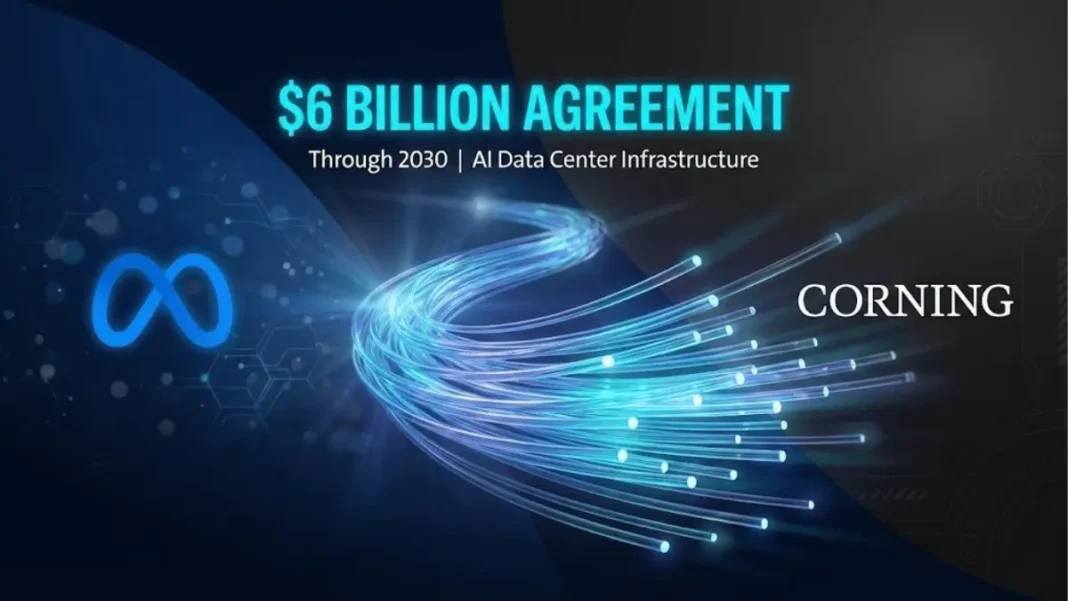
- The Deal: Meta and Corning announced a multiyear agreement worth up to $6 billion through 2030 for advanced fiber optic cables and connectivity solutions.
- The Impact: Corning expands North Carolina manufacturing by 15-20%, sustaining 5,000+ jobs; Meta accelerates buildout of 30 AI data centers, 26 in the US.
- The Context: Part of Meta’s $600 billion US infrastructure commitment through 2028 to secure domestic AI supply chains amid global competition.
- Market Reaction: Corning shares surged 7% in premarket trading; optical communications now Corning’s largest and fastest-growing segment.
Meta Platforms announced a multiyear agreement with Corning Incorporated worth up to $6 billion to supply fiber optic cables for its artificial intelligence data centers through 2030. The partnership, revealed January 27, 2026, positions Corning as a critical supplier in Meta’s aggressive AI infrastructure expansion, which includes plans for 30 data centers with 26 located across the United States. Joel Kaplan, Meta’s Chief Global Affairs Officer, stated the collaboration aims to “build the most advanced data centers in the U.S.” using domestic manufacturing capabilities.
Corning’s Manufacturing Expansion in North Carolina
Under the agreement, Corning will supply Meta with its latest generation optical fiber, cable, and connectivity products specifically designed to meet the density and scale demands of advanced AI data centers. The deal triggers significant capacity expansion at Corning’s optical cable manufacturing facility in Hickory, North Carolina, where Meta will serve as the anchor customer. Corning CEO Wendell P. Weeks confirmed the investment will increase the company’s employment levels in North Carolina by 15 to 20 percent, sustaining a highly skilled workforce of more than 5,000 employees across two of the world’s largest optical fiber and cable manufacturing facilities.
The Hickory facility expansion represents a critical infrastructure milestone as Corning has produced 13 billion kilometers of optical fiber to date, yet Meta’s Louisiana data center alone will require 8 million miles of cable. Corning’s optical communications segment generated $1.65 billion in revenue during Q3 2025, marking a 33% increase year-over-year, with enterprise sales jumping 58% driven by sustained adoption of generative AI technologies.
AdwaitX Analysis: Strategic Positioning in the AI Supply Chain Race
This agreement secures Meta’s position in the escalating competition for AI infrastructure resources as hyperscalers race to deploy trillion-dollar computing capacity. Meta’s $600 billion US investment commitment through 2028 includes flagship projects like the one-gigawatt Prometheus facility in New Albany, Ohio, and the Hyperion site in Richland Parish, Louisiana both incorporating Corning fiber-optic cables under this new agreement. The Louisiana facility is designed to scale from 2 gigawatts initially to 5 gigawatts. The deal addresses critical supply chain vulnerabilities, with Corning CEO Weeks noting “nearly every call I receive from my clients revolves around how we can provide them with more“.
The partnership demonstrates infrastructure differentiation as AI data centers require substantially more fiber than traditional cloud computing facilities. Weeks indicated the transition from copper to fiber within server racks is “inevitable” as graphics processor density increases to hundreds per rack, making fiber “substantially more cost-effective and energy-efficient” at scale. This positions both companies ahead of the anticipated shift as fiber eventually supplants copper in connecting chips within Nvidia-style server configurations.
Financial Implications and Market Position
| Metric | Details | Impact |
|---|---|---|
| Deal Value | Up to $6 billion through 2030 | Largest optical communications contract in Corning history |
| Stock Performance | Corning +7% premarket; +75% past year | Optical communications now Corning’s largest segment |
| Employment Growth | 15-20% increase in NC; 5,000+ total | Strengthens US manufacturing base in critical tech sector |
| Meta Infrastructure | 30 data centers (26 US-based) | Part of $600B domestic investment through 2028 |
| Q3 2025 Revenue | Optical segment: $1.65B (+33% YoY) | Enterprise sales up 58% |
| Timeline | Multiyear agreement through 2030 | Long-term supply chain security for Meta’s AI ambitions |
Meta’s 2026 capital expenditure is expected to exceed $100 billion as the company accelerates AI infrastructure deployment. The Corning partnership signals Meta’s commitment to building proprietary infrastructure capabilities rather than relying on third-party cloud providers. Corning’s diversified portfolio provides insulation against potential market volatility, with CEO Weeks emphasizing “we are designed to endure adverse conditions” despite concerns about a potential infrastructure bubble.
Regulatory and Competitive Landscape
The agreement aligns with broader US policy objectives to maintain AI leadership against Chinese competition. Kaplan warned “if we, as a nation, do not make appropriate policy decisions and investments, that poses a genuine risk” to US dominance in artificial intelligence development. The domestic manufacturing focus responds to supply chain disruptions exposed during recent technology cycles and positions both companies favorably for potential federal incentives supporting strategic technology production.
Corning faces intensifying demand from competing hyperscalers including Nvidia, OpenAI, Google, Amazon, and Microsoft, all requiring massive fiber deployments for AI infrastructure. Morgan Stanley analyst Meta Marshall acknowledged “volatility on the fiber side” but expressed confidence in Corning’s capacity to navigate demand fluctuations given its 175-year manufacturing heritage and diversified customer base.
Roadmap to 2030 Deployment and Infrastructure Buildout
Meta’s Prometheus facility in Ohio and Hyperion site in Louisiana represent first deployments under the Corning agreement, with the Louisiana facility designed to support up to 5 gigawatts of power consumption. The Louisiana project involves approximately $30 billion in financing with Blue Owl Capital, where Meta holds a 20% ownership stake. Meta announced its 30th global data center (26th in the United States) in Beaver Dam, Wisconsin, in November 2025, continuing its aggressive expansion trajectory. The phased rollout through 2030 allows Corning to incrementally expand production capacity while Meta stages data center construction across multiple US regions.
Corning’s Hickory facility, upon completion, will rank as the largest fiber-optic cable plant globally, purpose-built to handle hyperscaler-scale orders. The technical specifications remain proprietary, but industry sources indicate Meta requires cable configurations supporting higher bandwidth density than previous-generation cloud infrastructure, a requirement driving Corning’s next-generation fiber development. Both companies report earnings this week, with investors scrutinizing capital allocation plans and production timelines.

Frequently Asked Questions (FAQs)
How much is Meta paying Corning for fiber optic cables?
Meta committed up to $6 billion through 2030 for Corning’s fiber optic cables, optical fiber, and connectivity solutions for AI data centers.
Why does Meta need fiber optic cables for AI data centers?
AI data centers require substantially more fiber than traditional cloud infrastructure due to higher bandwidth density demands and hundreds of graphics processors per server rack.
Where will Corning manufacture fiber optic cables for Meta?
Corning expands manufacturing in Hickory, North Carolina, creating the world’s largest fiber-optic cable plant with Meta as anchor customer.
When does the Meta Corning fiber optic agreement end?
The multiyear agreement extends through 2030, supporting Meta’s buildout of 30 data centers including flagship Ohio and Louisiana facilities.
How many US jobs does the Meta Corning deal create?
Corning projects 15-20% employment growth in North Carolina, sustaining over 5,000 skilled manufacturing, engineering, and research positions.

