

The AdwaitX Verdict
| Category | Verdict |
|---|---|
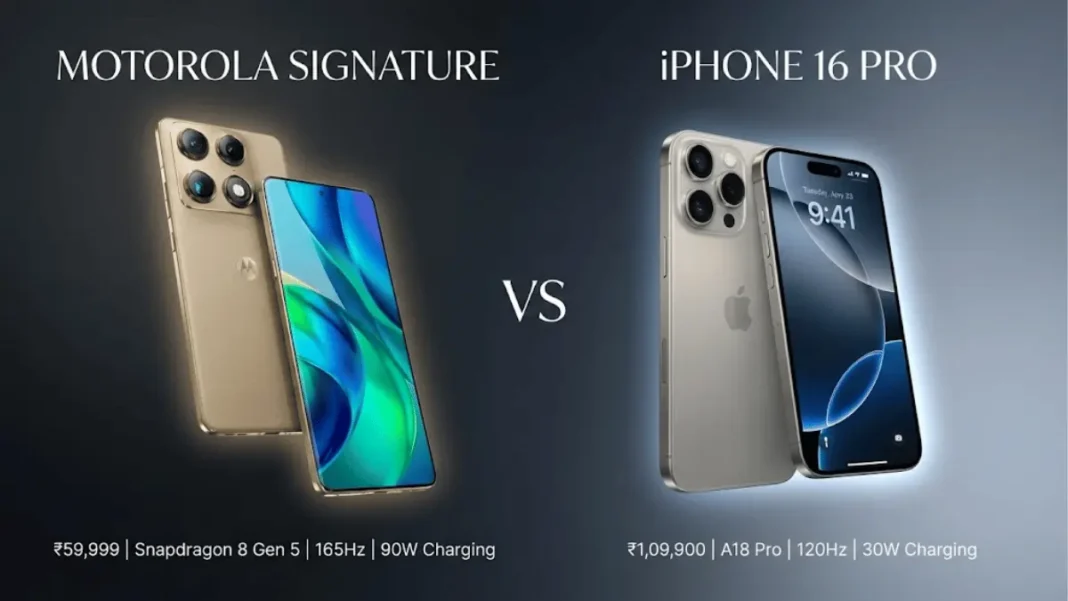
| The Bottom Line | Buy the Motorola Signature – It delivers flagship specs at half the price, but iPhone 16 Pro wins on ecosystem and long-term reliability. |
| Best Feature | Motorola: 90W TurboPower (50% charge in ~15 mins) & 165Hz display; iPhone: A18 Pro optimization & iOS ecosystem |
| Worst Feature | Motorola: Disappointing battery life (12h 53min PCMark test despite 5200mAh); iPhone: Tiny 3582mAh battery & slow 30W charging |
| Rating | Motorola Signature: 8.4/10 |
| Where to Buy | Motorola Signature on Flipkart – ₹59,999* (12GB/256GB) |
*Launch offer price with ₹5,000 instant bank discount on HDFC/Axis cards. Regular pricing may be higher.
Motorola Signature vs iPhone 16 Pro in the Flagship Arena
The Motorola Signature launches as India’s most aggressive flagship killer at ₹59,999 (with bank offers), directly challenging the ₹1,09,900 iPhone 16 Pro with superior specs on paper including Qualcomm’s Snapdragon 8 Gen 5 that delivers multi-core performance comparable to Apple’s A18 Pro while costing 45% less. But raw specifications don’t tell the complete story in this matchup.
Design & Build
Motorola delivers an ultra-thin 6.99mm aircraft-grade aluminum body with a linen-inspired finish, making it one of the slimmest flagships at just 186g despite the 6.8-inch display significantly thinner than the iPhone 16 Pro’s 8.25mm titanium frame (199g). The Signature earns IP68+IP69 water resistance and MIL-STD-810H military durability certifications with Gorilla Glass Victus 2 protection, while Apple counters with superior Ceramic Shield that better handles drop protection.
Performance: Benchmarks vs Real-World Usage
The Snapdragon 8 Gen 5 achieves Geekbench scores of 2,851 (single-core) and 9,363 (multi-core) versus the A18 Pro’s 3,358 and 8,184 respectively. Motorola’s 16GB LPDDR5X RAM option doubles the iPhone’s 8GB, enabling heavier multitasking and gaming on the Android flagship. However, thermal management is a concern the Motorola throttled to 39.1% sustained performance in CPU Burnout tests, heating up by 15.5°C during intensive gaming compared to better-cooled competitors. Apple’s vertical integration ensures iOS 18 feels equally fluid despite lower specs, and both phones promise 7 years of software updates.
Display, Audio & Camera
The Motorola’s 6.8-inch LTPO Extreme AMOLED display with 165Hz refresh rate and 6,200 nits peak brightness objectively surpasses the iPhone’s 6.3-inch 120Hz OLED panel for smoothness and outdoor visibility. However, audio quality disappoints despite Bose tuning and Dolby Atmos, the dual speakers lack depth and volume compared to competitors.
Camera hardware favors Motorola with a 50MP Sony LYT-828 sensor capable of 8K Dolby Vision video, plus dual 50MP ultrawide and Sony LYT-600 telephoto lenses versus iPhone’s 48MP primary and 12MP ultrawide. The iPhone 16 Pro counters with Apple’s superior computational photography that delivers more consistent colors and better dynamic range, while Motorola’s aggressive processing oversaturates images and smoothens details excessively.
Battery & Charging: The Critical Flaw
Here’s where Motorola stumbles badly. Despite a massive 5,200mAh silicon-carbon battery (versus iPhone’s 3,582mAh), PCMark testing revealed only 12 hours 53 minutes of endurance with 4-5 hours screen-on time, shockingly poor optimization for its capacity. The 90W TurboPower wired charging and 50W wireless charging partially redeem it, demolishing iPhone’s pedestrian 30W wired and 22W MagSafe speeds.
Full Specification Comparison Table
| Feature | Motorola Signature | iPhone 16 Pro | User Benefit |
|---|---|---|---|
| Processor | Snapdragon 8 Gen 5 (3nm) | Apple A18 Pro (3nm) | Motorola: Higher multi-core (9,363); iPhone: Better single-core (3,358) |
| RAM | 12GB / 16GB LPDDR5X | 8GB LPDDR5X | Motorola’s 16GB option future-proofs multitasking |
| Storage | 256GB / 512GB / 1TB UFS 4.1 | 128GB / 256GB / 512GB / 1TB NVMe | Motorola starts at 256GB; iPhone at 128GB |
| Display | 6.8″ LTPO AMOLED, 165Hz, 6200 nits | 6.3″ OLED LTPO, 120Hz | Motorola: 13% larger, 45Hz smoother, significantly brighter |
| Battery | 5200mAh silicon-carbon | 3582mAh | Motorola has 45% more capacity but poor optimization |
| Charging | 90W wired, 50W wireless | 30W wired, 22W MagSafe | Motorola charges 3x faster |
| Rear Camera | 50MP Sony LYT-828 + 50MP UW + 50MP LYT-600 Tele | 48MP + 12MP UW + 48MP Tele | Motorola: Higher res; iPhone: Better processing |
| Front Camera | 50MP Sony LYT-500 | 12MP | Motorola wins on paper; iPhone on computational photography |
| OS | Android 16, 7-year updates | iOS 18, 7-year updates | Both guarantee support until 2033 |
| Build | 6.99mm, 186g, Aluminum, Gorilla Glass Victus 2 | 8.25mm, 199g, Titanium, Ceramic Shield | Motorola thinner/lighter; iPhone more durable |
| Water Resistance | IP68 + IP69 | IP68 | Motorola adds IP69 high-pressure water protection |
| Price (Base) | ₹59,999* (12GB/256GB) | ₹1,09,900 (8GB/128GB) | Motorola costs 45% less with objectively better specs |
*With ₹5,000 HDFC/Axis Bank instant discount. Sale starts January 30, 2026 on Flipkart.
Motorola Signature
- Exceptional value – Flagship specs at ₹59,999 vs iPhone’s ₹1,09,900 (45% cheaper)
- Display excellence – 6.8″ 165Hz AMOLED at 6,200 nits peak brightness dominates competition
- Charging speed king – 90W wired + 50W wireless demolishes iPhone’s 30W speeds
- Ultra-thin design – At 6.99mm and 186g, it’s remarkably sleek for a 5,200mAh battery flagship
- Future-proof – 16GB RAM option, 1TB storage, and Android 16 with 7-year updates
- Battery optimization disaster – Only 12h 53min PCMark test result despite massive 5,200mAh battery
- Thermal throttling – Performance drops to 39.1% under sustained load, heats up 15.5°C during gaming
- Camera processing – Oversaturates colors, excessive noise reduction limits detail and dynamic range
- Weak audio – Speakers lack depth and volume despite Bose tuning and Dolby Atmos
iPhone 16 Pro
- Best-in-class optimization – A18 Pro + iOS 18 delivers buttery smooth experience with just 8GB RAM
- Superior durability – Titanium build + Ceramic Shield beats Motorola’s Gorilla Glass Victus 2
- Camera reliability – Computational photography delivers consistent, accurate colors and superior dynamic range
- Apple ecosystem – Seamless integration with Mac, iPad, Apple Watch, AirPods
- Terrible value – Nearly 2x price (₹1,09,900 vs ₹59,999) for objectively lower specs
- Pathetic battery – 3,582mAh is unacceptable for a 2026 flagship
- Slow charging – 30W wired feels ancient compared to 90W Android competitors
- Storage greed – Base model still ships with embarrassing 128GB in 2026
Competitor Comparison
vs OnePlus 15R (₹~65,999): Uses the same Snapdragon 8 Gen 5 processor and includes a massive 7,400mAh battery, addressing Motorola’s endurance weakness with superior thermal management.
vs Samsung Galaxy S24 FE (₹~65,999): Matches the 7-year update promise but lacks Motorola’s display specs and charging speeds.
vs OPPO Reno15 Pro Mini: Offers a more compact form factor for users who find the Signature’s 6.8-inch display too large.
Final Buying Advice
Buy the Motorola Signature if:
- You want flagship performance without the flagship price tag (₹59,999 vs ₹1,09,900)
- You prioritize display quality – 165Hz at 6,200 nits is segment-leading
- You need 90W charging for ultra-quick top-ups and can charge during the day
- You’re an Android power user who values the 16GB RAM for heavy multitasking
- You appreciate ultra-thin design (6.99mm) in a flagship package
Buy the iPhone 16 Pro if:
- You’re locked into the Apple ecosystem (Mac, iPad, AirPods, Apple Watch)
- You value camera consistency and computational photography over raw megapixels
- You need reliable all-day battery optimization (iPhone lasts longer despite smaller battery)
- Budget isn’t a constraint and you want proven long-term reliability
- You prioritize Ceramic Shield durability over thinness
Don’t Buy Either if:
- Motorola: You need dependable all-day battery life the 12h 53min PCMark result is unacceptable
- Motorola: You’re a heavy gamer – thermal throttling to 39% sustained performance is limiting
- iPhone: You’re a heavy user who needs fast charging and can’t afford ₹1+ lakh for a phone
- iPhone: You want value for money in 2026 – the pricing is indefensible
Frequently Asked Questions (FAQs)
Does the Motorola Signature overheat during gaming?
Yes – 91Mobiles testing showed 15.5°C temperature increase and performance throttling to 39.1% sustained CPU output during 30-minute BGMI and Call of Duty sessions. The 6.99mm ultra-thin design limits heat dissipation compared to thicker gaming-focused phones.
Is 8GB RAM on iPhone 16 Pro enough in 2026?
Yes – iOS’s superior memory management means 8GB on iPhone handles most tasks smoothly. However, Motorola’s 16GB RAM option future-proofs better for heavy multitasking and keeps more apps in memory simultaneously.
Why is Motorola Signature’s battery life so poor despite 5,200mAh capacity?
The combination of the 165Hz display at 6,200 nits peak brightness and Snapdragon 8 Gen 5’s aggressive performance drains battery rapidly. Motorola’s software optimization lags behind competitors PCMark testing revealed only 12h 53min endurance with 4-5 hours screen-on time.
Which has better camera quality for social media content creation?
iPhone 16 Pro wins for Instagram/TikTok with superior video stabilization, accurate colors, and better dynamic range. Motorola’s 8K Dolby Vision capability is overkill for social media, and its oversaturated color processing requires more editing.

