

Quick Brief
- The Launch: Sony Computer Science Laboratories unveiled Tomonami for KKAA, a creativity acceleration platform co-developed with renowned architect Kengo Kuma’s firm, exhibiting works January 24–June 14, 2026, at New Art Museum Singapore
- The Technology: Uses Japanese onomatopoeia (ParaPara, TsunTsun, SukeSuke) as interface parameters to visualize design intent and accelerate iterative exploration
- The Market: Generative AI in architecture reached $1.48B in 2025, projected to hit $5.85B by 2029 at 41.1% CAGR as firms adopt computational design tools
- The Context: Third Tomonami deployment after ceramic and yuzen textile projects, marking Sony CSL’s expansion from traditional crafts into built environment design
Sony Computer Science Laboratories (Sony CSL) announced January 23, 2026, the deployment of Tomonami for KKAA, a collaborative creativity system developed with Kengo Kuma and Associates (KKAA), one of Japan’s most prominent architectural firms with over 200 employees working on projects across 50+ countries. The system debuts publicly at Kengo Kuma’s solo exhibition “MAKERU Architecture: The Ecology of Rhythm and Particle” opening January 24 at Singapore’s New Art Museum.
The Onomatopoeia-Driven Design Framework
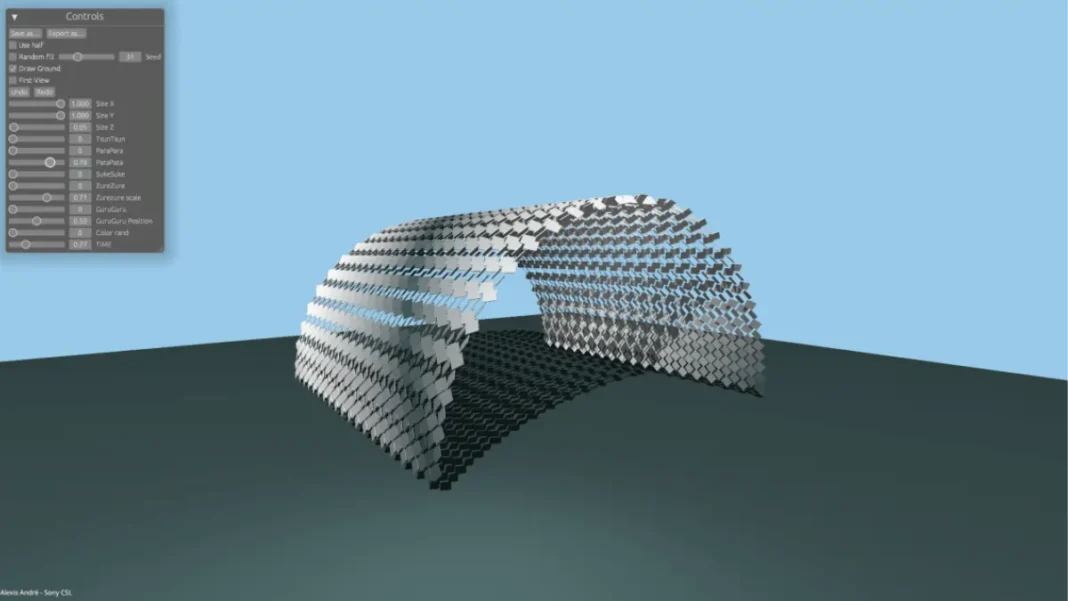
Tomonami for KKAA integrates Japanese onomatopoeic expressions directly into architectural design software, converting abstract concepts like “ParaPara” (rhythmic porosity), “TsunTsun” (outward thrust), and “SukeSuke” (perceptual transparency) into adjustable parameters. Architects manipulate sliders to modify particle behavior in real-time 3D renderings, transforming intuitive linguistic cues into shareable visual representations.
The platform enables rapid iteration cycles where designers explore options autonomously, then apply artistic judgment to select directions. Sony CSL researcher Alexis André, who conceived the system in 2009, states this process “leads to new creations that the creators themselves could not have imagined”. Where conventional architectural workflows previously required one week to generate perspective drawings, AI-assisted tools now complete similar tasks in 10 minutes.

AdwaitX Analysis: Strategic Shift in Creative AI Applications
This deployment represents Sony CSL’s pivot from supporting individual artisan workflows to enabling collaborative team environments. Previous Tomonami iterations partnered with ceramic artist Yukio Yoshita and yuzen textile artist Ken Yotsui. The architectural application addresses group dialogue dynamics, converting ambiguous design intentions into concrete visual formats that maintain creative coherence across design teams.
The timing aligns with broader industry adoption of generative AI in architecture. The sector’s market valuation grew from $1.05B (2024) to $1.48B (2025), driven by demand for sustainable building practices and computational design methodologies. However, Kengo Kuma’s approach differs from pure automation models. The 70-year-old architect emphasized in November 2024 that while AI provides “overwhelming ability” for efficiency, final design decisions require human judgment of social trends and client psychology.
Technical Architecture and User Workflow
| Component | Specification | Function |
|---|---|---|
| Interface Parameters | Japanese onomatopoeia (ParaPara, TsunTsun, SukeSuke) | Convert linguistic design intent to visual output |
| Visualization Engine | Real-time particle behavior modification | Generate explorable design spaces from parameter adjustments |
| Collaboration Layer | Shareable visual representations | Enable team dialogue beyond conventional ambiguous communication |
| Developer | Alexis André (Sony CSL-Paris) | Generative artist and researcher, created Sony’s toio platform |
The system name “Tomonami” combines Japanese words “tomo” (friend) and “nami” (wave), reflecting the co-creative philosophy between technologist and artist.
Deployment Roadmap and Cultural Implications
The Singapore exhibition runs through June 14, 2026, featuring interactive installations where visitors manipulate onomatopoeic inputs to observe spatial transformations in real-time. Kengo Kuma positions the work as exploring “primitive linguistic expression deeply rooted in the somatic sensibilities characteristic of Asian culture“.
Sony CSL President Hiroaki Kitano has not disclosed commercialization plans or licensing terms for Tomonami for KKAA. André indicated the project aims to “visualize creativity generated by group dialogue” and expand architectural thought processes, suggesting ongoing research and development beyond this initial deployment.
The broader generative AI architecture market expects expansion driven by digital fabrication technologies, parametric design tools, and demand for adaptive smart buildings through 2029. Firms adopting these systems face copyright infringement risks and information security challenges requiring staff education protocols.

Frequently Asked Questions (FAQs)
What is Sony CSL’s Tomonami system?
Tomonami is a creativity acceleration platform developed by Sony Computer Science Laboratories that uses AI to support iterative design exploration for artists and architects through intuitive visual interfaces.
How does Tomonami for KKAA work?
It converts Japanese onomatopoeic terms into adjustable parameters that modify 3D particle behaviors in real-time, allowing architects to visualize and share design concepts rapidly.
Who is Kengo Kuma?
Kengo Kuma, born 1954, founded Kengo Kuma & Associates in 1990. He serves as University Professor Emeritus at University of Tokyo and Japan Art Academy member, with projects in 50+ countries.
What were the previous Tomonami projects?
Sony CSL developed two prior Tomonami systems: one with ceramic artist Yukio Yoshita and another with yuzen textile artist Ken Yotsui, before expanding to architecture.

