

Quick Brief
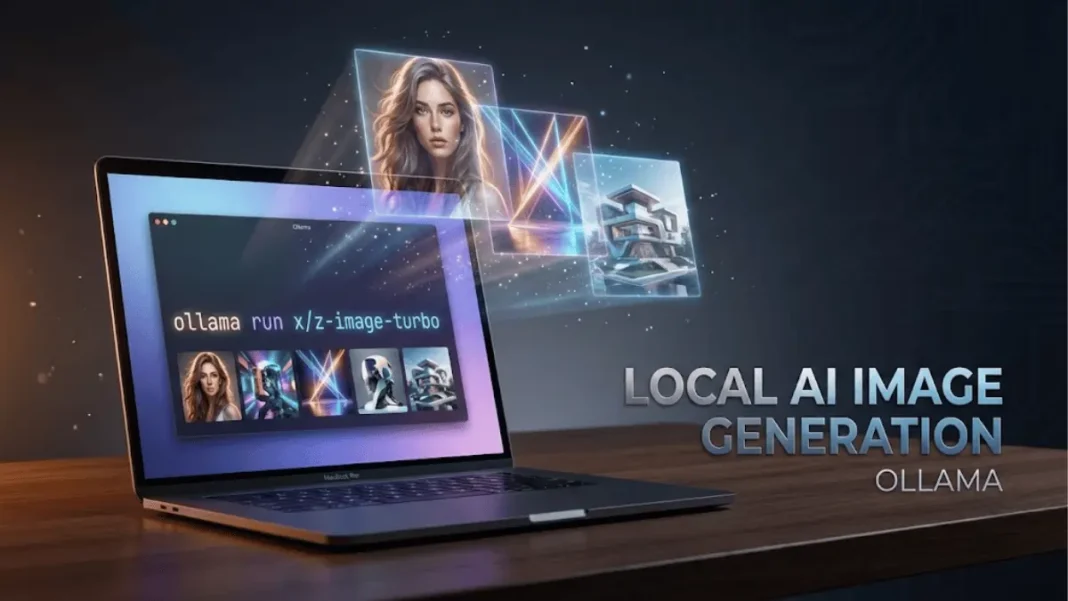
- The Launch: Ollama deployed experimental image generation capabilities on January 20, 2026, supporting two open-source models: Alibaba’s 6B-parameter Z-Image Turbo and Black Forest Labs’ FLUX.2 Klein (4B/9B variants).
- The Impact: Developers and enterprises gain privacy-focused, cost-free local image generation without cloud dependencies, running on consumer GPUs with 13GB+ VRAM.
- The Context: This marks Ollama’s expansion beyond large language models into multimodal AI, offering locally-executable alternatives to cloud-based image generation services.
Ollama, the open-source platform for running AI models locally, announced experimental image generation support for macOS on January 20, 2026, with Windows and Linux compatibility scheduled for future releases. The deployment integrates two text-to-image models: Alibaba’s Tongyi Lab Z-Image Turbo and Black Forest Labs’ FLUX.2 Klein, both offering Apache 2.0 commercial licensing for their base configurations.
The feature enables terminal-based image generation with inline preview support for compatible terminals including Ghostty and iTerm2, saving outputs directly to the current working directory.
Dual-Model Architecture: Alibaba and Black Forest Labs Integration
Ollama’s implementation supports two distinct model families targeting different use cases. Z-Image Turbo operates as a 6-billion-parameter model optimized for photorealistic output and bilingual text rendering in English and Chinese, achieving sub-second inference speeds while fitting within 12-16GB VRAM on consumer devices. The model utilizes 8 NFEs (Number of Function Evaluations) through knowledge distillation, delivering performance at reduced computational cost.
FLUX.2 Klein arrives in 4B and 9B parameter configurations, with the 4B variant released under Apache 2.0 for unrestricted commercial deployment. Black Forest Labs launched FLUX.2 Klein on January 15, 2026, positioning it as the fastest model in their portfolio. The architecture employs latent flow matching rather than traditional diffusion, learning direct paths between noise and clean images for improved efficiency.
The 4B model requires a minimum 13GB VRAM (Nvidia RTX 3090 or 4070), while the 9B version operates under FLUX Non-Commercial License v2.1, restricting commercial applications without separate licensing agreements.
Infrastructure and Licensing Implications
| Model | Parameters | License | VRAM Requirement | Inference Speed | Commercial Use |
|---|---|---|---|---|---|
| Z-Image Turbo | 6B | Apache 2.0 | 12-16GB | Sub-second | Unrestricted |
| FLUX.2 Klein 4B | 4B | Apache 2.0 | 13GB+ | Sub-second | Unrestricted |
| FLUX.2 Klein 9B | 9B | Non-Commercial v2.1 | Higher | Sub-second | Restricted |
Ollama’s local execution model eliminates recurring API costs and data transmission to cloud services, addressing privacy concerns for enterprises handling sensitive visual content. The Apache 2.0 licensing for both Z-Image Turbo and FLUX.2 Klein 4B permits modification, redistribution, and integration into commercial SaaS platforms without royalty obligations.
This deployment challenges cloud-based image generation providers by offering zero-marginal-cost inference after initial model download, particularly valuable for high-volume batch processing workflows. FLUX.2 Klein’s capabilities target design and enterprise use cases requiring precise specifications.
Platform Expansion and Multimodal Roadmap
Ollama currently restricts image generation to macOS, with the development team committing to Windows and Linux ports alongside expanded model support and image editing functionality. Users configure generation parameters through terminal commands controlling width, height, step count, random seeds, and negative prompts for output refinement.
The platform’s experimental status reflects ongoing optimization for cross-platform stability. Terminal integration enables programmatic workflows through command-line interfaces, distinguishing Ollama’s implementation from GUI-focused alternatives.
Z-Image Turbo’s bilingual capabilities address Chinese-language markets, expanding commercial applicability across Asia-Pacific regions.
Developer Adoption and Competitive Positioning
Ollama’s existing user base leverages the platform for local LLM deployment. The addition of image generation extends this ecosystem into multimodal applications, enabling developers to construct fully local AI stacks without external API dependencies.
The 6B and 4B parameter counts position both models for accessibility and deployment flexibility on consumer hardware. FLUX.2 Klein preserves advanced capabilities including accurate lighting, coherent spatial relationships, and readable text rendering.

Frequently Asked Questions (FAQs)
How do you generate images with Ollama?
Run ollama run x/z-image-turbo "your prompt" or ollama run x/flux2-klein in terminal. Images save to current directory with optional inline preview on supported terminals.
What are system requirements for Ollama image generation?
Minimum 13GB VRAM for FLUX.2 Klein 4B (RTX 3090/4070). Z-Image Turbo requires 12-16GB VRAM. Currently macOS only; Windows/Linux support pending.
Is Ollama image generation free for commercial use?
Yes for Z-Image Turbo and FLUX.2 Klein 4B under Apache 2.0 license. FLUX.2 Klein 9B restricted to non-commercial use without licensing agreement.
What image models does Ollama support?
Z-Image Turbo (6B, Alibaba) for photorealistic bilingual generation and FLUX.2 Klein (4B/9B, Black Forest Labs) for fast text-rendering and design workflows.

