

Quick Brief
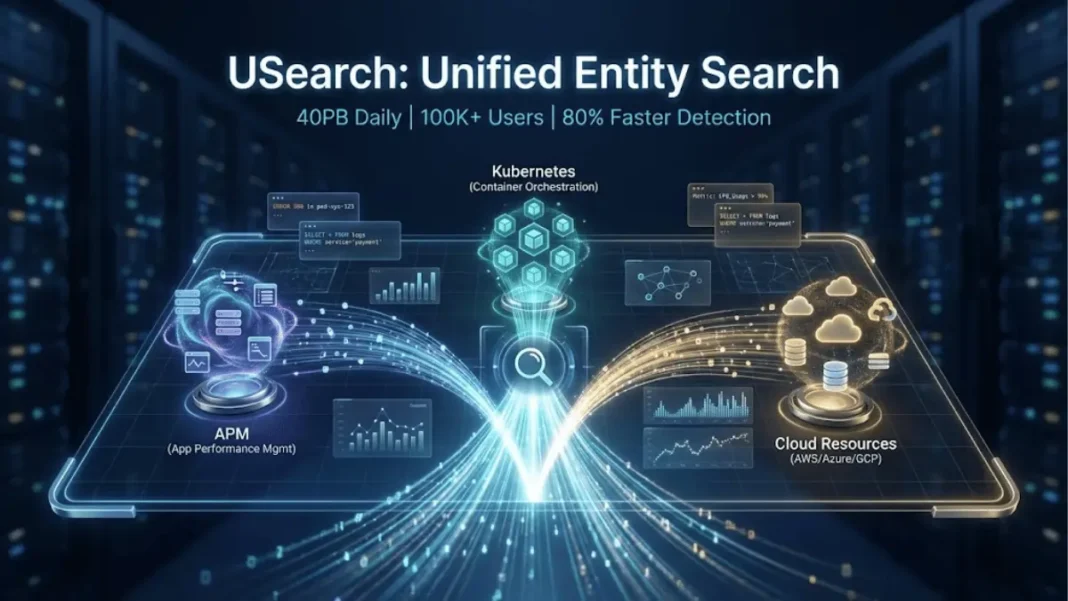
- The Technology: Alibaba Cloud launches USearch, a unified entity search engine powered by UModel that processes 40+ petabytes of observability data daily across APM, Kubernetes, and cloud resource domains.
- The Impact: Eliminates cross-system query fragmentation for DevOps teams while delivering 80% faster fault detection and 40% reduction in O&M costs based on production deployments.
- The Context: The broader search engine market expands at 11.09% CAGR as organizations demand unified platforms to consolidate fragmented monitoring infrastructure, with vertical engines projected to grow at 17.95% CAGR through 2031.
Alibaba Cloud released USearch, a layered entity search engine designed to query specific runtime instances across multiple observability domains through a single interface. The platform addresses infrastructure teams’ operational challenge of switching between isolated monitoring systems to locate service instances, pod configurations, and host data during incident response.
USearch Architecture and Query Capabilities
USearch implements a three-tier hierarchical storage model organized by workspace, domain, and entity type. The engine supports APM services, Kubernetes pods, and Alibaba Cloud Service instances within isolated logical layers while maintaining cross-domain query functionality. Each entity receives a unique __entity_id__ within its type, with column-oriented storage enabling SPL-based statistical analysis.
The platform delivers three distinct query methods: UModel queries for knowledge graph schema, entity queries for runtime instance data, and topology queries for relationship mapping. Entity queries handle full-text search, exact ID lookup, and conditional filtering with multi-keyword scoring algorithms that calculate relevance based on term weights and field priorities. The system processes fnmatch pattern matching, allowing wildcards such as domain='ac*' or name='*instance' for flexible type filtering.

Breaking Data Silos in Observability Stacks
Traditional observability platforms force infrastructure teams to query separate systems for application performance metrics, container orchestration data, and cloud resource status. USearch eliminates this fragmentation through unified cross-domain searches using syntax such as .entity with(domain='*', name='*', query='cart') to retrieve all entities containing specific keywords regardless of source system.
Alibaba Cloud’s observability engine currently serves 100,000+ users while processing over 40PB daily across internal and external deployments. The platform connects keyword queries, PromQL, external databases, and machine learning models through SQL as a top-level analysis language. AdwaitX analysis indicates this unified approach addresses the operational complexity of managing fragmented monitoring toolchains across distributed infrastructure environments.
Performance Optimizations and Query Patterns
USearch implements field-specific queries that outperform full-text searches by targeting exact attributes such as query='environment:production' instead of broad keyword matching. The engine supports logical operators (AND, OR, NOT) for complex conditions like query='(cluster:prod OR cluster:staging) AND NOT status:maintenance'. Suffix wildcards deliver faster results than prefix patterns, with name='service*' recommended over name='*service' for production workloads.
The platform integrates SPL for advanced data processing, enabling queries such as retrieving Java service counts by cluster or analyzing production application distribution across regions with descending sort by volume. Results default to relevance score ordering, with fallback to timestamp sorting when scores match. Query modes include exact ID lookup for alert-triggered entity details, full-text search for keyword-based discovery, SPL aggregation for statistical analysis by dimension, and cross-domain join operations for multi-system entity correlation.
The engine’s topk parameter controls result volume, with topk=10 recommended for targeted searches and higher values reserved for comprehensive analysis. Special characters in queries require double quotation marks, such as query='description:"ratio is 1:2"' for proper parsing.
Enterprise Adoption and Cost Impact
MoreFun Group deployed Alibaba Cloud’s observability platform to achieve 80% faster fault detection with 40% reduction in operational costs. The unified query interface eliminated manual context switching between monitoring tools during incident response workflows. Infrastructure teams now execute precise queries using entity IDs from alerts, perform full-text searches across domains, or filter by labels such as labels.team:backend AND labels.language:java AND status:running.
The broader search engine market reaches $280.48 billion in 2026, with enterprise deployments growing at 14.55% CAGR as businesses transform unstructured data archives into queryable knowledge hubs. Vertical search engines capture 17.95% CAGR in regulated sectors requiring domain-specific semantics and compliance features. AdwaitX projects unified observability platforms will accelerate adoption as organizations consolidate fragmented toolchains to meet governance requirements while reducing infrastructure complexity.
Integration with Cloud-Native Ecosystems
Alibaba Cloud positions USearch within its broader Observability Suite (ACOS), which incorporates Prometheus Service, Grafana, and Tracing Analysis to form an observable data layer. The platform supports eBPF collection, high-compression-ratio data algorithms, and parallel computing engines optimized for ultra-large-scale scenarios. Root cause analysis capabilities leverage machine learning models to filter alert noise and prioritize incident data.
The system enables infrastructure teams to balance query precision with operational requirements through configurable parameters and multiple search modes. Cross-domain entity correlation capabilities allow teams to trace dependencies across application services, container orchestration layers, and cloud infrastructure resources without switching platforms.

Frequently Asked Questions (FAQs)
What is USearch entity search engine for observability?
USearch is Alibaba Cloud’s unified query platform that retrieves runtime entity instances across APM, Kubernetes, and cloud domains through full-text search, exact lookup, and conditional filtering without switching systems.
How does unified entity search reduce O&M costs?
USearch eliminates multi-system query overhead by consolidating observability data access, enabling MoreFun Group to achieve 40% O&M cost reduction and 80% faster fault detection through streamlined workflows.
What query types does Alibaba Cloud USearch support?
The engine handles exact ID queries, full-text keyword searches, field-specific filters, cross-domain joins, and SPL-based aggregations with logical operators for complex conditions across entity types.
How does USearch handle cross-domain entity searches?
USearch processes unified queries like .entity with(domain='*', name='*', query='keyword') to retrieve entities across all domains simultaneously, eliminating the need to query each system separately.

