

Quick Brief
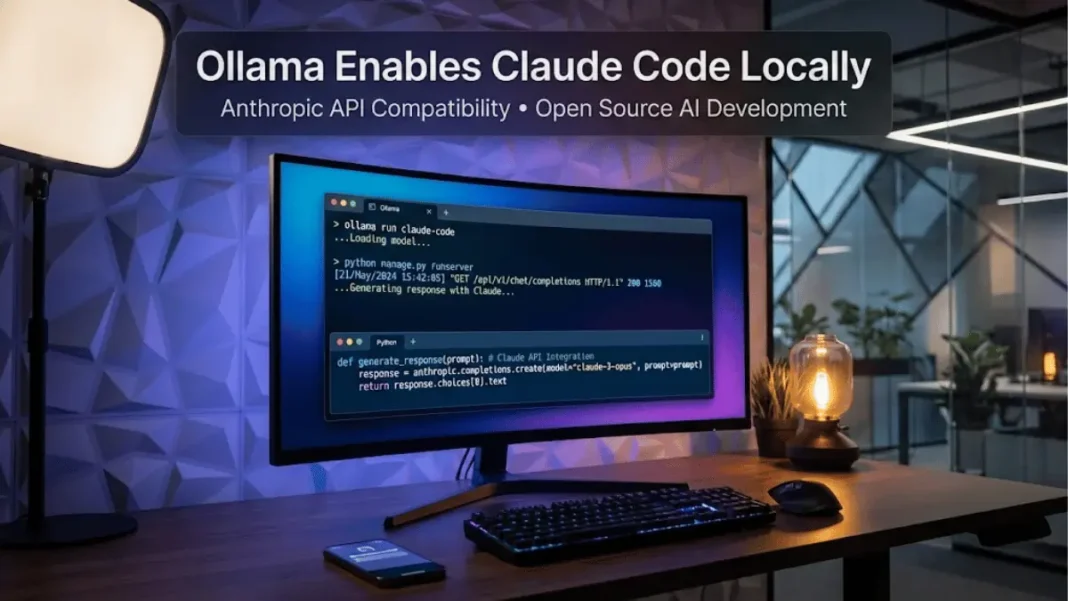
- The Launch: Ollama v0.14.0 introduces Anthropic Messages API compatibility, enabling Claude Code Anthropic’s terminal-based coding agent to run with open-source models locally instead of cloud-only proprietary systems.
- The Impact: Developers gain privacy-first AI coding without cloud dependencies; enterprises can deploy agentic tools on proprietary infrastructure with models like qwen3-coder and gpt-oss:20b.
- The Context: Ollama surged to 135,000+ GitHub stars by early 2025, growing 261% through 2024 as enterprises prioritize local AI deployment for data sovereignty and compliance.
Ollama announced January 16, 2026, that version 0.14.0 and later now support the Anthropic Messages API, allowing developers to execute Claude Code Anthropic’s agentic coding assistant with local open-source models rather than exclusively through Anthropic’s cloud infrastructure. The integration enables full offline operation while supporting advanced features including tool calling, multi-turn conversations, vision input, and extended thinking capabilities.
Technical Architecture: How Anthropic Compatibility Works
Developers configure Claude Code to communicate with Ollama’s local server by setting environment variables ANTHROPIC_AUTH_TOKEN=ollama and ANTHROPIC_BASE_URL=http://localhost:11434. This redirects API calls from Anthropic’s cloud endpoints to locally-running models managed by Ollama, which accumulated 135,000+ GitHub stars by early 2025 at a 261% growth rate through 2024 driven by its Docker-friendly CLI architecture.
The system supports both local models running on developer machines and Ollama’s cloud-hosted options. Recommended configurations include gpt-oss:20b and qwen3-coder for local deployment, plus glm-4.7:cloud and minimax-m2.1:cloud for cloud-based execution all requiring minimum 64k token context windows for optimal coding tasks.
| Feature | Ollama Implementation | Traditional Cloud |
|---|---|---|
| Data Privacy | Complete local processing | Data transmitted to vendor servers |
| Latency | Sub-100ms (local) | 200–500ms (network dependent) |
| Offline Capability | Full functionality | Requires connectivity |
| Model Flexibility | 50+ open-source options | Vendor-locked catalog |
| Context Length | Up to 128k tokens | Model-specific limits |
Existing applications using the Anthropic SDK require minimal code changes developers simply modify the base_url parameter to point to Ollama’s local server while maintaining identical method signatures for messages, streaming, and tool calling.
AdwaitX Analysis: The Enterprise Shift to Local AI Infrastructure
This integration reflects broader market movements toward sovereign AI deployment, where organizations prioritize data residency and regulatory compliance. The global LLM market, valued at $6.5 billion in 2024, projects to reach $84-141 billion by 2033, with open-source platforms capturing accelerating enterprise adoption as performance gaps with proprietary models continue narrowing.
Ollama’s approach addresses critical enterprise concerns around intellectual property exposure during code generation workflows. Financial services firms and healthcare organizations operating under GDPR, HIPAA, or regional data protection mandates can now deploy agentic coding tools without transmitting proprietary codebases to third-party cloud providers. Gartner predicts 35% of countries will enforce region-specific AI platforms by 2027, accelerating demand for locally-deployable alternatives.
The platform’s support for programmatic tool calling where AI orchestrates multiple tools through code execution rather than sequential API calls enables complex automation workflows while minimizing context window consumption. This architecture proves particularly valuable for embedded systems development and edge computing scenarios where cloud connectivity introduces unacceptable latency or security risks.
Implementation Requirements and Model Performance
Claude Code with Ollama requires models supporting extended context lengths, with the platform recommending minimum 64k tokens for coding applications. Developers can deploy models via single-command pulls across macOS, Linux, Windows (WSL), and Docker environments without manual GPU configuration.
The system supports vision-based inputs for UI mockup interpretation, streaming responses for real-time feedback, and system prompts for behavior customization. Tool calling capabilities enable Claude Code to invoke external APIs, file systems, and development tools programmatically matching functionality previously exclusive to cloud-based Anthropic deployments.
Competitive Positioning Against Cloud-Only Alternatives
Ollama competes with LocalAI and LM Studio in the local AI orchestration space, differentiating through CLI-first design optimized for DevOps workflows and container deployments. The Anthropic API compatibility provides interoperability with existing enterprise toolchains built around Claude’s SDK, reducing migration friction compared to proprietary local platforms.
Industry-specific generative AI adoption accelerates in 2026, with verticals demanding fine-tuned models trained on proprietary datasets. Ollama’s architecture supports this trend by enabling organizations to download base models, apply domain-specific training, and deploy without vendor approval or revenue-sharing arrangements typical of commercial AI platforms.
Frequently Asked Questions (FAQs)
Can Claude Code run completely offline with Ollama?
Yes. Ollama supports full offline operation with local models like qwen3-coder and gpt-oss:20b, requiring no internet connectivity once models are downloaded.
What features does Ollama’s Anthropic API support?
Ollama supports Messages API, streaming, system prompts, tool calling, extended thinking, vision input, and multi-turn conversations matching Anthropic’s cloud offering.
Which models work best for coding with Claude Code?
Recommended: qwen3-coder and gpt-oss:20b locally; glm-4.7:cloud and minimax-m2.1:cloud for cloud deployments. All require 64k+ token context.
Does this replace Anthropic’s commercial Claude service?
No. This enables local alternatives using open-source models. Organizations prioritizing maximum performance may still prefer Anthropic’s proprietary Claude models.

