

Quick Brief
- The Launch: ASUS released firmware updates enabling DisplayWidget Center for macOS, M Model P3 color matching, and MacBook keyboard integration across ProArt display lineup on January 15, 2026.
- The Impact: Directly targets 100 million Mac users globally and 44% of software developers who rely on macOS, offering a third-party alternative to Apple’s $1,599+ Studio Display.
- The Context: ASUS commands 21.9% of the OLED monitor market, the industry’s top position and now challenges Apple’s professional display ecosystem with cross-platform compatibility.
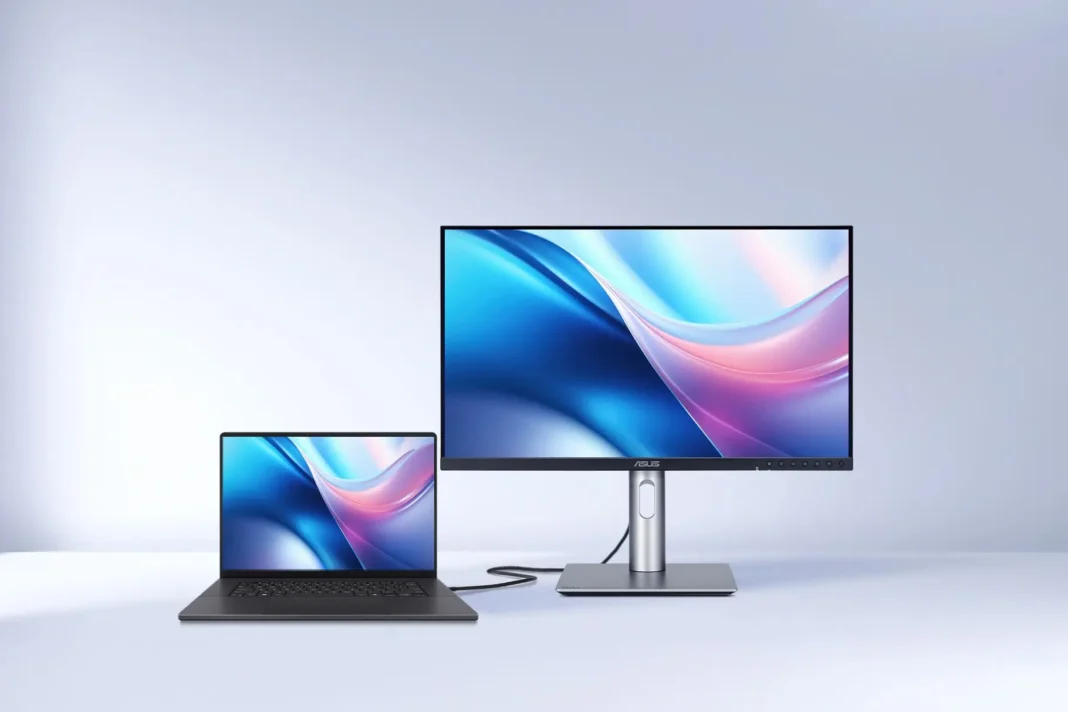
ASUS announced firmware updates for its ProArt display lineup on January 15, 2026, introducing native macOS support through DisplayWidget Center software, M Model P3 color synchronization with MacBooks, and MacBook keyboard shortcut integration. The update targets professional creatives using Mac Mini, Mac Studio, and MacBook devices, eliminating previous software barriers between ASUS hardware and Apple’s ecosystem. Affected models include PA279CRV, PA32UCDM, PA27JCV, and 10 additional ProArt displays.
DisplayWidget Center Architecture for macOS
The DisplayWidget Center application provides system-level control over ProArt monitors directly from macOS, enabling adjustment of brightness, contrast, and color temperature without accessing physical on-screen display (OSD) buttons. The software maps MacBook brightness shortcut keys to external ProArt displays when the cursor is active on the monitor, creating unified control across Apple and third-party hardware.
M Model P3 color settings synchronize the ProArt display’s DCI-P3 gamut output with MacBook screens, ensuring color consistency for photo editing, video production, and graphic design workflows. Models including PA278CGRV, PA279CRV, and PA32QCV support M Model P3 following firmware updates released in January 2026. Each ProArt display ships factory-calibrated to Delta E<1 color accuracy with 99% DCI-P3 coverage specifications matching professional broadcast monitors.
Hardware capabilities include Thunderbolt 4 connectivity with 96W Power Delivery for single-cable MacBook charging and data transfer, variable refresh rates up to 240Hz compatible with Apple ProMotion technology, and built-in Auto KVM switching between two connected Mac devices. Third-party lab testing verifies compatibility with MacBook Pro, Mac mini, and Mac Studio across current and previous generation models.
Market Disruption Analysis: Challenging Apple’s Display Ecosystem
ASUS’s macOS integration directly competes with Apple’s Studio Display ($1,599 base price) by offering comparable color accuracy, superior connectivity, and ergonomic flexibility at competitive pricing. The company secured 21.9% of the global OLED monitor market in Q3 2025 surpassing Samsung (18%) and establishing market leadership in the premium display segment.
The strategic timing targets the 100.4 million global Mac users, particularly the 44% of software developers and 87% of professional engineers who standardize on macOS. AdwaitX analysis indicates this positions ASUS to capture professional users previously locked into Apple’s first-party hardware due to software incompatibility. The ProArt Display OLED PA27USD received a CES 2026 Innovation Award in the Imaging category, reinforcing credibility in color-critical professional markets.
Global OLED monitor shipments reached 644,000 units in Q3 2025, representing 65% year-over-year growth, with TrendForce projecting 2.62 million total units shipped in 2025, an 84% increase from 2024. ASUS’s ProArt lineup contributes significantly to this expansion alongside ROG gaming displays.
Technical Specifications & Mac Integration
| Feature | Specification | Mac Benefit |
|---|---|---|
| Color Accuracy | Delta E<1, 99% DCI-P3 | Matches MacBook color profiles via M Model P3 |
| Refresh Rate | Up to 240Hz variable | Syncs with Apple ProMotion technology |
| Connectivity | Thunderbolt 4, USB-C, HDMI, DisplayPort | 96W Power Delivery charges MacBooks |
| Software | DisplayWidget Center for macOS | MacBook keyboard shortcut integration |
| Calibration | ProArt Calibration software, macOS compatible | Hardware-stored profiles independent of OS |
| Adobe Bundle | 3-month Creative Cloud subscription ($803.85 value) | Photography Plan, Premiere Pro, Illustrator included |
ProArt Calibration software supports macOS in both SDR and HDR modes, generating ICC profiles for ProArt displays and MacBook screens simultaneously to ensure cross-device consistency. Hardware calibration stores color profiles in the monitor’s internal scaler chip rather than the computer, preserving accuracy when switching between Mac and PC devices. Compatibility extends to major calibrators including X-Rite, Calibrite, Datacolor, and ASUS’s ProArt CaliControl MCA02.
The ProArt Color Center cloud platform enables administrators to manage calibration schedules for multiple displays across different locations, tracking last calibration dates and scheduling next sessions remotely. TÜV Rheinland-certified Flicker-free and Low Blue Light technologies reduce eye strain during extended editing sessions, with adjustable blue light filtering from 0-100%.
Deployment Timeline and Regulatory Considerations
Firmware updates for legacy ProArt models including PA16USV, PA24ACRV, PA278QGV, and PA32UCE began rolling out in January 2026 to enable DisplayWidget Center compatibility. New ProArt monitors ship with macOS support pre-installed. The Adobe Creative Cloud redemption period extends through August 31, 2026, with each customer eligible for one-time redemption of 3-month and 1-month subscriptions applicable to new or existing Adobe accounts.
ASUS disclosed that “features may vary by model” and emphasized that ProArt products are not affiliated with Apple Inc., addressing potential trademark and ecosystem integration concerns. MacBook daisy-chaining capabilities for multi-display setups vary by Mac model generation and require verification through Apple support documentation.
The company’s OLED monitor shipments contributed to the 12% quarter-over-quarter growth in Q3 2025, with ProArt displays targeting professional creative markets while ROG gaming monitors address high-refresh gaming segments. CES 2026 saw ASUS launch three new ProArt OLED monitors (PA279CDV, PA32UCDMR-K, PA27UCDMR) featuring 240Hz refresh rates and LuxPixel anti-glare technology, expanding the Mac-compatible lineup.

Frequently Asked Questions (FAQs)
What are the new Mac features on ASUS ProArt displays?
DisplayWidget Center for macOS enables brightness control via MacBook keyboard shortcuts, M Model P3 color sync matches MacBook screens, and Thunderbolt 4 provides 96W Power Delivery charging.
Does ASUS ProArt work with MacBook Pro and Mac Studio?
Yes. All ProArt displays undergo third-party lab testing to verify compatibility with MacBook Pro, Mac mini, and Mac Studio across current and previous generations.
How much does a ProArt display cost compared to Apple Studio Display?
ASUS ProArt OLED PA32UCDM costs $1,899 with full ergonomic stand included, while Apple Studio Display starts at $1,599 but requires $400 extra for height-adjustable stand.
Is ProArt color accuracy sufficient for professional video editing?
ProArt displays achieve Delta E<1 factory calibration with 99% DCI-P3 coverage and Calman Verified certification, meeting broadcast and cinema production color standards.

