

Quick Brief
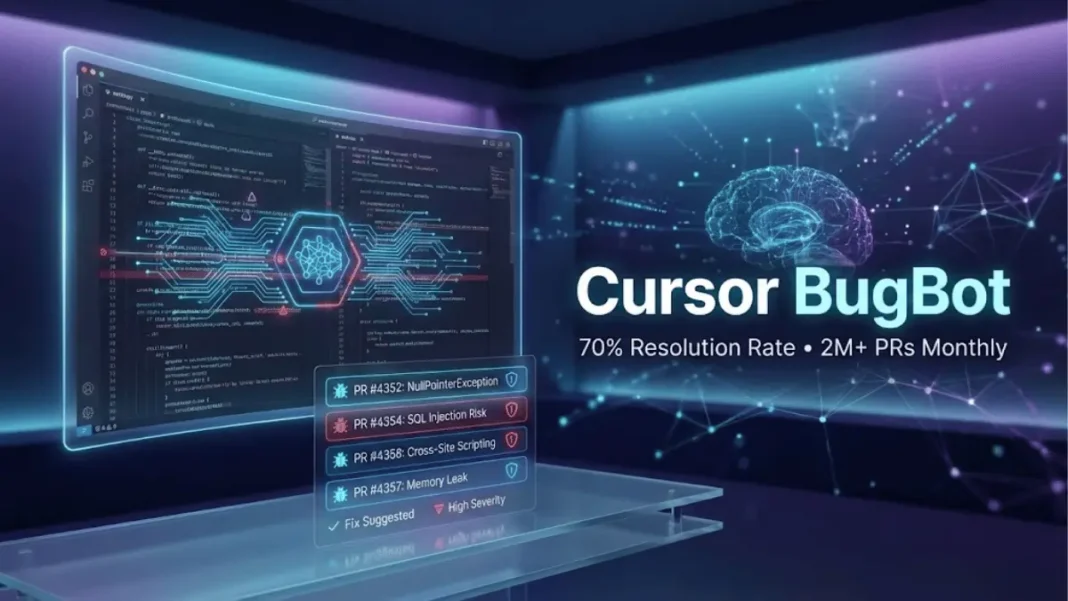
- The Launch: Cursor’s BugBot agent now reviews over 2 million pull requests monthly, achieving a 70% resolution rate up from 52% at launch while doubling resolved bugs per PR from 0.2 to 0.5
- The Impact: Fortune 500 companies including Rippling, Discord, Samsara, Airtable, and Sierra AI now deploy BugBot for automated security and logic bug detection before production
- The Context: As the AI code review tools market reached $1.28 billion in 2024, Cursor shifts from qualitative assessment to data-driven optimization, introducing BugBot Autofix beta for autonomous remediation
The Product
Cursor disclosed in a technical blog post that BugBot, the company’s autonomous code review agent, analyzes pull requests for logic bugs, performance issues, and security vulnerabilities at enterprise scale. The system processes over 2 million PRs monthly across customers including Fortune 500 companies like Rippling, Discord, and Samsara.
BugBot’s resolution rate, an AI-powered metric tracking which flagged bugs developers actually fix at merge time, climbed from 52% at launch to over 70% following 40 major experiments. The agent now flags an average of 0.7 bugs per run compared to 0.4 initially, translating to approximately 0.5 resolved bugs per PR versus 0.2 at launch.
The company, which reached $500 million in ARR and serves over half the Fortune 500, built BugBot to address review bottlenecks as coding agents became more capable.
Technical Architecture Evolution
Cursor transitioned BugBot from a pipeline-based system to a fully agentic design in fall 2025, enabling the largest quality gains to date. The original architecture ran eight parallel passes with randomized diff ordering, applied majority voting to filter single-pass bugs, and deployed validator models to catch false positives.
The agentic loop allows BugBot to reason over diffs, call tools dynamically, and determine investigation depth rather than executing fixed sequences. This shift required aggressive prompting strategies the opposite of earlier versions that restrained models to minimize false positives. The agent now investigates every suspicious pattern and pulls additional context at runtime instead of requiring upfront loading.
| Metric | Launch | Current | Change |
|---|---|---|---|
| Resolution Rate | 52% | 70%+ | +35% |
| Bugs Flagged/Run | 0.4 | 0.7 | +75% |
| Resolved Bugs/PR | ~0.2 | ~0.5 | +150% |
| Monthly PR Volume | Not disclosed | 2M+ |
Infrastructure at Scale
Cursor rebuilt its Git integration in Rust to support BugBot’s operational requirements, minimizing data fetch operations while ensuring repository access speed and reliability. The engineering team implemented rate-limit monitoring, request batching, and proxy infrastructure to operate within GitHub’s API constraints.
The company added Bugbot Rules to encode codebase-specific invariants, unsafe migrations or incorrect internal API usage without hardcoding checks into the core system. This extensibility makes BugBot adaptable to real-world codebases with unique architectural requirements.
Cursor’s approach positions the company within a code review market growing at 8.24% CAGR through 2031, as 85% of developers now integrate at least one AI tool into their workflows.
Competitive Positioning in $1.28B Market
The AI code review tools market reached $1.28 billion globally in 2024, driven by automation adoption in software development. Cursor’s $500 million ARR reflects 35-40% market penetration in the AI IDE segment, where it competes directly with GitHub Copilot’s code review features.
BugBot differentiates through project-wide context awareness and multi-file edit capabilities, contrasting with Copilot’s inline completion strength. Cursor supports GPT-4o, Claude 3.5 Sonnet, Gemini 2.5 Pro, and Grok Code, offering model flexibility that GitHub has recently matched through expanded options.
The company’s focus on resolution rate as a primary metric enables quantitative hill-climbing on quality, moving beyond anecdotal feedback that dominated early development. This data infrastructure underpins BugBot’s 40-iteration improvement cycle.
Development Roadmap and Strategic Initiatives
Cursor launched BugBot Autofix in beta, automatically spawning Cloud Agents to remediate bugs identified during PR reviews. The roadmap includes code execution capabilities for bug report verification, deep research functionality for complex issues, and an always-on scanning mode that monitors codebases continuously rather than waiting for pull requests.
The company expects new models from external providers and internal training efforts to arrive regularly, requiring ongoing optimization of model combinations, harness design, and review structure. Cursor’s engineering team including Lee Danilek, Vincent Marti, Rohan Varma, and Federico Cassano aims to maintain code quality as AI development workflows scale.
AdwaitX analysis suggests BugBot’s agentic architecture positions Cursor to capitalize on foundation model improvements without architectural rewrites, a strategic advantage as GitHub plans “significant changes” to Copilot’s underlying platform.
Frequently Asked Questions (FAQs)
How does Cursor BugBot improve code review efficiency?
BugBot automatically analyzes pull requests for logic bugs, security vulnerabilities, and performance issues before production, flagging 0.7 bugs per run with a 70% resolution rate.
What is BugBot’s current resolution rate?
BugBot achieves over 70% resolution rate, meaning engineers fix 70% of flagged bugs at merge time. This increased from 52% at launch through 40 experiments.
Which companies use Cursor BugBot?
Enterprise customers include Rippling, Discord, Samsara, Airtable, and Sierra AI. Over half the Fortune 500 use Cursor’s platform, which processes 2 million PRs monthly.
How does BugBot compare to GitHub Copilot?
BugBot focuses on automated code review with project-wide context, while Copilot emphasizes inline completion. Cursor offers multiple AI models and recently introduced autonomous bug fixing.

