

Quick Brief
- The Launch: Alibaba Cloud unveiled Qoder NEXT on January 8, 2026, featuring ActionRL preference alignment and AST-based trajectory simulation for multi-step code editing
- The Impact: Code acceptance rates increased 65%, generation ratio surged 53%, and P50 latency dropped from 800ms to 300ms directly targeting the $4.70 billion AI code assistant market
- The Context: Qoder NEXT competes with GitHub Copilot and Amazon Q Developer as enterprises seek faster, intent-aware coding tools capable of understanding complex edit sequences
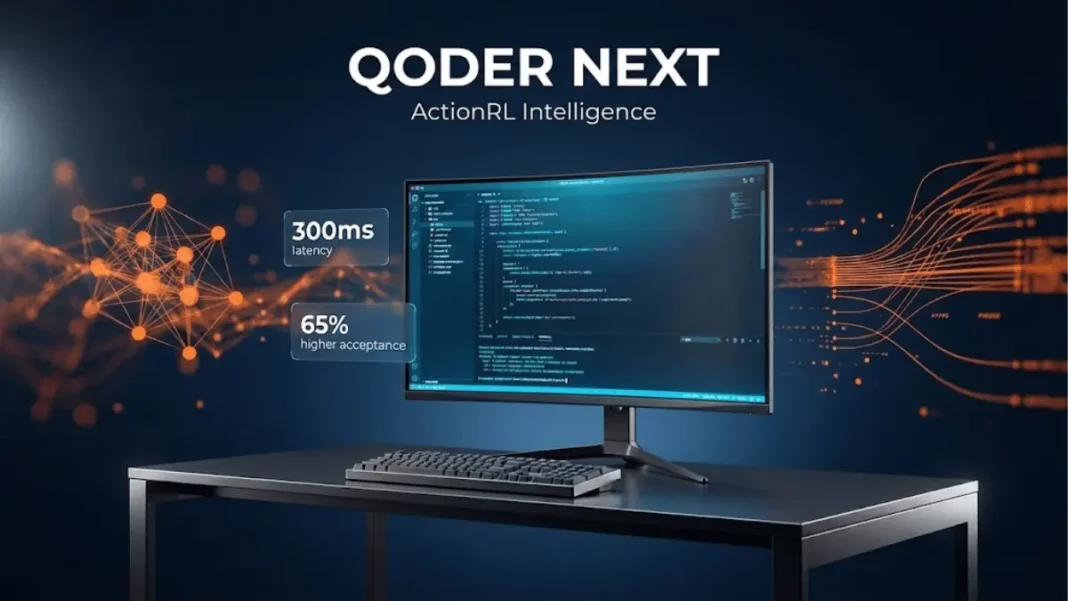
Alibaba Cloud introduced Qoder NEXT and its proprietary ActionRL preference alignment algorithm on January 8, 2026, marking a fundamental shift from traditional code completion to intelligent, multi-step edit prediction. The system achieves 65% higher code acceptance rates and reduces first-action latency to 300ms through Abstract Syntax Tree (AST) simulation and behavioral divergence point optimization. Qoder NEXT operates within a 24-hour data flywheel, enabling measurable performance improvements in live production environments within one day.
Technical Architecture
Qoder NEXT leverages AST parsers like Tree-sitter to reverse-engineer realistic edit trajectories from high-quality code repositories, teaching the model how edits unfold across multiple dependencies. The system handles six advanced editing patterns: signature changes that auto-update call sites, logic extraction into new functions, type refinement from abstract to concrete implementations, method override generation, LSP-based error refactoring, and automatic import insertion. Unlike random masking approaches, this AST-based simulation enables the model to learn causally dependent edits during pre-training.
ActionRL addresses the critical “over-suppression” problem in conventional alignment methods by shifting optimization to the Behavioral Divergence Point (BDP), the first action where accepted and rejected edit sequences diverge. The algorithm maximizes the margin between chosen and rejected actions at the BDP while detaching gradients for all subsequent tokens, preventing valid code segments from receiving misleading negative signals. This localized optimization strategy increased code generation ratio by 53% compared to naive alignment baselines.
Performance Metrics
| Metric | Before Optimization | After Qoder NEXT | Improvement |
|---|---|---|---|
| P50 Latency | 800ms | 300ms | 63% reduction |
| Code Acceptance Rate | Baseline | +65% | 65% increase |
| Code Generation Ratio | Baseline | +53% | 53% increase |
| Cache Reuse Rate | N/A | 23% | Memory-optimized |
Network transfer optimization reduced round-trip time from 200ms to 50ms through proximity access and global acceleration via dedicated cloud lines. Streaming architecture prioritizes first-action delivery, enabling developers to make decisions within 300ms while subsequent content streams asynchronously. The system maintains a 30-second cache with LRU eviction, achieving 23% result reuse while controlling memory overhead.
Market Positioning
The AI code assistant market reached $4.70 billion in 2025 and projected growth to $14.62 billion by 2033 at a 15.31% CAGR, driven by enterprise demand for automated code generation, review, and debugging. Large Language Models command 41.5% market share with the fastest segment growth at 22.4% CAGR, while code generation applications expand at 23.1% annually. Qoder NEXT enters a competitive landscape dominated by GitHub Copilot, Amazon Q Developer, Tabnine, and Cursor, differentiating through its AST-based multi-step prediction and sub-300ms latency.
North America leads with 42% market share, but Asia Pacific demonstrates the highest regional CAGR at 17.54% from 2026-2033, fueled by rapid digital transformation and expanding developer communities. Alibaba’s positioning leverages this regional strength while targeting global enterprises requiring advanced code intelligence beyond single-line autocomplete.
Implementation Strategy
Qoder NEXT integrates as an IDE component performing continuous inference, predicting the next likely action as developers edit and proactively surfacing follow-up edits. The system collects high-fidelity behavioral logs under strict privacy protocols, categorizing feedback into explicit accept (Tab key), partial edit (manual modification of later steps), and explicit reject (Esc key or ignore) signals. Rejection signals function as high-value training data, revealing gaps in domain-specific semantic understanding when users correct predictions like obj.getName() to obj.getDisplayName()
The 24-hour data flywheel enables rapid iteration: real-time feedback collection feeds directly into model retraining, with measurable accuracy improvements deployed to production within one day. Alibaba explores knowledge distillation for lighter specialized models and INT4 quantization for hardware-level acceleration, targeting zero-wait experiences through Next Action Prediction (NAP) that computes results before user-triggered suggestions.
Development Roadmap
Qoder NEXT aims to evolve from intelligent edit suggestion to a comprehensive development partner automating end-to-end workflows from feature implementation and testing to code commits and post-merge remediation. The system’s ability to reason about causal logic behind code modifications positions it to handle complex refactoring scenarios that require understanding multi-file dependencies and architectural patterns. As ActionRL refinement continues, Alibaba expects further gains in scenario coverage and prediction activeness without sacrificing first-action accuracy.

Frequently Asked Questions (FAQs)
What is Qoder NEXT?
Qoder NEXT is Alibaba Cloud’s intelligent code editing model using AST-based simulation and ActionRL alignment to predict multi-step, intent-aware code changes with 300ms latency.
How does ActionRL differ from traditional alignment?
ActionRL optimizes decisions at the Behavioral Divergence Point rather than penalizing entire sequences, preventing over-suppression and increasing code generation 53%.
What latency does Qoder NEXT achieve?
P50 latency decreased from 800ms to 300ms through network optimization, streaming architecture, and proximity access to regional nodes.
Which markets does Qoder NEXT target?
Qoder NEXT competes in the $4.70 billion AI code assistant market, focusing on enterprises requiring advanced multi-step prediction beyond GitHub Copilot.

