

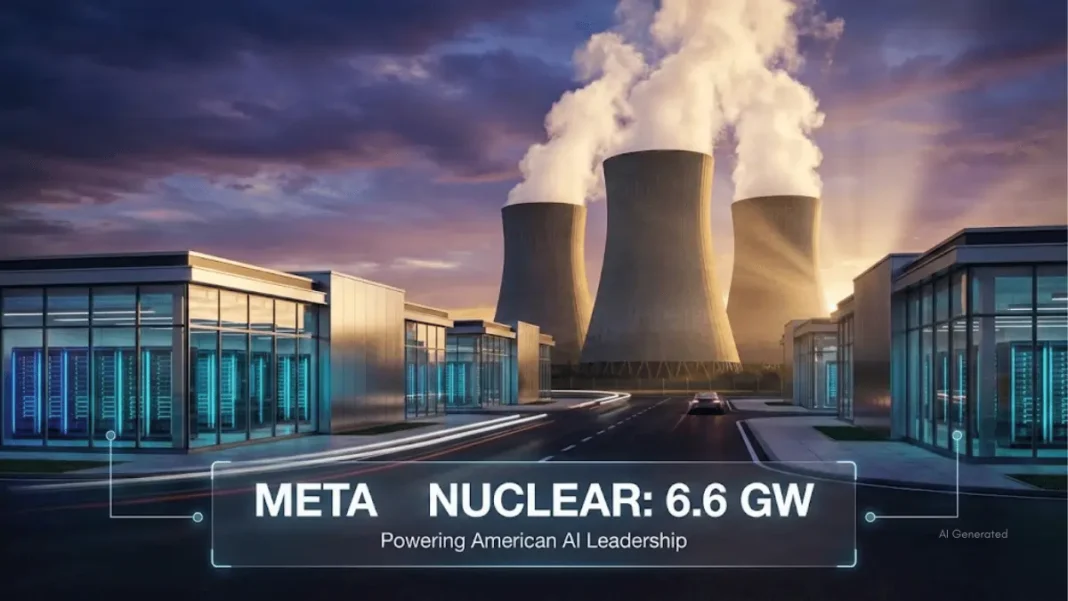
Summary: Meta announced landmark nuclear energy agreements with Vistra, TerraPower, and Oklo to secure up to 6.6 GW of power by 2035 enough for 5 million homes. The deals support Meta’s Prometheus AI supercluster in Ohio while making Meta America’s largest corporate nuclear energy purchaser.
What Meta Just Announced: Breaking Down the Nuclear Agreements
Three Partners, One Mission
Meta revealed three distinct nuclear energy partnerships on January 9, 2026, each serving a specific purpose in its energy portfolio. The announcement follows a comprehensive nuclear Request for Proposals (RFP) process Meta launched in December 2024 to identify partners capable of accelerating new nuclear generators at scale.
The first partnership with Vistra focuses on extending the operational lifespan of three existing nuclear plants: Perry and Davis-Besse in Ohio, plus Beaver Valley in Pennsylvania. Meta will purchase more than 2.1 GW of energy through 20-year agreements while supporting uprates (capacity expansions) totaling 433 MW at all three facilities.
The second deal with TerraPower, founded by Bill Gates, involves funding two new Natrium advanced reactors capable of generating up to 690 MW with delivery as early as 2032. Meta secured rights for energy from six additional Natrium units producing 2.1 GW targeted for 2035 delivery, a total of eight potential units with 2.8 GW baseload capacity plus 1.2 GW of built-in storage.
The third partnership with Oklo, backed by OpenAI CEO Sam Altman, supports development of an advanced nuclear technology campus in Pike County, Ohio. The facility could deliver up to 1.2 GW of clean baseload power directly into the PJM market as early as 2030 using multiple Aurora Powerhouse reactors.
Timeline: When Will This Power Come Online?
Nuclear power will become available in phases across the next decade. Oklo’s Ohio campus could begin operations as early as 2030, making it the first deliverable. TerraPower’s initial two Natrium units target 2032, with six more by 2035. Vistra’s uprates at existing plants are expected in the early 2030s. This staggered approach ensures Meta receives increasing nuclear capacity as its AI infrastructure scales.
Why Meta Needs Nuclear Energy for AI
The Prometheus Supercluster Connection
These nuclear projects will power Meta’s Prometheus supercluster in New Albany, Ohio described by CEO Mark Zuckerberg in July 2025 as critical for the company’s advanced AI initiatives. Prometheus represents Meta’s largest AI-focused data center investment and is expected to become operational in 2026.
AI supercomputers like Prometheus require continuous, massive electrical loads that dwarf traditional data centers. Training large language models and running inference for billions of users demands reliability that intermittent renewable sources like wind and solar cannot consistently provide.
AI’s Massive Energy Appetite
Global company spending on AI infrastructure is projected to reach $480 billion in 2026, with energy consumption representing a critical bottleneck. Modern AI data centers can require power equivalent to small cities the 6.6 GW Meta is securing equals approximately 5 million homes’ worth of electricity.
Nuclear energy delivers three advantages for AI workloads: baseload reliability (24/7 operation without weather dependence), carbon-free operation (meeting sustainability commitments), and firm capacity (predictable output for grid planning).
TerraPower: Advanced Natrium Reactors Explained
What Makes Natrium Technology Different
TerraPower’s Natrium reactors use sodium fast reactor technology instead of traditional light-water designs. Sodium coolant operates at atmospheric pressure, eliminating the risk of high-pressure accidents. The design also incorporates molten salt energy storage, enabling the reactor to provide 345 MW continuous output plus up to 500 MW peak power when needed essentially functioning as both a nuclear plant and a giant battery.
Chris Levesque, TerraPower’s president and CEO, emphasized that the design is complete with established supply chains and cleared regulatory milestones. The company’s first Natrium plant is already under development, positioning TerraPower to deliver on the multi-unit Meta agreement.
Capacity and Delivery Schedule
Meta’s agreement with TerraPower represents the company’s largest support of advanced nuclear technologies to date. The two initial units (690 MW combined) target 2032 delivery, followed by six more units (2.1 GW) by 2035. The eight-unit total would provide 2.8 GW of baseload generation capacity plus 1.2 GW of built-in storage capability.
Oklo Aurora Powerhouses: Pike County’s Nuclear Campus
Fast Reactor Technology Breakdown
Oklo’s Aurora powerhouses use proven fast reactor designs with inherently safe systems capable of utilizing both fresh and repurposed fuel. Fast reactors operate with higher-energy neutrons, enabling them to extract more energy from uranium and even consume certain types of nuclear waste.
The modular design allows incremental expansion starting with smaller units and adding capacity as demand grows. This scalability contrasts sharply with traditional gigawatt-scale reactors that must be built entirely upfront, reducing financial risk.
Economic Impact on Ohio Communities
The Pike County campus is expected to create thousands of construction jobs and hundreds of permanent operational positions. Jacob DeWitte, Oklo’s co-founder and CEO, highlighted that the vision shared two years ago is now becoming reality through Meta’s support, delivering clean energy and high-quality jobs to Ohio.
Pre-construction and site characterization are slated to begin in 2026, with the first phase targeted for 2030 and full 1.2 GW capacity by 2034. The facility will generate new local and state tax revenue through major energy infrastructure investments.
Vistra’s Role: Extending Existing Nuclear Plants
Perry, Davis-Besse, and Beaver Valley Plants
Many American nuclear plants face premature retirement due to economic pressures despite being technically capable of decades more operation. Meta’s agreements with Vistra provide the long-term financial certainty needed to justify continued investment in three facilities.
All three plants Perry, Davis-Besse, and Beaver Valley deliver power into the PJM grid region, which serves 65 million people across 13 states including Ohio, Pennsylvania, and parts of surrounding states. The agreements extend operational lifespans by 20 years, similar to Meta’s earlier deal with Constellation Energy for the Clinton, Illinois plant.
What Are Nuclear Uprates?
Nuclear uprates increase a reactor’s maximum power output through modifications like improved fuel designs, enhanced cooling systems, or optimized operations. The 433 MW of combined uprates Meta is supporting across the three Vistra plants represent the largest nuclear capacity expansions backed by a corporate customer in U.S. history.
Jim Burke, Vistra’s president and CEO, noted the agreement powers American AI innovation while extending plant life, boosting grid capacity, protecting existing jobs, creating new ones, and continuing community investments. Consumers benefit from increased reliable power supply without bearing the costs Meta pays full energy expenses for its data centers.
How Meta Compares to Other Tech Giants
Google, Amazon, and Microsoft’s Nuclear Bets
Meta joins a broader industry trend toward nuclear energy for data centers. Microsoft signed a 20-year agreement to purchase power from the restarted Three Mile Island Unit 1 reactor in Pennsylvania. Google announced partnerships with Kairos Power to deploy small modular reactors by the early 2030s. Amazon invested in X-energy’s advanced reactors and purchased land adjacent to an existing nuclear plant in Pennsylvania.
Together, Meta, Amazon, Google, and Microsoft committed in March 2025 to triple global nuclear energy production by 2050. However, Meta’s agreements now position it as the most significant corporate nuclear purchaser among hyperscalers.
Who’s Leading the Corporate Nuclear Race?
Meta’s combined agreements with Vistra, TerraPower, Oklo, and its earlier Constellation deal total more than 6.6 GW of nuclear capacity. This exceeds the nuclear commitments publicly disclosed by its tech peers, though exact comparisons are difficult due to varying contract structures and timelines.
The company stated that state-of-the-art data centers and AI infrastructure are essential to securing America’s position as a global leader in AI, with nuclear energy strengthening the country’s energy infrastructure. Joel Kaplan, Meta’s Chief Global Affairs Officer, emphasized that these projects will create thousands of skilled jobs, add new energy to the grid, extend three existing plants, and accelerate new reactor technologies.
Advanced Nuclear vs. Traditional Reactors
Safety Improvements
Advanced reactors from TerraPower and Oklo incorporate passive safety systems that shut down automatically without operator action or external power. Sodium-cooled fast reactors operate at low pressure, eliminating the possibility of high-pressure coolant loss accidents that affected earlier reactor generations.
The designs also feature smaller core sizes and more efficient fuel use, reducing waste volumes. Oklo’s reactors can even utilize repurposed fuel from conventional reactors, helping address the nuclear waste challenge.
Size and Scalability Benefits
Traditional nuclear plants produce 1,000+ MW from single reactors requiring 5-7 year construction timelines. Advanced reactors like Oklo’s Aurora (15-50 MW per unit) and TerraPower’s Natrium (345 MW per unit) can be deployed modularly.
This modularity enables incremental investment matching demand growth rather than betting billions on massive upfront construction. Multiple smaller units also improve grid flexibility and reduce project risk.
Faster Deployment Timelines
Advanced reactors aim for factory fabrication of major components, shifting work from slow on-site construction to faster, quality-controlled manufacturing. TerraPower’s completed design and established supply chains position it to deliver multiple units more rapidly than traditional reactors.
Oklo’s 2030 target for first power from Pike County would represent one of the fastest advanced reactor deployments in the United States. However, both companies acknowledge that regulatory approval processes and first-of-a-kind construction challenges could affect timelines.
Environmental and Economic Impact
Carbon-Free Power for AI
Nuclear energy produces electricity without direct carbon emissions, helping Meta progress toward sustainability goals while powering energy-intensive AI workloads. The 6.6 GW of nuclear capacity avoids millions of tons of CO2 annually compared to natural gas alternatives.
Meta noted that innovation at AI’s scale requires more electricity, and nuclear provides clean, reliable, firm electricity that helps power America’s economy and communities. The company has added nearly 28 GW of new energy to grids across 27 states through clean energy partnerships over the past decade.
Job Creation Numbers
The three projects are expected to provide thousands of construction jobs and hundreds of long-term operational positions. Nuclear plants typically employ 500-800 permanent workers with above-average wages and require extensive skilled trades during construction phases.
Pike County’s Oklo campus alone anticipates thousands of construction and long-term operations jobs, generating substantial local and state tax revenue. The Vistra agreements protect hundreds of existing jobs at Perry, Davis-Besse, and Beaver Valley that could have been lost to premature plant closures.
Grid Reliability Benefits
Adding 6.6 GW of firm, dispatchable nuclear capacity strengthens the PJM grid’s reliability for all customers. Unlike intermittent renewables requiring backup, nuclear plants provide consistent output regardless of weather, time of day, or season.
The uprates at Vistra’s plants inject 433 MW of new capacity into a grid region experiencing growing demand from data centers, electric vehicles, and manufacturing reshoring. Meta emphasized that consumers benefit from larger reliable power supply without bearing data center electricity costs Meta pays full price for energy used.
Meta’s Three Nuclear Partners Comparison
| Partner | Technology | Capacity | Timeline | Location |
|---|---|---|---|---|
| Oklo | Aurora fast reactors | Up to 1.2 GW | 2030-2034 | Pike County, OH |
| TerraPower | Natrium sodium reactors | Up to 2.8 GW + 1.2 GW storage | 2032-2035 | TBD |
| Vistra | Existing plant extensions + uprates | 2.1 GW + 433 MW uprates | Early 2030s | OH & PA |
Advanced vs. Traditional Nuclear Reactors
| Feature | Traditional Reactors | Advanced Reactors (Natrium/Aurora) |
|---|---|---|
| Unit size | 1,000+ MW per reactor | 15-500 MW per unit |
| Pressure | High pressure water | Low/atmospheric pressure sodium |
| Safety | Active systems requiring power | Passive shutdown, inherent safety |
| Construction | 5-7 years on-site | Factory-built modules, faster deployment |
| Fuel | Fresh uranium only | Fresh or repurposed fuel |
- Massive scale: 6.6 GW enough for 5 million homes ensures long-term AI infrastructure power
- Carbon-free: Nuclear produces zero direct emissions, meeting sustainability commitments
- Reliability: 24/7 baseload power without weather dependence
- Job creation: Thousands of construction and hundreds of permanent operational jobs
- Grid benefits: Consumers gain reliable power supply without bearing Meta’s data center costs
- Advanced technology: Supporting next-generation safer, smaller reactors
- Diversified risk: Three different partners and technology approaches
- Timeline uncertainty: Advanced reactors face regulatory approval and first-of-a-kind construction risks
- High upfront costs: Nuclear requires substantial capital despite long-term economics
- Regulatory delays: NRC licensing can extend timelines unexpectedly
- Unproven technology: Neither Natrium nor Aurora has commercial operating licenses yet
- Decade-long wait: Most power won’t arrive until early 2030s, requiring bridge solutions
- Public perception: Nuclear energy faces opposition in some communities
- Waste concerns: Long-term storage challenges persist despite advanced fuel cycles
Meta Nuclear Energy Deal Technical Specifications
Total Capacity: Up to 6.6 GW by 2035
Partner 1 – Oklo:
- Technology: Aurora fast reactor powerhouses
- Capacity: Up to 1.2 GW
- Location: Pike County, Ohio (PJM market)
- Timeline: 2030 first phase, full capacity by 2034
- Fuel: Fresh and repurposed fuel capability
- Units: Multiple modular Aurora powerhouses
Partner 2 – TerraPower:
- Technology: Natrium sodium-cooled fast reactors
- Capacity: 2.8 GW baseload + 1.2 GW storage (8 units total)
- Unit size: 345 MW per reactor
- Peak output: Up to 500 MW with molten salt storage
- Timeline: 2 units by 2032, 6 more by 2035
- Coolant: Liquid sodium at atmospheric pressure
Partner 3 – Vistra:
- Technology: Existing pressurized water reactors + uprates
- Capacity: 2.1 GW existing + 433 MW uprates
- Plants: Perry (OH), Davis-Besse (OH), Beaver Valley (PA)
- Contract: 20-year energy purchase agreements
- Timeline: Uprates in early 2030s
- Grid: All deliver to PJM interconnection
Power Destination:
- Primary: Prometheus supercluster, New Albany, Ohio
- Grid: PJM region (13 states, 65 million people)
- Online: Prometheus expected 2026
Economic Impact:
- Jobs: Thousands construction, hundreds permanent operations
- Equivalency: Enough power for ~5 million homes
- Investment: Undisclosed (financial terms not revealed)
Challenges and Risks
Regulatory Hurdles
All three partners face significant Nuclear Regulatory Commission (NRC) licensing processes. TerraPower’s Natrium design and Oklo’s Aurora design require NRC approval before construction can proceed at scale. While both companies report progress, no advanced reactor design has yet received full commercial operating licenses in the U.S..
The uprates at Vistra’s existing plants also require NRC review and approval, though the process is generally faster for modifications to operating reactors versus new designs.
Construction Delays
Nuclear projects historically face schedule delays and cost overruns. The only advanced reactors under construction in the U.S. NuScale’s canceled Utah project and TerraPower’s demonstration Natrium plant have experienced timeline adjustments.
Oklo’s aggressive 2030 target for first power requires flawless execution on permitting, supply chain, and construction. TerraPower’s 2032 delivery assumes successful completion of its demonstration plant and establishment of manufacturing processes.
Cost Considerations
Advanced nuclear developers promise lower costs than traditional plants through factory fabrication and design simplification. However, first-of-a-kind units typically cost more than later copies. Meta’s financial commitments provide crucial early-stage support, but the economics depend on successful deployment of multiple units.
The levelized cost of electricity from new nuclear must compete with natural gas and renewables plus storage. While nuclear avoids fuel price volatility and carbon costs, upfront capital remains substantial.
Featured Snippet Boxes
What is Meta’s nuclear energy deal?
Meta signed agreements with Vistra, TerraPower, and Oklo to secure up to 6.6 gigawatts of nuclear power by 2035 for its AI data centers. The deals involve extending three existing nuclear plants, building eight advanced Natrium reactors, and developing a 1.2 GW Aurora powerhouse campus in Ohio.
Why do AI data centers need nuclear energy?
AI data centers require continuous, massive electrical loads that exceed traditional facilities. Nuclear energy provides 24/7 baseload power without weather dependence, meeting the reliability needs of AI training and inference workloads while delivering carbon-free electricity.
When will Meta’s nuclear reactors come online?
Oklo’s Ohio campus could begin operations as early as 2030, TerraPower’s first Natrium units target 2032, and Vistra’s uprates are expected in the early 2030s. The staggered timeline ensures increasing nuclear capacity as Meta’s AI infrastructure scales.
What is TerraPower Natrium technology?
Natrium reactors use sodium fast reactor technology operating at atmospheric pressure, eliminating high-pressure accident risks. They incorporate molten salt energy storage, providing 345 MW continuous output plus up to 500 MW peak power.
How does Meta compare to other tech companies in nuclear energy?
Meta’s 6.6+ GW of nuclear commitments exceed publicly disclosed agreements by Microsoft, Google, and Amazon, making Meta the largest corporate nuclear purchaser among hyperscalers. Together, these four companies pledged to triple global nuclear production by 2050.
What are nuclear uprates?
Nuclear uprates increase a reactor’s maximum power output through improvements like enhanced fuel designs, better cooling systems, or optimized operations. Meta is supporting 433 MW of uprates across three Vistra plants, the largest corporate-backed nuclear expansions in U.S. history.

Frequently Asked Questions (FAQs)
How much nuclear power did Meta secure?
Meta secured up to 6.6 gigawatts of nuclear power capacity by 2035 through three partnerships. This includes 1.2 GW from Oklo, up to 2.8 GW from TerraPower, and 2.1 GW plus 433 MW of uprates from Vistra.
What is the Prometheus supercluster?
Prometheus is Meta’s massive AI supercomputer being built in New Albany, Ohio. CEO Mark Zuckerberg announced it in July 2025 as critical for advanced AI development, with operations expected to begin in 2026.
Why is Meta investing in nuclear energy instead of solar or wind?
AI data centers require continuous, massive electrical loads that intermittent renewables cannot reliably provide. Nuclear delivers 24/7 baseload power without weather dependence, meeting AI’s reliability requirements while producing zero carbon emissions.
When will Meta’s nuclear reactors start producing power?
Oklo’s Ohio facility could come online as early as 2030, TerraPower’s first Natrium units target 2032, and Vistra’s uprates are expected in the early 2030s. The staggered timeline provides increasing capacity as Meta’s AI infrastructure grows.
Are advanced nuclear reactors safe?
Advanced reactors like TerraPower’s Natrium and Oklo’s Aurora incorporate passive safety systems that shut down automatically without operator action. They operate at low pressure, eliminating high-pressure coolant loss accidents, and feature smaller cores with more efficient fuel use.
How does Meta’s nuclear investment compare to other tech companies?
Meta’s 6.6+ GW of nuclear commitments make it the largest corporate nuclear purchaser among hyperscalers, exceeding disclosed agreements by Microsoft, Google, and Amazon. Together, these four companies pledged to triple global nuclear production by 2050.
What are the challenges with Meta’s nuclear plans?
Key challenges include NRC licensing timelines, first-of-a-kind construction risks, potential cost overruns, and the decade-long wait for most capacity. Neither the Natrium nor Aurora reactor designs have received commercial operating licenses yet.
Will Meta’s nuclear deal affect electricity prices for consumers?
Meta pays full costs for energy used by its data centers, so consumers don’t bear these expenses. The additional nuclear capacity actually benefits consumers by adding reliable, always-available power to the PJM grid, potentially stabilizing wholesale electricity prices.

