

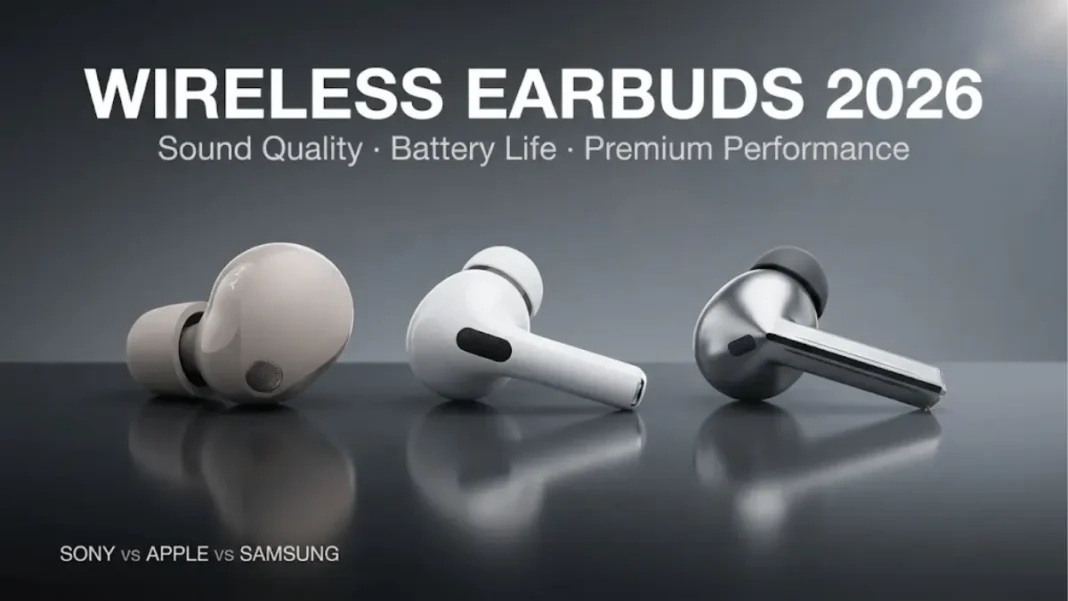
The flagship wireless earbuds from Sony, Apple, and Samsung compete head-to-head in 2026, each offering distinct advantages in battery endurance and audio performance. Sony’s WF-1000XM5 delivers 8 hours continuous playback with ANC enabled, matching Apple’s recently launched AirPods Pro 3, while Samsung’s Galaxy Buds 3 Pro trails at 6 hours despite premium pricing. Sound quality differences emerge through codec support and driver technology, with Sony championing LDAC, Apple refining its AAC implementation, and Samsung introducing the Seamless Codec for Galaxy device users.
What’s New in 2026
Premium wireless earbuds have entered a maturity phase where battery life and sound fidelity separate market leaders from challengers. The Sony WF-1000XM5, launched in 2023, remains the benchmark with 8.4mm dynamic drivers and LDAC codec support delivering high-resolution audio. Apple’s AirPods Pro 3, released in late 2025, upgraded battery life from 6 to 8 hours with ANC active, directly addressing user complaints about insufficient runtime on long flights.
Samsung’s Galaxy Buds 3 Pro introduced a hybrid driver system combining 10.5mm dynamic and 6.1mm planar drivers, but battery performance disappoints at just 6 hours with ANC enabled. The Buds 3 Pro received an IP57 rating for water resistance, surpassing Sony’s IPX4 and offering better protection during workouts.
Total battery life with charging cases varies significantly. Sony provides 24-30 hours depending on ANC usage, Apple delivers 30+ hours, and Samsung offers 26 hours total. Fast charging capabilities remain consistent across all three: 3 minutes yields approximately 60 minutes of playback.
Why Battery Life and Sound Quality Matter
Battery endurance directly impacts user experience for commuters, travelers, and remote workers who depend on uninterrupted audio. Eight-hour battery life has become the new standard for flagship earbuds, enabling full workday usage without mid-day charging. Sony and Apple meet this threshold, while Samsung’s 6-hour limitation requires more frequent recharging.
Sound quality differentiation centers on codec support and tuning philosophy. Sony’s LDAC codec enables 24-bit/96kHz wireless transmission for lossless audio from compatible Android devices and streaming services. Apple’s proprietary H2 chip optimizes AAC performance specifically for iOS devices, delivering spatial audio and adaptive EQ. Samsung’s Seamless Codec (SSC) achieves 24-bit/96kHz quality but exclusively with Galaxy smartphones, limiting cross-platform utility.
Real-world testing confirms Sony’s WF-1000XM5 lasted 9 hours and 32 minutes under continuous playback conditions, while Samsung’s Galaxy Buds 3 Pro managed only 4 hours and 31 minutes in identical testing protocols.
Head-to-Head Comparison
| Feature | Sony WF-1000XM5 | Apple AirPods Pro 3 | Samsung Galaxy Buds 3 Pro |
|---|---|---|---|
| Battery (ANC On) | 8 hours | 8 hours | 6 hours |
| Total with Case | 24-36 hours | 30+ hours | 26 hours |
| Driver Size | 8.4mm dynamic | Proprietary | 10.5mm + 6.1mm planar |
| Codec Support | LDAC, AAC, SBC | AAC (optimized) | SSC, AAC, SBC |
| Water Resistance | IPX4 | IP54 | IP57 |
| Bluetooth Version | 5.3 | 5.3 | 5.4 |
| Weight per Bud | 5.9g | Not disclosed | Not disclosed |
Sony leads in battery longevity and codec versatility, making it ideal for Android users seeking high-resolution audio. AirPods Pro 3 excel within Apple’s ecosystem, offering seamless device switching and enhanced Transparency Mode with Live Translation. Galaxy Buds 3 Pro deliver superior water resistance but sacrifice battery life for the hybrid driver system.
Sound Quality Breakdown
The WF-1000XM5 produces crisp, controlled audio with carbon cone drivers that create space in the soundstage. Vocals sit perfectly in the mix, highs shimmer without harshness, and bass remains tight rather than boomy. LDAC support enables lossless streaming from services like Tidal and Qobuz when paired with compatible Android devices.
AirPods Pro 3 improved Active Noise Cancellation over the second generation, doubling the ANC runtime of Bose QuietComfort Ultra earbuds. The H2 chip enables Adaptive EQ that automatically tunes frequencies to ear shape, while spatial audio with head tracking creates immersive soundscapes for Apple Music subscribers.
Galaxy Buds 3 Pro’s dual-driver configuration theoretically offers superior frequency response, but real-world testing shows marginal improvements over single-driver competitors. The Samsung Seamless Codec delivers 24-bit/96kHz audio exclusively to Galaxy S24, S25, and compatible tablets, but falls back to standard AAC for iPhone users.
ANC performance varies between models. Sony’s adaptive noise cancellation blocks sharp treble sounds and mid-range conversations effectively but struggles with low-frequency rumble. Apple’s ANC implementation improved significantly in the Pro 3 generation. Samsung’s ANC performs adequately but doesn’t match Sony’s precision.
What’s Next for Premium Earbuds
The wireless earbud market is consolidating around three key features: 8+ hour battery life with ANC, high-resolution codec support, and adaptive noise cancellation. Bluetooth LE Audio with LC3 codecs promises even longer battery life in 2026-2027 models through more efficient wireless transmission.
Sony’s next-generation WF-1000XM6 remains unannounced, but industry observers expect improved ANC and extended battery beyond 8 hours. Apple typically refreshes AirPods Pro every two years, placing the hypothetical Pro 4 in 2027 timeframe. Samsung’s release cycle suggests Galaxy Buds 4 Pro could arrive in summer 2026 with battery improvements addressing current shortcomings.
Pricing remains stable across flagships: Sony WF-1000XM5 sells for approximately $249-299, AirPods Pro 3 retail at $249, and Galaxy Buds 3 Pro list at $229-249. Discounts frequently appear during holiday sales periods, with 20-30% reductions common.
Current owners should consider upgrading if their existing earbuds provide less than 5 hours of continuous battery life, as lithium-ion degradation accelerates after 2-3 years of daily use. Sony offers battery replacement services for WF-1000XM4 owners experiencing degradation, though this program’s availability varies by region.
Featured Snippet Boxes
Which wireless earbuds last longest on a single charge?
Sony WF-1000XM5 and Apple AirPods Pro 3 both deliver 8 hours of continuous playback with ANC enabled, tying for longest battery life among flagship models. Samsung Galaxy Buds 3 Pro lag at 6 hours, requiring more frequent charging during extended use.
Do Sony earbuds sound better than AirPods for Android users?
Yes, Sony WF-1000XM5 support LDAC codec enabling 24-bit/96kHz lossless audio from Android devices, while AirPods Pro 3 use standard AAC codec when paired with non-Apple phones. LDAC provides noticeably higher fidelity for high-resolution streaming services like Tidal.
Are Samsung Galaxy Buds 3 Pro worth the price?
Galaxy Buds 3 Pro excel for Samsung ecosystem users with IP57 water resistance and Seamless Codec support, but the 6-hour battery life and limited cross-platform codec compatibility make them less competitive against Sony and Apple alternatives at similar pricing.
How often should I charge premium wireless earbuds?
With 8-hour battery life from Sony or Apple models, daily charging suffices for most users with 4-6 hours of listening per day. Samsung’s 6-hour Galaxy Buds 3 Pro may require mid-day charging for heavy users or during travel.

