

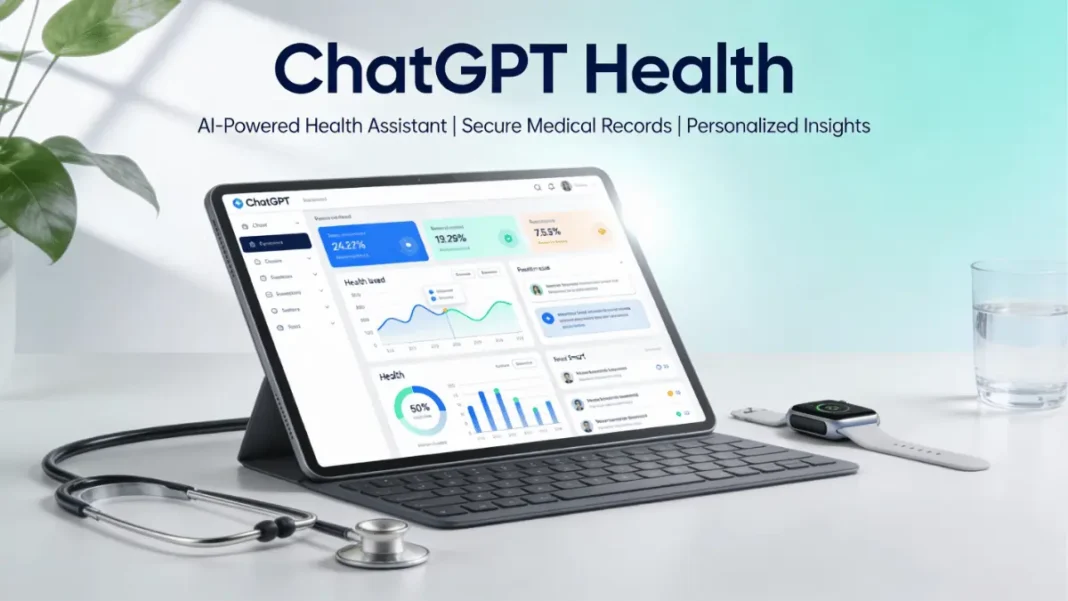
OpenAI launched ChatGPT Health on January 7, 2026 a dedicated AI health assistant that securely connects medical records and wellness apps like Apple Health, MyFitnessPal, and Function to provide personalized health insights. With 230 million weekly users already asking health questions, ChatGPT Health adds purpose-built encryption, data isolation, and physician-validated responses across 30 specialties. It’s not designed for diagnosis or treatment, but helps users understand lab results, prepare for appointments, and track wellness patterns. Currently rolling out via waitlist to ChatGPT Free, Go, Plus, and Pro users outside the EEA, Switzerland, and UK, with full availability expected in coming weeks.
OpenAI has launched ChatGPT Health, a dedicated AI health assistant that securely connects your medical records and wellness apps to provide personalized health insights without replacing your doctor. Announced January 7, 2026, this new experience responds to a massive demand: over 230 million people globally already ask ChatGPT health and wellness questions every week.
ChatGPT Health isn’t a diagnostic tool or medical treatment platform. Instead, it’s designed to help you understand lab results, prepare appointment questions, track wellness patterns from wearables, and navigate healthcare decisions like insurance plan comparisons. Built with input from 260+ physicians across 60 countries and 30 specialties, it brings physician-validated responses and layered privacy protections specifically engineered for sensitive health data.
What Is ChatGPT Health?
ChatGPT Health is a separate, dedicated space within ChatGPT that combines AI intelligence with your personal health information. Unlike standard ChatGPT conversations, Health operates in an isolated environment with enhanced encryption, separate memory storage, and strict data compartmentalization.
The core innovation is integration: you can connect medical records through healthcare provider networks, sync wellness apps like Apple Health and MyFitnessPal, and upload lab results or visit summaries directly. ChatGPT then grounds its responses in your actual health data rather than generic information, making advice more relevant to your specific situation.
ChatGPT Health is OpenAI’s dedicated AI health assistant launched January 2026 that securely connects medical records and wellness apps to provide personalized health insights. It uses purpose-built encryption and operates separately from standard ChatGPT with enhanced privacy protections designed specifically for sensitive health data.
Key Features and Capabilities
Medical Record Integration
ChatGPT Health partners with b.well, which connects to approximately 2.2 million U.S. healthcare providers, to enable secure medical record access. Users can pull in lab results, visit summaries, diagnoses, medication lists, and clinical history to ground AI conversations in their actual health timeline.
This integration allows practical use cases like asking “How’s my cholesterol trending?” or “Summarize my latest bloodwork before my appointment tomorrow”. The AI can identify patterns across multiple visits, flag abnormal results in context, and help you formulate better questions for your physician.
Wellness App Connectivity
Eight wellness apps launched with ChatGPT Health:
- Apple Health (iOS only): Syncs movement, sleep, heart rate, activity patterns, and fitness data
- Function: Provides lab test insights and nutrition recommendations
- MyFitnessPal: Tracks macros, nutrition intake, and generates recipe suggestions
- Weight Watchers: Offers GLP-1 personalized meal ideas and food guidance
- Peloton: Suggests workout classes and guided meditations
- AllTrails: Recommends hiking routes based on fitness level
- Instacart: Converts meal plans into shoppable grocery lists
Each app requires explicit permission before connecting, even if already linked to standard ChatGPT. You can disconnect any app instantly, immediately revoking its access.
Personalized Health Insights
With connected data, ChatGPT Health provides context-aware responses to questions about diet adjustments, workout routines, insurance plan comparisons based on your healthcare usage, or understanding trade-offs between treatment options. It can analyze trends over time like tracking how sleep patterns correlate with exercise intensity rather than just addressing isolated symptoms.
Custom instructions let you set preferences: focus areas, topics to avoid mentioning, or how responses should be framed (e.g., simplified explanations vs. technical detail). These instructions apply only within Health conversations and can be updated anytime.

Privacy and Security Architecture
Dedicated Health Space
Health lives as a separate environment within ChatGPT where conversations, connected apps, and uploaded files are stored completely isolated from your other chats. While health conversations appear in your chat history for easy access, the information itself never crosses into non-Health areas.
ChatGPT may use context from standard chats like a recent move or job change to make health conversations more relevant when helpful. However, this flow is unidirectional: Health information and memories never leak back into non-Health chats, and regular conversations can’t access Health files, memories, or data.
Purpose-Built Encryption
Standard ChatGPT already encrypts conversations at rest and in transit as baseline security. ChatGPT Health adds layered protections on top: purpose-built encryption specifically designed for health data compartmentalization. OpenAI clarified during a press briefing that this is not end-to-end encryption, but multiple specialized encryption layers.
You can strengthen protection further by enabling multi-factor authentication (MFA) to prevent unauthorized account access.
Data Isolation and Memory Management
Health maintains separate memories that stay contained within the Health space. You can view or delete Health memories anytime through the Health interface or ChatGPT’s “Personalization” settings section.
Critically, conversations in Health are not used to train OpenAI’s foundation models. This addresses a major privacy concern raised about earlier ChatGPT versions, where users worried about inadvertently training models with sensitive personal health information.
What’s Not HIPAA Certified (Yet)
Despite enhanced protections, OpenAI has not explicitly stated that ChatGPT Health is HIPAA-compliant. The partnership with b.well which adheres to industry-standard health data security suggests alignment with healthcare privacy expectations, but no formal Business Associate Agreement (BAA) for covered entities has been announced.
Privacy experts have historically criticized ChatGPT for data retention concerns. The new layered protections and no-training policy address some issues, but healthcare providers subject to HIPAA’s Privacy Rule should exercise caution before recommending ChatGPT Health to patients for PHI-related questions.
ChatGPT Health uses purpose-built encryption, data isolation, and separate memory storage specifically for health conversations. Health data never flows back to standard ChatGPT chats, conversations aren’t used to train AI models, and you can delete Health memories anytime. However, OpenAI has not explicitly confirmed HIPAA compliance.
How ChatGPT Health Works
Connecting Your Medical Records
Medical record integration is U.S.-only and powered by b.well’s provider network. To connect:
- Select “Health” from the ChatGPT sidebar menu
- Click the tools (+) button or navigate to “Apps” in Settings
- Choose “Medical Records” and authenticate with your healthcare provider
- Grant permission for specific data types (lab results, visit summaries, etc.)
You can revoke access anytime through the “Apps” section in Settings.
Integrating Wellness Apps
Each wellness app connection requires explicit permission, even if already linked to standard ChatGPT. When connecting an app for the first time, ChatGPT explains what data types the third party may collect.
All apps available in Health must meet OpenAI’s privacy and security requirements, including minimum data collection principles, and undergo additional security review specific to health integration. For Apple Health sync, you must use iOS devices.
Starting Health Conversations
Health conversations feel identical to standard ChatGPT: you can upload photos, use voice mode, dictation, search, and the deep research feature. When relevant, ChatGPT automatically references your connected information to provide personalized responses.
To explicitly invoke a connected app, start your question with the app name, select it from the tools (+) menu, or let ChatGPT suggest one when appropriate.
Custom Instructions and Personalization
Custom instructions in Health help ChatGPT focus on specific health goals, avoid sensitive topics, or adjust response framing. For example, you might instruct: “Focus on diabetes management and avoid mentioning my family medical history” or “Explain everything in simple terms without medical jargon.”
These instructions apply only to Health chats and can be updated or removed through Health settings or the main Settings menu.
Supported Apps and Integrations
| App | Primary Use Case | Availability |
|---|---|---|
| Medical Records (via b.well) | Lab results, visit summaries, clinical history | U.S. only |
| Apple Health | Movement, sleep, heart rate, fitness tracking | iOS required |
| Function | Lab test insights, nutrition recommendations | Available |
| MyFitnessPal | Macro tracking, nutrition advice, recipes | Available |
| Weight Watchers | GLP-1 meal ideas, food guidance | Available |
| Peloton | Workout class suggestions, guided meditations | Available |
| AllTrails | Hiking route recommendations | Available |
| Instacart | Meal plan to grocery list conversion | Available |
Built with 260+ Physicians
Over two years, OpenAI collaborated with 260+ physicians who practiced in 60 countries across dozens of specialties to develop ChatGPT Health. This physician network provided feedback on model outputs over 600,000 times across 30 focus areas.
This collaboration shaped not just capabilities, but response quality: how urgently to recommend clinical follow-ups, how to communicate clearly without oversimplifying, and how to prioritize safety in critical moments.
OpenAI developed HealthBench, an evaluation framework created with physician input that assesses responses using physician-written rubrics reflecting real clinical judgment. Unlike exam-style questions or generic accuracy tests, HealthBench prioritizes safety, clarity, appropriate care escalation, and respect for individual context.
This evaluation-driven approach ensures ChatGPT Health performs well on practical tasks: explaining lab results in accessible language, preparing appointment questions, interpreting wearable data, and summarizing care instructions.
Availability and Rollout Timeline
ChatGPT Health launched January 7, 2026, with a phased rollout:
- Current access: Waitlist-only for early users to provide feedback
- Eligible plans: ChatGPT Free, Go, Plus, and Pro
- Excluded regions: European Economic Area (EEA), Switzerland, United Kingdom
- Expected expansion: Full availability to all users on web and iOS “in the coming weeks”
Medical record integrations and some apps are U.S.-only. Apple Health connectivity requires iOS devices.
OpenAI’s waitlist strategy mirrors successful beta testing approaches used for ChatGPT Plus in 2023, building anticipation while gathering user feedback to refine the experience before broad release.
ChatGPT Health is currently available via waitlist to ChatGPT Free, Go, Plus, and Pro users outside the EEA, Switzerland, and UK. OpenAI expects full rollout to all users on web and iOS within weeks. Medical record integration is U.S.-only, and Apple Health sync requires iOS devices.
ChatGPT Health vs Traditional Health AI
| Aspect | ChatGPT Health | Traditional Health AI |
|---|---|---|
| Data Integration | Medical records + 8 wellness apps | Typically siloed within single platforms |
| Privacy Model | Separate space, enhanced encryption, no model training | Varies; often unclear training practices |
| Physician Validation | 260+ physicians, 600K+ feedback instances | Limited or undisclosed clinical input |
| Use Case | Everyday health navigation, appointment prep | Often diagnostic-focused or symptom checkers |
| Accessibility | Free to Pro tiers | Often enterprise or subscription-only |
| Response Quality | Built on ChatGPT foundation (prior research: 9.8x more empathetic) | Varies by platform |
ChatGPT Health builds on the conversational foundation of standard ChatGPT, which has shown strong communication capabilities in healthcare contexts. A 2023 research study comparing standard ChatGPT to physician responses found evaluators preferred the AI’s answers 78.6% of the time, rating them as “good” or “very good” quality 3.6 times more often and “empathetic” or “very empathetic” 9.8 times more frequently. ChatGPT responses averaged 211 words compared to 52 for physicians, providing significantly more detail. While this research predates ChatGPT Health’s launch, the new Health experience leverages these conversational strengths while adding physician validation, specialized privacy protections, and health data integration.
Note on Research Context:
The empathy and response quality research cited above studied standard ChatGPT in 2023, before ChatGPT Health launched. ChatGPT Health builds on these conversational capabilities while adding 260+ physician collaborators, specialized health safeguards, and physician-validated responses across 30 medical specialties.
Limitations and What It Can’t Do
ChatGPT Health explicitly is not designed for:
- Diagnosis: It cannot diagnose medical conditions
- Treatment: It cannot prescribe treatments or medications
- Emergency response: Not for urgent medical situations
- Replacing clinicians: Designed to support, not substitute, healthcare providers
When handling mental health discussions which OpenAI’s CEO of Applications, Fidji Simo, confirmed is part of Health the system is “very focused on ensuring that in distressing situations we respond appropriately and direct users towards health professionals, family members, or other resources”.
If you start a health-related conversation in standard ChatGPT, the system will suggest moving to the Health space for additional protections.
Getting Started: Waitlist and Access
To join the waitlist:
- Visit chatgpt.com/health/waitlist
- Sign in with your ChatGPT account (Free, Go, Plus, or Pro)
- Confirm your region is eligible (outside EEA, Switzerland, UK)
- Submit your waitlist request
Once access is granted:
- Select “Health” from the ChatGPT sidebar
- Connect medical records, wellness apps, or upload files directly
- Set custom instructions if desired
- Start conversations grounded in your health data
OpenAI plans to notify waitlist users as access becomes available, with broader rollout expected within weeks of the January 7 launch.
- Unified health data: Connects medical records, wearables, and wellness apps in one place for comprehensive insights
- Enhanced privacy: Purpose-built encryption, data isolation, and no model training on Health conversations
- Physician-validated: Built with 260+ doctors providing 600K+ feedback instances across 30 specialties
- Free tier access: Available to ChatGPT Free users, not just paid tiers
- Practical use cases: Excellent for appointment prep, lab result interpretation, and wellness tracking
- Empathetic responses: Research shows ChatGPT responses 9.8x more empathetic than physicians
- Not HIPAA-certified: No explicit HIPAA compliance statement raises concerns for healthcare providers
- Limited diagnosis capability: Explicitly not designed for diagnosis or treatment
- Regional restrictions: Unavailable in EEA, Switzerland, UK; medical records U.S.-only
- Waitlist access: Not immediately available to all users
- iOS requirement: Apple Health integration requires iOS devices
- Third-party dependencies: Relies on b.well for medical records and external app security
Frequently Asked Questions (FAQs)
Is ChatGPT Health free to use?
Yes, ChatGPT Health is available to ChatGPT Free, Go, Plus, and Pro plan users. You don’t need a paid subscription to access Health features once it’s available beyond the current waitlist phase.
Can ChatGPT Health diagnose medical conditions?
No, ChatGPT Health is explicitly not designed for diagnosis or treatment of medical conditions. It’s designed to help you understand health information, prepare for appointments, and navigate wellness questions but always to support, not replace, medical care from clinicians.
Is ChatGPT Health HIPAA compliant?
OpenAI has not explicitly stated that ChatGPT Health is HIPAA-compliant. While it includes enhanced privacy protections like purpose-built encryption and data isolation, and partners with b.well (which adheres to healthcare security standards), healthcare providers subject to HIPAA should verify compliance requirements before recommending it to patients.
What happens to my health data in ChatGPT Health?
Your health data is stored in a separate, isolated space within ChatGPT with purpose-built encryption. Health conversations are not used to train OpenAI’s foundation models. Health information never flows back into standard ChatGPT conversations, and you can delete Health memories anytime. You can disconnect apps instantly, immediately revoking their access.
Which countries can use ChatGPT Health?
ChatGPT Health is available to users outside the European Economic Area (EEA), Switzerland, and the United Kingdom. Medical record integration is currently U.S.-only. OpenAI plans to expand availability in the coming weeks.
Can I connect my Apple Health data?
Yes, but only if you’re using an iOS device. Apple Health integration syncs movement, sleep, heart rate, and activity patterns to provide more personalized health insights.
How is ChatGPT Health different from regular ChatGPT?
ChatGPT Health operates as a separate space with enhanced privacy protections, including purpose-built encryption and data isolation specifically for health conversations. It connects medical records and wellness apps to ground responses in your actual health data, and conversations aren’t used to train AI models. It also features physician-validated responses developed with input from 260+ doctors.
What wellness apps work with ChatGPT Health?
At launch, ChatGPT Health supports Apple Health, Function, MyFitnessPal, Weight Watchers, Peloton, AllTrails, and Instacart. Medical records connect via b.well’s provider network. Each app requires explicit permission before connecting.

Featured Snippet Boxes
What Is ChatGPT Health
ChatGPT Health is OpenAI’s dedicated AI health assistant launched January 2026 that securely connects medical records and wellness apps to provide personalized health insights. It uses purpose-built encryption and operates separately from standard ChatGPT with enhanced privacy protections designed specifically for sensitive health data.
Privacy Features
ChatGPT Health uses purpose-built encryption, data isolation, and separate memory storage specifically for health conversations. Health data never flows back to standard ChatGPT chats, conversations aren’t used to train AI models, and you can delete Health memories anytime. However, OpenAI has not explicitly confirmed HIPAA compliance.
Availability
ChatGPT Health is currently available via waitlist to ChatGPT Free, Go, Plus, and Pro users outside the EEA, Switzerland, and UK. OpenAI expects full rollout to all users on web and iOS within weeks. Medical record integration is U.S.-only, and Apple Health sync requires iOS devices.

